San Francisco pilot offers e-bikes to delivery workers; first cohort shows strong interest, training boosts rider comfort
September 15, 2023 | San Francisco City, San Francisco County, California
This article was created by AI summarizing key points discussed. AI makes mistakes, so for full details and context, please refer to the video of the full meeting. Please report any errors so we can fix them. Report an error »
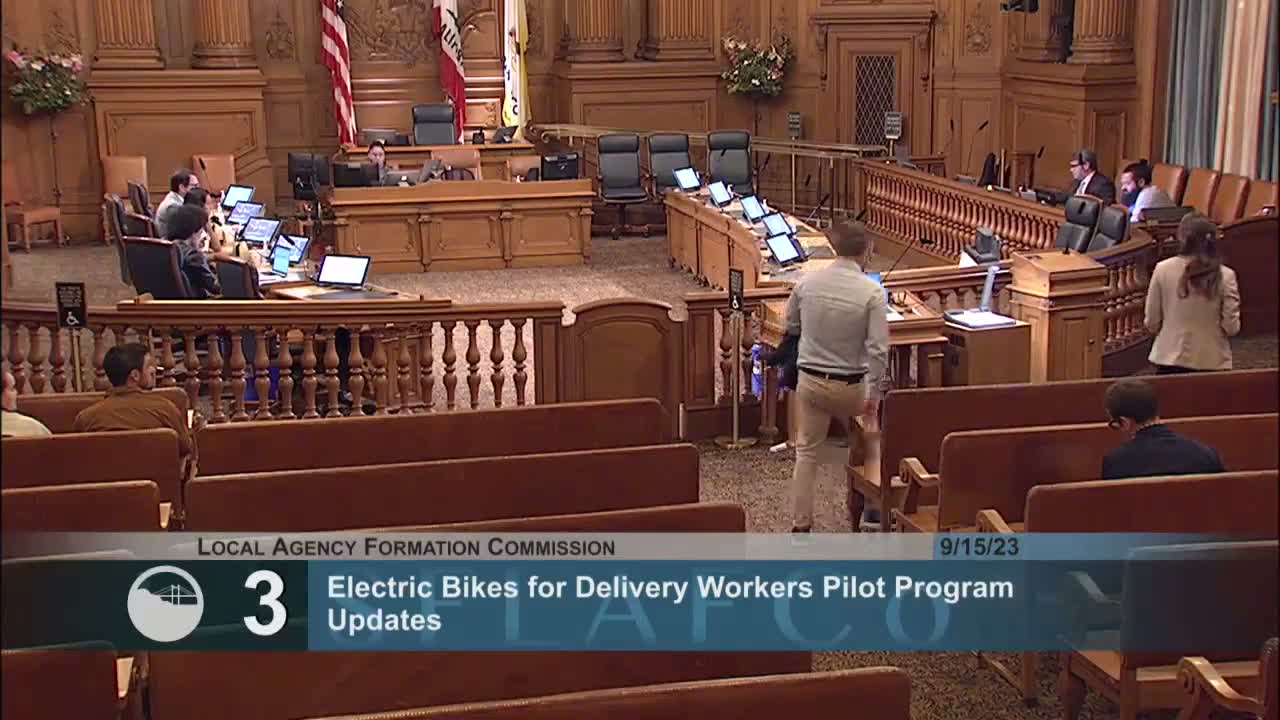
San Francisco Environment Department staff on Thursday updated the Local Agency Formation Commission on a pilot program that will shift up to 30 meal delivery workers from cars to electric bicycles while using a matched control group to measure outcomes. Anna Sheruto, a clean transportation specialist, described the project and its early results.
The yearlong pilot, funded under a $2,400,000 California Energy Commission grant, runs in two cohorts. Each cohort includes 15 bikers and 15 drivers as the control group; each biker cohort will complete one month of onboarding and training, four months of data collection and one month of offboarding, after which participants receive full ownership of their e-bikes, Sheruto said.
Sheruto said recruitment began in March and generated 173 eligible applications from 21 ZIP codes, concentrated in the Mission, Tenderloin and downtown areas. "We received 173 eligible applications across 21 ZIP codes," she said. Program partners include GRID Alternatives for recruitment and procurement, SF Bike Coalition for training, Driver's Seat Cooperative for data collection, and Hub Bicycles as equipment provider.
The project uses surveys, interviews and app-based telemetry to compare working conditions, income, safety, emissions and delivery efficiency between e-bikes and cars. Sheruto summarized early lessons: training raised riders’ comfort — "90% of participants surveyed said that they felt more comfortable biking in San Francisco and making deliveries" — and onboarding delays occurred when participants were new to delivery apps and were waitlisted.
Commissioners pressed staff for details on demand and eligibility. Commissioner Dean Preston noted interest in scaling the pilot and asked whether additional funds would simply allow more participants. Sheruto said city staff are finalizing a Department of Energy grant that could double the pilot’s size by adding 30 more bikers and confirmed the pilot's current wait list is roughly 100 people.
On eligibility and support, Sheruto said participants must be San Francisco residents, at least 18 years old, able to commit to about 20 hours per week on delivery apps during the four-month data period, and priority is given to lower-income individuals. The program supplies baseline equipment — helmets, locks, lights, baskets and insulated food bags — and requires SF Bike Coalition training before on-road riding.
Sheruto said the team is still in the data-collection phase; cohort 1 will wrap later this month and staff expect to begin preliminary analysis comparing surveys and app-collected data. She also flagged infrastructure concerns: participants identified intersections and gaps in bike infrastructure as safety issues, and the program has found a need for more secure long-term bike parking across the city.
The commission took no formal action on the item and heard no public commenters on the pilot.
The yearlong pilot, funded under a $2,400,000 California Energy Commission grant, runs in two cohorts. Each cohort includes 15 bikers and 15 drivers as the control group; each biker cohort will complete one month of onboarding and training, four months of data collection and one month of offboarding, after which participants receive full ownership of their e-bikes, Sheruto said.
Sheruto said recruitment began in March and generated 173 eligible applications from 21 ZIP codes, concentrated in the Mission, Tenderloin and downtown areas. "We received 173 eligible applications across 21 ZIP codes," she said. Program partners include GRID Alternatives for recruitment and procurement, SF Bike Coalition for training, Driver's Seat Cooperative for data collection, and Hub Bicycles as equipment provider.
The project uses surveys, interviews and app-based telemetry to compare working conditions, income, safety, emissions and delivery efficiency between e-bikes and cars. Sheruto summarized early lessons: training raised riders’ comfort — "90% of participants surveyed said that they felt more comfortable biking in San Francisco and making deliveries" — and onboarding delays occurred when participants were new to delivery apps and were waitlisted.
Commissioners pressed staff for details on demand and eligibility. Commissioner Dean Preston noted interest in scaling the pilot and asked whether additional funds would simply allow more participants. Sheruto said city staff are finalizing a Department of Energy grant that could double the pilot’s size by adding 30 more bikers and confirmed the pilot's current wait list is roughly 100 people.
On eligibility and support, Sheruto said participants must be San Francisco residents, at least 18 years old, able to commit to about 20 hours per week on delivery apps during the four-month data period, and priority is given to lower-income individuals. The program supplies baseline equipment — helmets, locks, lights, baskets and insulated food bags — and requires SF Bike Coalition training before on-road riding.
Sheruto said the team is still in the data-collection phase; cohort 1 will wrap later this month and staff expect to begin preliminary analysis comparing surveys and app-collected data. She also flagged infrastructure concerns: participants identified intersections and gaps in bike infrastructure as safety issues, and the program has found a need for more secure long-term bike parking across the city.
The commission took no formal action on the item and heard no public commenters on the pilot.
Don't Miss a Word: See the Full Meeting!
Go beyond summaries. Unlock every video, transcript, and key insight with a Founder Membership.
✓
Get instant access to full meeting videos
✓
Search and clip any phrase from complete transcripts
✓
Receive AI-powered summaries & custom alerts
✓
Enjoy lifetime, unrestricted access to government data
30-day money-back guarantee
