HSH director outlines housing placements, eviction prevention and EHV rollout; commissioners press for data and eviction policy agenda
June 01, 2023 | San Francisco City, San Francisco County, California
This article was created by AI summarizing key points discussed. AI makes mistakes, so for full details and context, please refer to the video of the full meeting. Please report any errors so we can fix them. Report an error »
The Department of Homelessness and Supportive Housing presented an operational update at a community meeting called after the session could not be held as an official commission meeting because of a posting glitch.
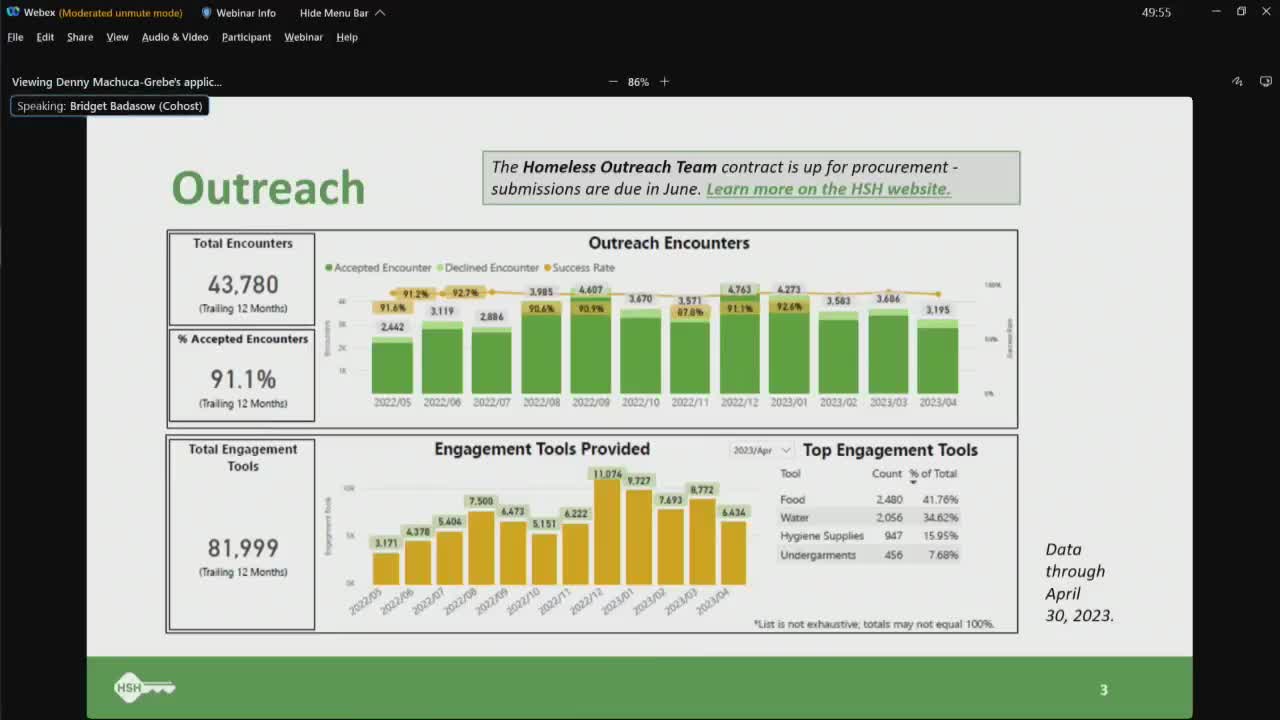
Director (speaker 1) reported outreach engagements in April were 3,200 and that coordinated entry assessments were steady at 974 for the month. She said 764 households have resolved their homelessness through problem-solving this fiscal year with about $2,300,000 dispersed in financial assistance, and that housing placements rose to 154 in April.
Department staff described progress on the emergency housing voucher program: as of late May, 876 vouchers had been issued and 617 households had moved into units, representing roughly two-thirds of available vouchers. Of households who moved in, Director said 50% were experiencing homelessness at referral (30% unsheltered, 20% sheltered), 12% were recently homeless, 17% were survivors of domestic violence, and 21% were at risk of homelessness. The director noted 90% of applicants referred were BIPOC and that a substantial share had applied from the Bayview neighborhood.
HSH also reported housing-quality work: the department is applying for Homekey funding for 1174 Folsom, expanding elevator and capital repair funds and beginning housing-quality inspections for site-based permanent supportive housing on a biennial schedule. HSH is adding unit-level inventory to the homelessness management information system to improve vacancy and eviction tracking.
On evictions, the director said the department’s annual eviction report (for fiscal year 2021–22) showed 142 evictions among 10,978 households in funded sites (a 1.29% eviction rate) and that stability rates in HSH-funded continuum-of-care sites remain well above national averages. She stressed that HSH is a funder, not a landlord, and that providers are legally responsible for lease enforcement. HSH described several prevention tactics, including a 30% rent cap in PSH, wage-floor investments for property management and case managers, and targeted prevention funding through ERAP and other programs.
Commissioners pressed staff on how shelter counts and occupancy are calculated after the dashboard showed an 89% occupancy figure while ‘‘guest’’ counts sometimes exceeded capacity. Deputy Director Emily Cohen explained that family units are counted by individuals (so a family counted by members can push the guest total above unit-level capacity) and that the occupancy rate is computed on units/beds. Cohen said a new reservation system, launching July 1, will provide a phone/web waitlist and allow HSH to capture demand more precisely.
Several public speakers called for the commission to agendize a specific eviction-policy discussion. Jordan Davis, a PSH10 activist, asked the commission to place eviction policy changes on the July agenda and said tenants had prepared a “redline” to strengthen provider eviction guidelines. Jean Jacques Zanger urged an investigation into Conard House after alleging multiple evictions and insufficient case management. Christopher and other tenant speakers questioned whether the department’s reported stability rate reflected informal or ‘‘soft’’ evictions.
What happens next: commissioners asked staff to return with more granular data — including vacancy types, how offer/refusal policies are changing, and whether qualitative assessment fields can be added to coordinated entry to better capture reasons for exits — and several commissioners requested a follow-up hearing focused on eviction policy and data transparency.
Sources: Director’s report and staff answers to commissioners at the community meeting. The meeting was conducted as an informal/community meeting because staff said the agenda posting error prevented an official commission meeting; as a result, minutes from this session will not be approved as formal commission minutes.
Director (speaker 1) reported outreach engagements in April were 3,200 and that coordinated entry assessments were steady at 974 for the month. She said 764 households have resolved their homelessness through problem-solving this fiscal year with about $2,300,000 dispersed in financial assistance, and that housing placements rose to 154 in April.
Department staff described progress on the emergency housing voucher program: as of late May, 876 vouchers had been issued and 617 households had moved into units, representing roughly two-thirds of available vouchers. Of households who moved in, Director said 50% were experiencing homelessness at referral (30% unsheltered, 20% sheltered), 12% were recently homeless, 17% were survivors of domestic violence, and 21% were at risk of homelessness. The director noted 90% of applicants referred were BIPOC and that a substantial share had applied from the Bayview neighborhood.
HSH also reported housing-quality work: the department is applying for Homekey funding for 1174 Folsom, expanding elevator and capital repair funds and beginning housing-quality inspections for site-based permanent supportive housing on a biennial schedule. HSH is adding unit-level inventory to the homelessness management information system to improve vacancy and eviction tracking.
On evictions, the director said the department’s annual eviction report (for fiscal year 2021–22) showed 142 evictions among 10,978 households in funded sites (a 1.29% eviction rate) and that stability rates in HSH-funded continuum-of-care sites remain well above national averages. She stressed that HSH is a funder, not a landlord, and that providers are legally responsible for lease enforcement. HSH described several prevention tactics, including a 30% rent cap in PSH, wage-floor investments for property management and case managers, and targeted prevention funding through ERAP and other programs.
Commissioners pressed staff on how shelter counts and occupancy are calculated after the dashboard showed an 89% occupancy figure while ‘‘guest’’ counts sometimes exceeded capacity. Deputy Director Emily Cohen explained that family units are counted by individuals (so a family counted by members can push the guest total above unit-level capacity) and that the occupancy rate is computed on units/beds. Cohen said a new reservation system, launching July 1, will provide a phone/web waitlist and allow HSH to capture demand more precisely.
Several public speakers called for the commission to agendize a specific eviction-policy discussion. Jordan Davis, a PSH10 activist, asked the commission to place eviction policy changes on the July agenda and said tenants had prepared a “redline” to strengthen provider eviction guidelines. Jean Jacques Zanger urged an investigation into Conard House after alleging multiple evictions and insufficient case management. Christopher and other tenant speakers questioned whether the department’s reported stability rate reflected informal or ‘‘soft’’ evictions.
What happens next: commissioners asked staff to return with more granular data — including vacancy types, how offer/refusal policies are changing, and whether qualitative assessment fields can be added to coordinated entry to better capture reasons for exits — and several commissioners requested a follow-up hearing focused on eviction policy and data transparency.
Sources: Director’s report and staff answers to commissioners at the community meeting. The meeting was conducted as an informal/community meeting because staff said the agenda posting error prevented an official commission meeting; as a result, minutes from this session will not be approved as formal commission minutes.
Don't Miss a Word: See the Full Meeting!
Go beyond summaries. Unlock every video, transcript, and key insight with a Founder Membership.
✓
Get instant access to full meeting videos
✓
Search and clip any phrase from complete transcripts
✓
Receive AI-powered summaries & custom alerts
✓
Enjoy lifetime, unrestricted access to government data
30-day money-back guarantee
