Community and providers push back on mayor’s plan to reallocate Prop C funds; commissioners seek a dedicated hearing
June 01, 2023 | San Francisco City, San Francisco County, California
This article was created by AI summarizing key points discussed. AI makes mistakes, so for full details and context, please refer to the video of the full meeting. Please report any errors so we can fix them. Report an error »
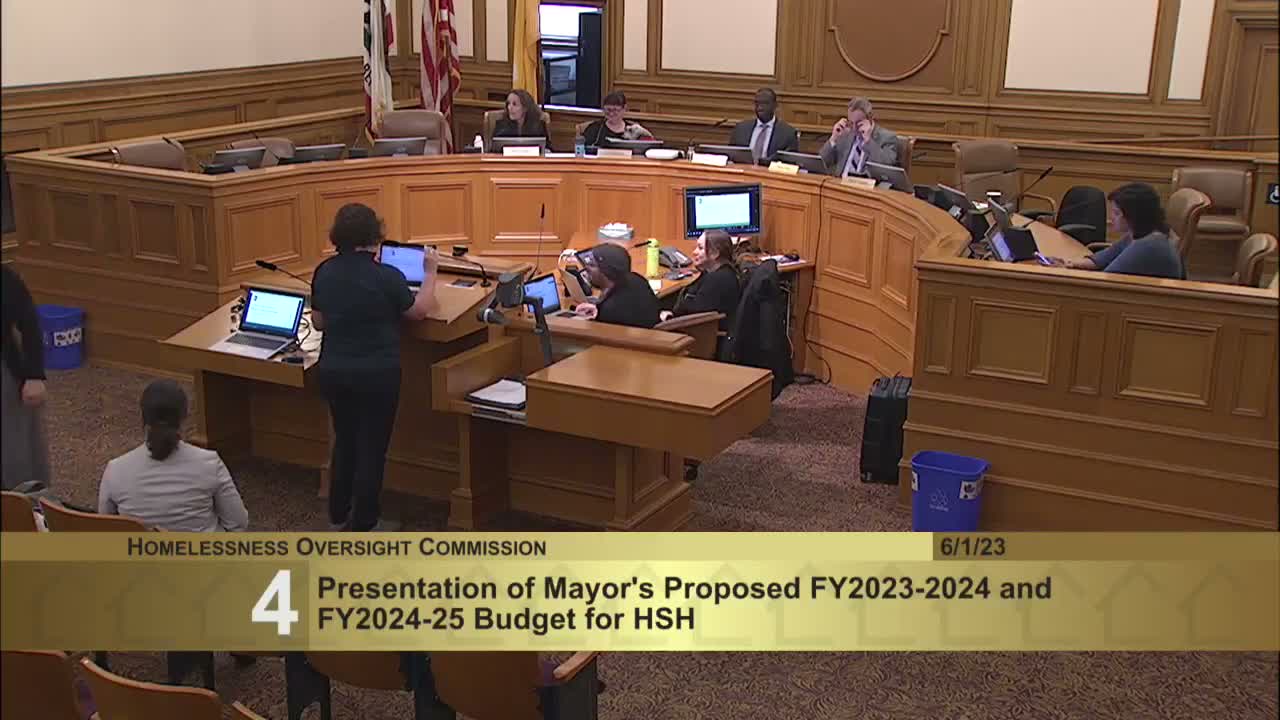
Deputy Director for Finance Gigi Whitley presented the mayor’s proposed two-year budget for the Department of Homelessness and Supportive Housing and summarized a package of one-time and ongoing funding changes that the mayor’s office is sending to the Board of Supervisors.
Whitley said HSH’s adopted budget is $672 million and that the mayor’s proposed two-year package increases available funds on a one-time basis to about $690 million, with a second-year dip to roughly $661 million because some state one-time revenues do not recur. The proposal includes roughly $18.5 million in one-time general fund support in year one, funding for a 4% cost-of-doing-business increase for nonprofit providers and partial funding for positions added in the prior year.
Key investments Whitley highlighted include $25.5 million over two years for building upgrades and ADA/elevator repairs to older permanent supportive-housing stock, a ramp-up for rapid rehousing with $14 million in one-time funds over two years, funding for a 75-unit permanent supportive housing building in year two, and an increase in shelter capacity to about 3,656 beds (roughly 594 net new beds) through a mix of leased cabins, hotel-based operations and other shelter expansions.
The mayor’s proposal would also preserve several Shelter-in-Place (SIP) hotels on a one-time basis (three hotels providing 288 beds under booking agreements) and includes one-time funds to continue operating those sites for one year while HSH seeks lower-cost, longer-term replacements.
Most contentious was a proposed one-time reallocation of prior Our City Our Home (OCO, Prop C) fund balances and unprogrammed OCO revenue. Whitley described a plan to reprogram roughly $11.7 million of transitional-age-youth (TAY) revenue and $8.8 million of family revenue in year one (about $20.6 million total) and to use about $40 million in prior-year fund balance as a one-time source in year two. She said legal advice supports a one-time reallocation but that the Board of Supervisors must approve any change by a two-thirds vote and that in year two revenue allocations would revert to the statute’s percentages.
Community providers and advocates testified strongly against using OCO fund balance or reprogramming allocations that had previously been set aside for family and youth housing. Marnie Regan of Larkin Street Youth Services told the commission she and HESPA ‘‘strongly oppose the mayor’s plan to defund and divest…funds from TAY and families’’ and warned cutting those investments would harm long-term youth outcomes. Jennifer Friedenbach of the Coalition on Homelessness and the Prop C oversight committee said the measure’s allocations were deliberately constructed to protect youth and families and argued the mayor’s plan violated the voters’ intent.
Remote callers and providers (HomeRise, Hospitality House, Third Street Youth Center, Compass Family Services, among others) reiterated that reallocating OCO funds would damage family and youth programs and urged the commission to press supervisors to oppose the reallocation. Commissioners pressed Whitley and staff for a breakdown of what had been promised versus spent and how Homekey awards and other state funds intersect with Prop C programming; staff said Homekey awards free up some acquisition dollars but do not replace the statutory purposes of OCO funds.
Commissioners asked for additional detail and transparency and several requested a dedicated commission hearing before the Board’s budget votes in June. Whitley said reprogramming is being proposed by the mayor’s office to address urgent capacity and prevention needs and affirmed that any final reallocation would require Board action.
What happens next: commissioners agreed to pursue follow-up briefings with staff and to explore scheduling a focused hearing on the proposed OCO reallocation and its impact on youth and family programs. The Board of Supervisors will consider the mayor’s budget proposal; any change to OCO allocations would require a two-thirds vote.
Sources: Budget presentation by Gigi Whitley and public testimony during the community meeting.
Whitley said HSH’s adopted budget is $672 million and that the mayor’s proposed two-year package increases available funds on a one-time basis to about $690 million, with a second-year dip to roughly $661 million because some state one-time revenues do not recur. The proposal includes roughly $18.5 million in one-time general fund support in year one, funding for a 4% cost-of-doing-business increase for nonprofit providers and partial funding for positions added in the prior year.
Key investments Whitley highlighted include $25.5 million over two years for building upgrades and ADA/elevator repairs to older permanent supportive-housing stock, a ramp-up for rapid rehousing with $14 million in one-time funds over two years, funding for a 75-unit permanent supportive housing building in year two, and an increase in shelter capacity to about 3,656 beds (roughly 594 net new beds) through a mix of leased cabins, hotel-based operations and other shelter expansions.
The mayor’s proposal would also preserve several Shelter-in-Place (SIP) hotels on a one-time basis (three hotels providing 288 beds under booking agreements) and includes one-time funds to continue operating those sites for one year while HSH seeks lower-cost, longer-term replacements.
Most contentious was a proposed one-time reallocation of prior Our City Our Home (OCO, Prop C) fund balances and unprogrammed OCO revenue. Whitley described a plan to reprogram roughly $11.7 million of transitional-age-youth (TAY) revenue and $8.8 million of family revenue in year one (about $20.6 million total) and to use about $40 million in prior-year fund balance as a one-time source in year two. She said legal advice supports a one-time reallocation but that the Board of Supervisors must approve any change by a two-thirds vote and that in year two revenue allocations would revert to the statute’s percentages.
Community providers and advocates testified strongly against using OCO fund balance or reprogramming allocations that had previously been set aside for family and youth housing. Marnie Regan of Larkin Street Youth Services told the commission she and HESPA ‘‘strongly oppose the mayor’s plan to defund and divest…funds from TAY and families’’ and warned cutting those investments would harm long-term youth outcomes. Jennifer Friedenbach of the Coalition on Homelessness and the Prop C oversight committee said the measure’s allocations were deliberately constructed to protect youth and families and argued the mayor’s plan violated the voters’ intent.
Remote callers and providers (HomeRise, Hospitality House, Third Street Youth Center, Compass Family Services, among others) reiterated that reallocating OCO funds would damage family and youth programs and urged the commission to press supervisors to oppose the reallocation. Commissioners pressed Whitley and staff for a breakdown of what had been promised versus spent and how Homekey awards and other state funds intersect with Prop C programming; staff said Homekey awards free up some acquisition dollars but do not replace the statutory purposes of OCO funds.
Commissioners asked for additional detail and transparency and several requested a dedicated commission hearing before the Board’s budget votes in June. Whitley said reprogramming is being proposed by the mayor’s office to address urgent capacity and prevention needs and affirmed that any final reallocation would require Board action.
What happens next: commissioners agreed to pursue follow-up briefings with staff and to explore scheduling a focused hearing on the proposed OCO reallocation and its impact on youth and family programs. The Board of Supervisors will consider the mayor’s budget proposal; any change to OCO allocations would require a two-thirds vote.
Sources: Budget presentation by Gigi Whitley and public testimony during the community meeting.
View the Full Meeting & All Its Details
This article offers just a summary. Unlock complete video, transcripts, and insights as a Founder Member.
✓
Watch full, unedited meeting videos
✓
Search every word spoken in unlimited transcripts
✓
AI summaries & real-time alerts (all government levels)
✓
Permanent access to expanding government content
30-day money-back guarantee
