City outlines SF ERAP prevention targets and problem-solving diversion results
October 19, 2023 | San Francisco City, San Francisco County, California
This article was created by AI summarizing key points discussed. AI makes mistakes, so for full details and context, please refer to the video of the full meeting. Please report any errors so we can fix them. Report an error »
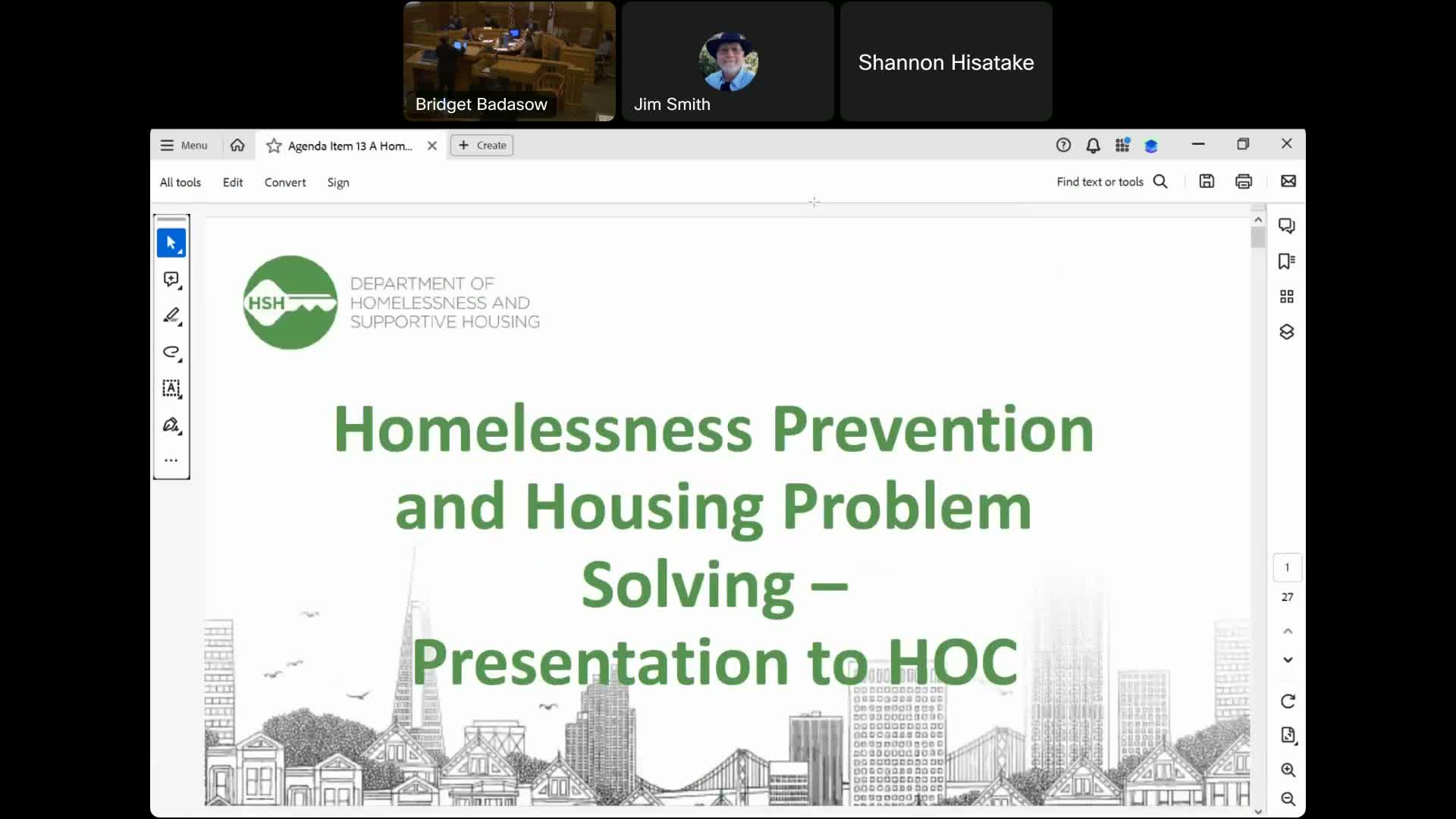
Julieta Barcalone presented a detailed briefing on homelessness prevention and problem solving to the commission on Oct. 19.
Barcalone described SF ERAP (San Francisco Emergency Rental Assistance Program), a targeted prevention program developed in partnership with the Mayor's Office of Housing and Community Development and All Home. Eligibility is limited to current San Francisco residents at or below 50% of area median income (with automatic prioritization for people who experienced homelessness in the prior two years, permanent supportive housing residents behind on rent with an existing payment plan, and those moving into Housing Choice Vouchers). SF ERAP provides moving assistance, past-due rent payments and up to three months of future rent for stabilization.
Barcalone said SF ERAP first operated as COVID-relief work: in the first two years it helped over 5,500 households and distributed more than $38 million (complementary to state programs). Since a March 2023 relaunch as a steady-state, targeted prevention program, HSH and MOCD have helped 2,241 households in seven months with roughly $12 million disbursed and an average assistance amount of $6,288. She said 89% of recent recipients were at or below 30% AMI, 74% had lifetime experience of homelessness and 75% identified as BIPOC. A formal evaluation by Focused Strategies will assess targeting, equity and outcomes, and the department is piloting customer-service hotlines, automatic referrals to Eviction Defense Collaborative and linkages to housing-location services like HomeMatch.
On problem solving (San Francisco's diversion/rapid-exit approach), Barcalone described brief, strength-based interventions at access points and shelters that help households resolve imminent housing crises outside the formal homelessness response system. Problem solving can include housing-location assistance, relocation outside San Francisco, mediation, limited financial assistance for stabilization and referrals to employment services. Since November 2020 HSH reports problem solving has helped 1,774 households, distributing about $5.7 million (average $3,100 per household); the program accepts returns and the department plans to track return rates as part of evaluation.
Barcalone emphasized plans to connect prevention applicants to employment and ongoing subsidies where possible, explore a fiscal intermediary model to accelerate assistance within 48 hours, and evaluate whether process improvements can speed aid without sacrificing targeting or equity. Commissioners requested a provider list, contract sizes and fund sources for the prevention budget; HSH staff said they will provide those details.
Barcalone described SF ERAP (San Francisco Emergency Rental Assistance Program), a targeted prevention program developed in partnership with the Mayor's Office of Housing and Community Development and All Home. Eligibility is limited to current San Francisco residents at or below 50% of area median income (with automatic prioritization for people who experienced homelessness in the prior two years, permanent supportive housing residents behind on rent with an existing payment plan, and those moving into Housing Choice Vouchers). SF ERAP provides moving assistance, past-due rent payments and up to three months of future rent for stabilization.
Barcalone said SF ERAP first operated as COVID-relief work: in the first two years it helped over 5,500 households and distributed more than $38 million (complementary to state programs). Since a March 2023 relaunch as a steady-state, targeted prevention program, HSH and MOCD have helped 2,241 households in seven months with roughly $12 million disbursed and an average assistance amount of $6,288. She said 89% of recent recipients were at or below 30% AMI, 74% had lifetime experience of homelessness and 75% identified as BIPOC. A formal evaluation by Focused Strategies will assess targeting, equity and outcomes, and the department is piloting customer-service hotlines, automatic referrals to Eviction Defense Collaborative and linkages to housing-location services like HomeMatch.
On problem solving (San Francisco's diversion/rapid-exit approach), Barcalone described brief, strength-based interventions at access points and shelters that help households resolve imminent housing crises outside the formal homelessness response system. Problem solving can include housing-location assistance, relocation outside San Francisco, mediation, limited financial assistance for stabilization and referrals to employment services. Since November 2020 HSH reports problem solving has helped 1,774 households, distributing about $5.7 million (average $3,100 per household); the program accepts returns and the department plans to track return rates as part of evaluation.
Barcalone emphasized plans to connect prevention applicants to employment and ongoing subsidies where possible, explore a fiscal intermediary model to accelerate assistance within 48 hours, and evaluate whether process improvements can speed aid without sacrificing targeting or equity. Commissioners requested a provider list, contract sizes and fund sources for the prevention budget; HSH staff said they will provide those details.
Don't Miss a Word: See the Full Meeting!
Go beyond summaries. Unlock every video, transcript, and key insight with a Founder Membership.
✓
Get instant access to full meeting videos
✓
Search and clip any phrase from complete transcripts
✓
Receive AI-powered summaries & custom alerts
✓
Enjoy lifetime, unrestricted access to government data
30-day money-back guarantee
