Providers warn rising acuity, vacancies and unpaid rent threaten supportive housing stability
February 12, 2024 | San Francisco City, San Francisco County, California
This article was created by AI summarizing key points discussed. AI makes mistakes, so for full details and context, please refer to the video of the full meeting. Please report any errors so we can fix them. Report an error »
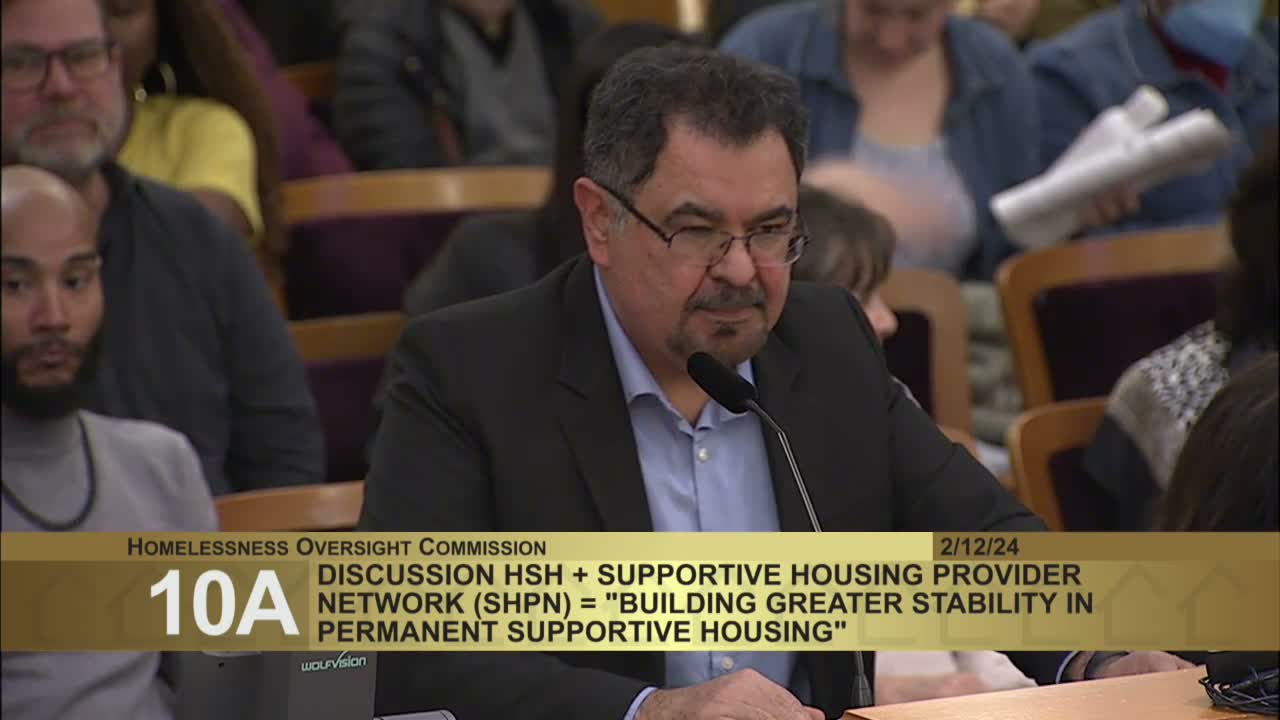
Salvador (housing division) and Lauren Hall, co-chair of the Supportive Housing Provider Network (SHPN), presented a consolidated account of operational pressures facing permanent supportive housing (PSH) providers, including resident acuity, unit damage, vacancies and arrears.
Salvador said the PSH portfolio is housing people with increasingly acute behavioral-health and medical needs as coordinated entry has successfully reached people who were previously out of reach. He cited incident-reporting data for calendar year 2023 that showed hundreds of incidents involving threats or physical violence and notable unit damage across dozens of buildings.
Lauren Hall explained the provider perspective: eviction remains rare (about 1.2% historically), but providers are seeing higher nonpayment of rent (estimates presented: roughly 30% of tenants more than 90 days in arrears in some portfolios), higher vacancy-related losses, and significant capital needs in older buildings. Hall and Salvador warned these pressures threaten provider financial sustainability and staff capacity.
SHPN proposed several policy and program changes: expand money-management supports and outreach to enroll residents in benefits, create damage-mitigation or repair pools to avoid eviction-driven turnover costs, invest more in capital improvements (providers suggested larger recurring investment than currently allocated), increase specialized on-site clinical and behavioral-health support (fax teams) and improve data sharing across providers.
Commissioners and providers discussed options: HSH described recent capital investments ($5M previously, an additional $10M in targeted improvements and $10M for elevator repairs) and an HSH-issued nonpayment-of-rent guideline (not a binding policy) to help standardize provider approaches. Providers urged the commission to protect PSH funding lines and to consider longer-term funding for maintenance and higher service levels.
Public commenters with provider experience (Tenderloin Housing Clinic, Episcopal Community Services and others) reinforced the need for sustained funding, faster release of allocated capital funds (e.g., elevator repairs) and strategies to fill long-term vacant units for families and adults.
HSH staff said they will continue to explore flexible mitigation funds, prioritize capital repairs in upcoming bond planning, and work with the commission on options that support provider sustainability while protecting tenant rights.
Salvador said the PSH portfolio is housing people with increasingly acute behavioral-health and medical needs as coordinated entry has successfully reached people who were previously out of reach. He cited incident-reporting data for calendar year 2023 that showed hundreds of incidents involving threats or physical violence and notable unit damage across dozens of buildings.
Lauren Hall explained the provider perspective: eviction remains rare (about 1.2% historically), but providers are seeing higher nonpayment of rent (estimates presented: roughly 30% of tenants more than 90 days in arrears in some portfolios), higher vacancy-related losses, and significant capital needs in older buildings. Hall and Salvador warned these pressures threaten provider financial sustainability and staff capacity.
SHPN proposed several policy and program changes: expand money-management supports and outreach to enroll residents in benefits, create damage-mitigation or repair pools to avoid eviction-driven turnover costs, invest more in capital improvements (providers suggested larger recurring investment than currently allocated), increase specialized on-site clinical and behavioral-health support (fax teams) and improve data sharing across providers.
Commissioners and providers discussed options: HSH described recent capital investments ($5M previously, an additional $10M in targeted improvements and $10M for elevator repairs) and an HSH-issued nonpayment-of-rent guideline (not a binding policy) to help standardize provider approaches. Providers urged the commission to protect PSH funding lines and to consider longer-term funding for maintenance and higher service levels.
Public commenters with provider experience (Tenderloin Housing Clinic, Episcopal Community Services and others) reinforced the need for sustained funding, faster release of allocated capital funds (e.g., elevator repairs) and strategies to fill long-term vacant units for families and adults.
HSH staff said they will continue to explore flexible mitigation funds, prioritize capital repairs in upcoming bond planning, and work with the commission on options that support provider sustainability while protecting tenant rights.
Don't Miss a Word: See the Full Meeting!
Go beyond summaries. Unlock every video, transcript, and key insight with a Founder Membership.
✓
Get instant access to full meeting videos
✓
Search and clip any phrase from complete transcripts
✓
Receive AI-powered summaries & custom alerts
✓
Enjoy lifetime, unrestricted access to government data
30-day money-back guarantee
