HSH reports progress on outreach, emergency housing vouchers and Hope House rehousing
April 04, 2024 | San Francisco City, San Francisco County, California
This article was created by AI summarizing key points discussed. AI makes mistakes, so for full details and context, please refer to the video of the full meeting. Please report any errors so we can fix them. Report an error »
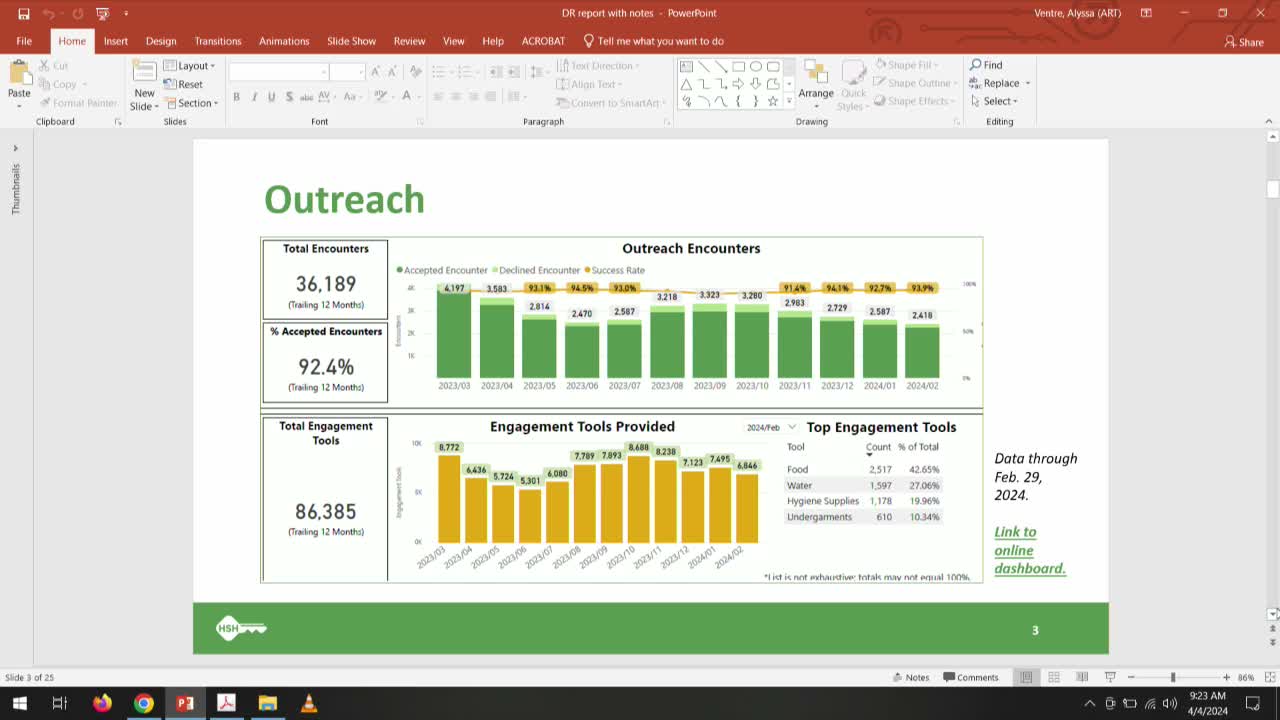
San Francisco's Department of Homelessness & Supportive Housing told the Homelessness & Supportive Housing Commission on April 4 that outreach engagement and contracted staff hiring have improved and that new tools are coming online to better track placements.
Executive Director Shereen McSpadden said outreach teams recorded 2,418 engagements in February and that Haluna Health has added eight outreach positions under a new contract, bringing the provider close to the mandated 90% staffing rate. HSH reported an overall staffing fill rate of about 86%, with nine case managers and nine outreach staff hired since Feb. 1.
McSpadden also introduced a new public emergency housing voucher dashboard. HSH, in partnership with the San Francisco Housing Authority, has issued roughly 1,261 EHVs and moved in about 984 households, she said, noting that about a third of referrals and move-ins prioritized District 10 (Bayview). She added that 57% of households issued EHVs were Black and 89% were people of color.
On contract transitions, McSpadden said HSH moved services from United Council of Human Services to the Felton Institute after the city found compliance problems with the prior contractor. Per HUD Continuum of Care (CoC) rules, some tenants were not properly documented as eligible for HUD CoC rental subsidies. Of 84 Hope House clients enrolled at the start of the wind-down, HSH reported 64 rehoused as of April 1 (27 to permanent supportive housing, 28 to rapid rehousing, one to veterans housing, one to family housing, four to stable housing outside the system, and three HSH staff could not track). Twenty households remain in the placement process, 14 of them actively engaged, McSpadden said.
HSH also highlighted systemwide infrastructure changes: a unit-level inventory system is now live for site-based permanent supportive housing, which HSH said will improve accuracy in vacancy and occupancy reporting. The department reported roughly 13,200 units in its inventory and 196 housing placements in January (reported in the February slide), and a shelter system capacity of 3,438 with 93% occupancy as of March 26.
Commissioners and public commenters pressed HSH on operational details. Several speakers, including public commenters and Commissioner Kristen Evans, described problems with the shelter reservation waitlist (a reported 10 a.m.'noon callback window) that can disadvantage people without reliable phones. Commissioners asked staff to return with clearer metrics and a slide presentation at the next meeting to show rehousing counts and placements by program.
The commission did not take action on these program updates; staff said they would return with additional detail and follow-up.
Executive Director Shereen McSpadden said outreach teams recorded 2,418 engagements in February and that Haluna Health has added eight outreach positions under a new contract, bringing the provider close to the mandated 90% staffing rate. HSH reported an overall staffing fill rate of about 86%, with nine case managers and nine outreach staff hired since Feb. 1.
McSpadden also introduced a new public emergency housing voucher dashboard. HSH, in partnership with the San Francisco Housing Authority, has issued roughly 1,261 EHVs and moved in about 984 households, she said, noting that about a third of referrals and move-ins prioritized District 10 (Bayview). She added that 57% of households issued EHVs were Black and 89% were people of color.
On contract transitions, McSpadden said HSH moved services from United Council of Human Services to the Felton Institute after the city found compliance problems with the prior contractor. Per HUD Continuum of Care (CoC) rules, some tenants were not properly documented as eligible for HUD CoC rental subsidies. Of 84 Hope House clients enrolled at the start of the wind-down, HSH reported 64 rehoused as of April 1 (27 to permanent supportive housing, 28 to rapid rehousing, one to veterans housing, one to family housing, four to stable housing outside the system, and three HSH staff could not track). Twenty households remain in the placement process, 14 of them actively engaged, McSpadden said.
HSH also highlighted systemwide infrastructure changes: a unit-level inventory system is now live for site-based permanent supportive housing, which HSH said will improve accuracy in vacancy and occupancy reporting. The department reported roughly 13,200 units in its inventory and 196 housing placements in January (reported in the February slide), and a shelter system capacity of 3,438 with 93% occupancy as of March 26.
Commissioners and public commenters pressed HSH on operational details. Several speakers, including public commenters and Commissioner Kristen Evans, described problems with the shelter reservation waitlist (a reported 10 a.m.'noon callback window) that can disadvantage people without reliable phones. Commissioners asked staff to return with clearer metrics and a slide presentation at the next meeting to show rehousing counts and placements by program.
The commission did not take action on these program updates; staff said they would return with additional detail and follow-up.
View the Full Meeting & All Its Details
This article offers just a summary. Unlock complete video, transcripts, and insights as a Founder Member.
✓
Watch full, unedited meeting videos
✓
Search every word spoken in unlimited transcripts
✓
AI summaries & real-time alerts (all government levels)
✓
Permanent access to expanding government content
30-day money-back guarantee
