Planning staff present housing element update centered on racial and social equity; commissioners press for more specificity
February 02, 2022 | San Francisco City, San Francisco County, California
This article was created by AI summarizing key points discussed. AI makes mistakes, so for full details and context, please refer to the video of the full meeting. Please report any errors so we can fix them. Report an error »
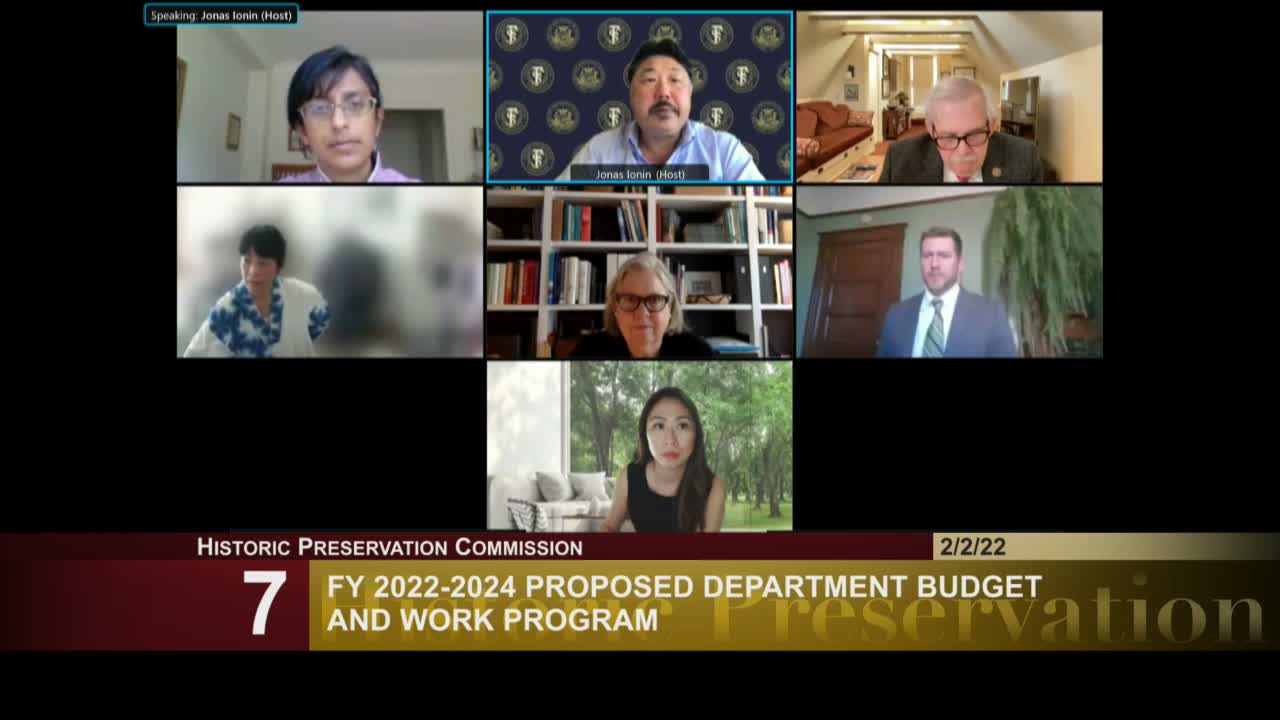
Planning Department staff presented a draft 2022 Housing Element update to the Historic Preservation Commission on Feb. 3, describing it as the first housing plan in the city's history that is explicitly centered on racial and social equity.
"This is the first time that San Francisco's housing plan will be centered in racial and social equity," Shelly, a housing element project lead, told the commission. She said the update responds to substantial increases in regional targets and to community directives gathered during extensive outreach.
Staff summarized engagement work: 22 focus groups (targeting disproportionately affected communities), 40 community-hosted virtual events, 10 language-specific sessions (Cantonese and Spanish), and an online survey with more than 1,600 respondents. From that input, staff said the draft emphasizes three priorities: quality and access for vulnerable households; distribution and housing choice (including small and mid-rise construction in well-resourced neighborhoods); and strengthened accountability measures to document past discriminatory government action and track equity outcomes.
Policy and timeline highlights given to the commission included:
- A structure of five goals and 15 objectives tying 37 policies to implementing actions; staff flagged 27 "priority actions" expected to deliver the largest equity gains.
- Calls for expanding permanent supportive housing, scaling rental assistance, and updating preferences and area median income calculations to address racial inequities in program access.
- Place-based strategies and targets to place 25% to 50% of affordable housing in well-resourced neighborhoods during the next 15 years to improve access to amenities.
- A commitment to launch a racial and social equity analysis to inform policy refinement and project-by-project assessment.
- Environmental review milestones: staff said the draft Environmental Impact Report would be published in April with a hearing in June (Planning Commission and Historic Preservation Commission review).
Commissioners broadly commended the scope and the explicit equity focus but pressed staff on implementation details. Questions and concerns included: how an interagency implementation committee would operate and hold agencies to measurable targets (Kimiya Hadadan said staff had identified 27 priority actions and expects an interagency body and periodic (every two years) review); how the housing element would align with updates to the transportation element and transit corridors; how the plan's anti-displacement measures (policy 21) could be made more specific; and whether the ambitious homelessness reduction objective (a referenced goal of 50% reduction in chronic homelessness by December 2022) was achievable and how it would be tracked.
Commissioners also asked about the role of nonprofit housing providers in implementation, the department's ability to fund priority actions without mayoral or Board of Supervisors commitments, and tools to address speculative uses of housing stock (short-term rentals, vacancy taxes, enforcement of existing rules). Staff acknowledged many of these are implementation questions that stretch beyond Planning's authority and said further analysis and coordination with the Mayor's Office of Housing and Community Development, the Department of Homelessness and Supportive Housing, and other partners will be required.
Several commissioners requested more specificity in future drafts: funding sources for the priority actions, a clearer timeline and responsibilities for the equity analysis, and more concrete anti-displacement guidelines tied to the policy map. Staff committed to return with additional detail as the plan advances through public review and the EIR process.
The commission did not take a formal vote on the housing element at this meeting; staff will continue phase 3 outreach through February and synthesize public input for draft 3 in March.
"This is the first time that San Francisco's housing plan will be centered in racial and social equity," Shelly, a housing element project lead, told the commission. She said the update responds to substantial increases in regional targets and to community directives gathered during extensive outreach.
Staff summarized engagement work: 22 focus groups (targeting disproportionately affected communities), 40 community-hosted virtual events, 10 language-specific sessions (Cantonese and Spanish), and an online survey with more than 1,600 respondents. From that input, staff said the draft emphasizes three priorities: quality and access for vulnerable households; distribution and housing choice (including small and mid-rise construction in well-resourced neighborhoods); and strengthened accountability measures to document past discriminatory government action and track equity outcomes.
Policy and timeline highlights given to the commission included:
- A structure of five goals and 15 objectives tying 37 policies to implementing actions; staff flagged 27 "priority actions" expected to deliver the largest equity gains.
- Calls for expanding permanent supportive housing, scaling rental assistance, and updating preferences and area median income calculations to address racial inequities in program access.
- Place-based strategies and targets to place 25% to 50% of affordable housing in well-resourced neighborhoods during the next 15 years to improve access to amenities.
- A commitment to launch a racial and social equity analysis to inform policy refinement and project-by-project assessment.
- Environmental review milestones: staff said the draft Environmental Impact Report would be published in April with a hearing in June (Planning Commission and Historic Preservation Commission review).
Commissioners broadly commended the scope and the explicit equity focus but pressed staff on implementation details. Questions and concerns included: how an interagency implementation committee would operate and hold agencies to measurable targets (Kimiya Hadadan said staff had identified 27 priority actions and expects an interagency body and periodic (every two years) review); how the housing element would align with updates to the transportation element and transit corridors; how the plan's anti-displacement measures (policy 21) could be made more specific; and whether the ambitious homelessness reduction objective (a referenced goal of 50% reduction in chronic homelessness by December 2022) was achievable and how it would be tracked.
Commissioners also asked about the role of nonprofit housing providers in implementation, the department's ability to fund priority actions without mayoral or Board of Supervisors commitments, and tools to address speculative uses of housing stock (short-term rentals, vacancy taxes, enforcement of existing rules). Staff acknowledged many of these are implementation questions that stretch beyond Planning's authority and said further analysis and coordination with the Mayor's Office of Housing and Community Development, the Department of Homelessness and Supportive Housing, and other partners will be required.
Several commissioners requested more specificity in future drafts: funding sources for the priority actions, a clearer timeline and responsibilities for the equity analysis, and more concrete anti-displacement guidelines tied to the policy map. Staff committed to return with additional detail as the plan advances through public review and the EIR process.
The commission did not take a formal vote on the housing element at this meeting; staff will continue phase 3 outreach through February and synthesize public input for draft 3 in March.
Don't Miss a Word: See the Full Meeting!
Go beyond summaries. Unlock every video, transcript, and key insight with a Founder Membership.
✓
Get instant access to full meeting videos
✓
Search and clip any phrase from complete transcripts
✓
Receive AI-powered summaries & custom alerts
✓
Enjoy lifetime, unrestricted access to government data
30-day money-back guarantee
