Planning staff outlines Housing Element draft prioritizing racial equity, reparations framework and large funding gap
April 20, 2022 | San Francisco City, San Francisco County, California
This article was created by AI summarizing key points discussed. AI makes mistakes, so for full details and context, please refer to the video of the full meeting. Please report any errors so we can fix them. Report an error »
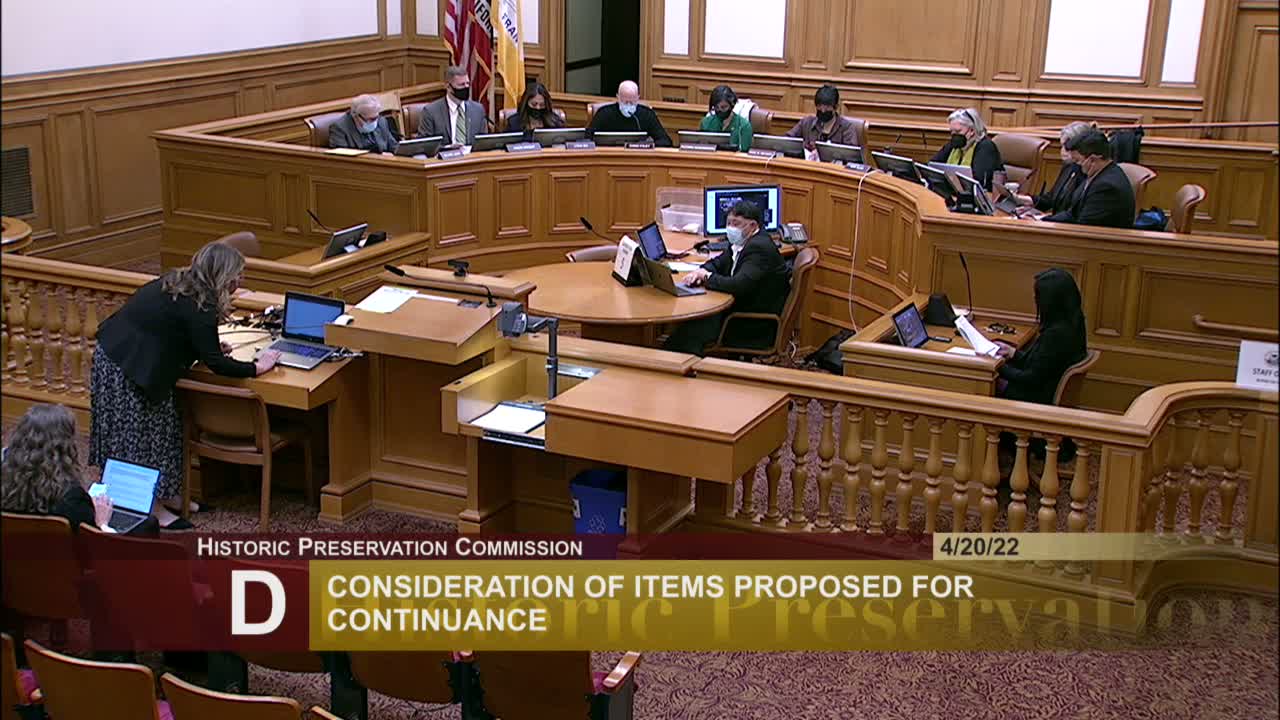
Shelly Calthildrone, a Planning Department staffer, told the Historic Preservation Commission that the department published Draft 3 of the Housing Element on March 25 and would submit it to the state for review on May 10. "I'm here today to talk about the City's housing element," she said, and noted the draft environmental impact report was released the same day and will be discussed at the Commission on June 1.
Calthildrone said the draft advances racial and social equity as a core principle and proposes a "reparations framework" aimed at groups harmed by past discriminatory actions, offering homeownership opportunities, rental preferences and investments in cultural anchors. "If adopted, this would be the first plan that calls for offering reparations to racial groups harmed by past discriminatory action," she said.
The presentation described outreach with 21 community-based organizations, three phases of public engagement and analyses covering constraints, fair housing and a sites inventory. Staff said the plan's housing targets for the next eight years are roughly triple the previous cycle and warned that meeting them will require an unprecedented scale of funding. The presentation estimated the funding gap for building the required affordable units at between $1,500,000,000 and $2,000,000,000 per year over the next eight years.
Commissioners questioned how the plan balances preservation of historic resources with increased housing capacity. Calthildrone said cultural resources and CEQA review remain part of the existing review process and that the plan explicitly excludes cultural resources from streamlining measures: "We are not trying to streamline review necessarily of cultural resources. We want to make sure there is space for proper analysis and evaluation." She pointed to Policy 37 and described a proposed historic preservation mitigation fund as an action the department will research further.
Several commissioners praised the document's analysis and the reparative measures while noting the difficulty of producing deeply affordable units in San Francisco's high-cost market. Commissioners asked about next steps: staff said the state's first-round comments are expected in August, a fourth draft will follow, and adoption hearings are targeted for January 2023 to secure a certified housing element in early spring 2023.
The presentation and the draft EIR will be the basis for future hearings and formal comment opportunities; staff said additional meetings will follow as the state provides feedback and the department refines policies.
Calthildrone said the draft advances racial and social equity as a core principle and proposes a "reparations framework" aimed at groups harmed by past discriminatory actions, offering homeownership opportunities, rental preferences and investments in cultural anchors. "If adopted, this would be the first plan that calls for offering reparations to racial groups harmed by past discriminatory action," she said.
The presentation described outreach with 21 community-based organizations, three phases of public engagement and analyses covering constraints, fair housing and a sites inventory. Staff said the plan's housing targets for the next eight years are roughly triple the previous cycle and warned that meeting them will require an unprecedented scale of funding. The presentation estimated the funding gap for building the required affordable units at between $1,500,000,000 and $2,000,000,000 per year over the next eight years.
Commissioners questioned how the plan balances preservation of historic resources with increased housing capacity. Calthildrone said cultural resources and CEQA review remain part of the existing review process and that the plan explicitly excludes cultural resources from streamlining measures: "We are not trying to streamline review necessarily of cultural resources. We want to make sure there is space for proper analysis and evaluation." She pointed to Policy 37 and described a proposed historic preservation mitigation fund as an action the department will research further.
Several commissioners praised the document's analysis and the reparative measures while noting the difficulty of producing deeply affordable units in San Francisco's high-cost market. Commissioners asked about next steps: staff said the state's first-round comments are expected in August, a fourth draft will follow, and adoption hearings are targeted for January 2023 to secure a certified housing element in early spring 2023.
The presentation and the draft EIR will be the basis for future hearings and formal comment opportunities; staff said additional meetings will follow as the state provides feedback and the department refines policies.
View the Full Meeting & All Its Details
This article offers just a summary. Unlock complete video, transcripts, and insights as a Founder Member.
✓
Watch full, unedited meeting videos
✓
Search every word spoken in unlimited transcripts
✓
AI summaries & real-time alerts (all government levels)
✓
Permanent access to expanding government content
30-day money-back guarantee
