Planning Department outlines Mills Act audit, flags equity gaps and caps
January 04, 2023 | San Francisco City, San Francisco County, California
This article was created by AI summarizing key points discussed. AI makes mistakes, so for full details and context, please refer to the video of the full meeting. Please report any errors so we can fix them. Report an error »
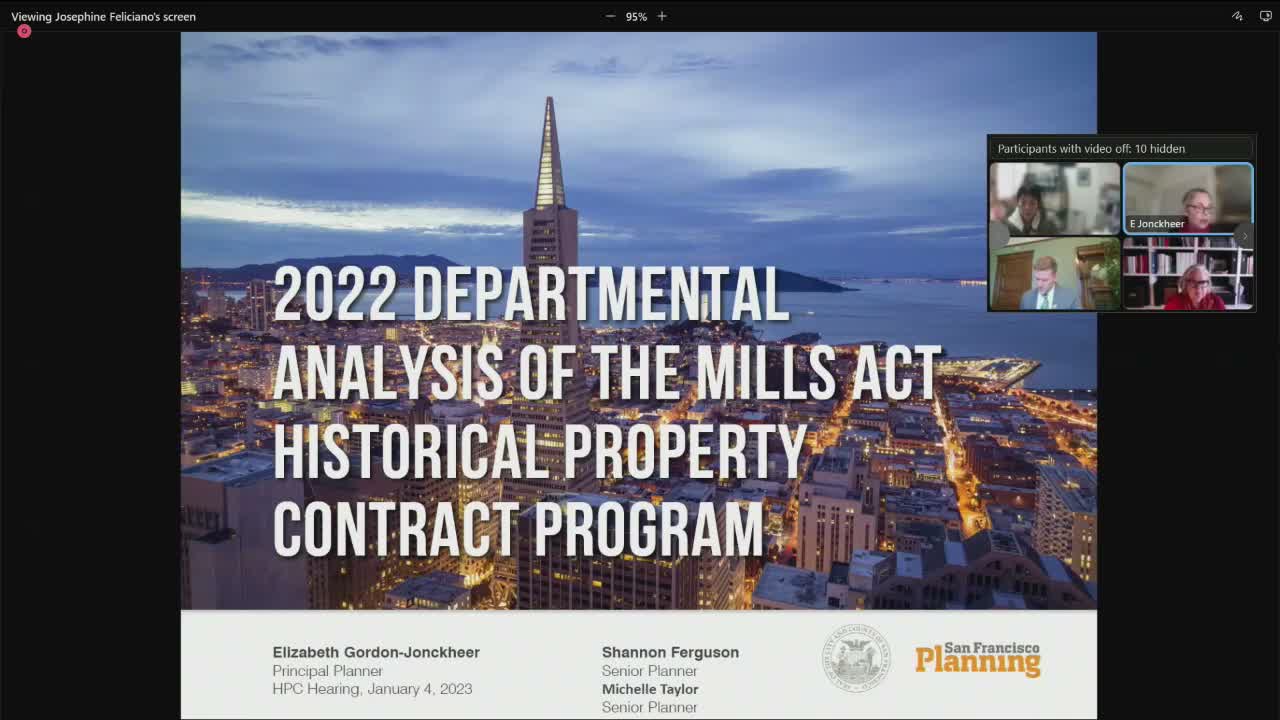
The San Francisco Planning Department presented an informational update on the Mills Act program to the Historic Preservation Commission on Jan. 4, saying the city will undertake an equity-focused audit of the program in 2023.
Planning staff said the Mills Act — state legislation that allows local governments to contract with private owners of qualified historic properties for property tax reductions in exchange for preservation work — now covers 45 active contracts in San Francisco. Elizabeth (department staff) told the commission the contracts are unevenly distributed across supervisorial districts, with the largest concentration in District 8 and many properties clustered in the downtown/Northeast areas. "The department currently holds 45 active Mills Act contracts," she said.
Staff said the program’s structure and statewide tax rules (including Proposition 13) can make the Mills Act more advantageous to recent purchasers than to long-term owners and to certain property types. The presentation listed program barriers: only properties formally listed on local, state, or national registers are eligible; many eligible resources are concentrated in higher-opportunity areas; and application cycles have yielded only a small average number of applications per cycle.
Members of the public who called in urged changes to eligibility and expansion of historic districts to include underrepresented neighborhoods. A caller also asked whether there are assessed-value caps limiting which properties can participate. Shannon Ferguson (department staff) responded: "It's currently 3,000,000 for residential properties and 5,000,000 for commercial properties," and said any change to those thresholds would require action by the Board of Supervisors.
Staff said the department will analyze Mills Act participation under its racial and social equity initiative in 2023, pursue community engagement with neighborhood groups and local preservation organizations, compare practices in other California jurisdictions and consult bodies such as the California Preservation Foundation, and require property owners to self-report rehabilitation spending for monitoring purposes.
The presentation included program statistics: prior to 2012 the city had seven Mills Act contracts; that number rose to 30 in 2018 and 45 at the time of the presentation. Staff said 25 properties are owner-occupied, 14 renter-occupied and four are mixed; single-family homes account for the largest share of contracts; commercial properties and one condominium also hold contracts. The department also noted several contracts are in nonrenewal status and that average rehab costs per property are "forthcoming" and will be requested during 2023 monitoring.
Commissioners and callers urged staffing support for applicants and more outreach to underrepresented communities. Staff said the department intends to develop equity objectives and recommendations this year and return with further analysis and community input. The item was informational; no formal action on the Mills Act program was taken by the commission at this meeting.
Planning staff said the Mills Act — state legislation that allows local governments to contract with private owners of qualified historic properties for property tax reductions in exchange for preservation work — now covers 45 active contracts in San Francisco. Elizabeth (department staff) told the commission the contracts are unevenly distributed across supervisorial districts, with the largest concentration in District 8 and many properties clustered in the downtown/Northeast areas. "The department currently holds 45 active Mills Act contracts," she said.
Staff said the program’s structure and statewide tax rules (including Proposition 13) can make the Mills Act more advantageous to recent purchasers than to long-term owners and to certain property types. The presentation listed program barriers: only properties formally listed on local, state, or national registers are eligible; many eligible resources are concentrated in higher-opportunity areas; and application cycles have yielded only a small average number of applications per cycle.
Members of the public who called in urged changes to eligibility and expansion of historic districts to include underrepresented neighborhoods. A caller also asked whether there are assessed-value caps limiting which properties can participate. Shannon Ferguson (department staff) responded: "It's currently 3,000,000 for residential properties and 5,000,000 for commercial properties," and said any change to those thresholds would require action by the Board of Supervisors.
Staff said the department will analyze Mills Act participation under its racial and social equity initiative in 2023, pursue community engagement with neighborhood groups and local preservation organizations, compare practices in other California jurisdictions and consult bodies such as the California Preservation Foundation, and require property owners to self-report rehabilitation spending for monitoring purposes.
The presentation included program statistics: prior to 2012 the city had seven Mills Act contracts; that number rose to 30 in 2018 and 45 at the time of the presentation. Staff said 25 properties are owner-occupied, 14 renter-occupied and four are mixed; single-family homes account for the largest share of contracts; commercial properties and one condominium also hold contracts. The department also noted several contracts are in nonrenewal status and that average rehab costs per property are "forthcoming" and will be requested during 2023 monitoring.
Commissioners and callers urged staffing support for applicants and more outreach to underrepresented communities. Staff said the department intends to develop equity objectives and recommendations this year and return with further analysis and community input. The item was informational; no formal action on the Mills Act program was taken by the commission at this meeting.
View the Full Meeting & All Its Details
This article offers just a summary. Unlock complete video, transcripts, and insights as a Founder Member.
✓
Watch full, unedited meeting videos
✓
Search every word spoken in unlimited transcripts
✓
AI summaries & real-time alerts (all government levels)
✓
Permanent access to expanding government content
30-day money-back guarantee
