Commission adopts two citywide historic-context statements to guide SF Survey and preservation review
January 18, 2023 | San Francisco City, San Francisco County, California
This article was created by AI summarizing key points discussed. AI makes mistakes, so for full details and context, please refer to the video of the full meeting. Please report any errors so we can fix them. Report an error »
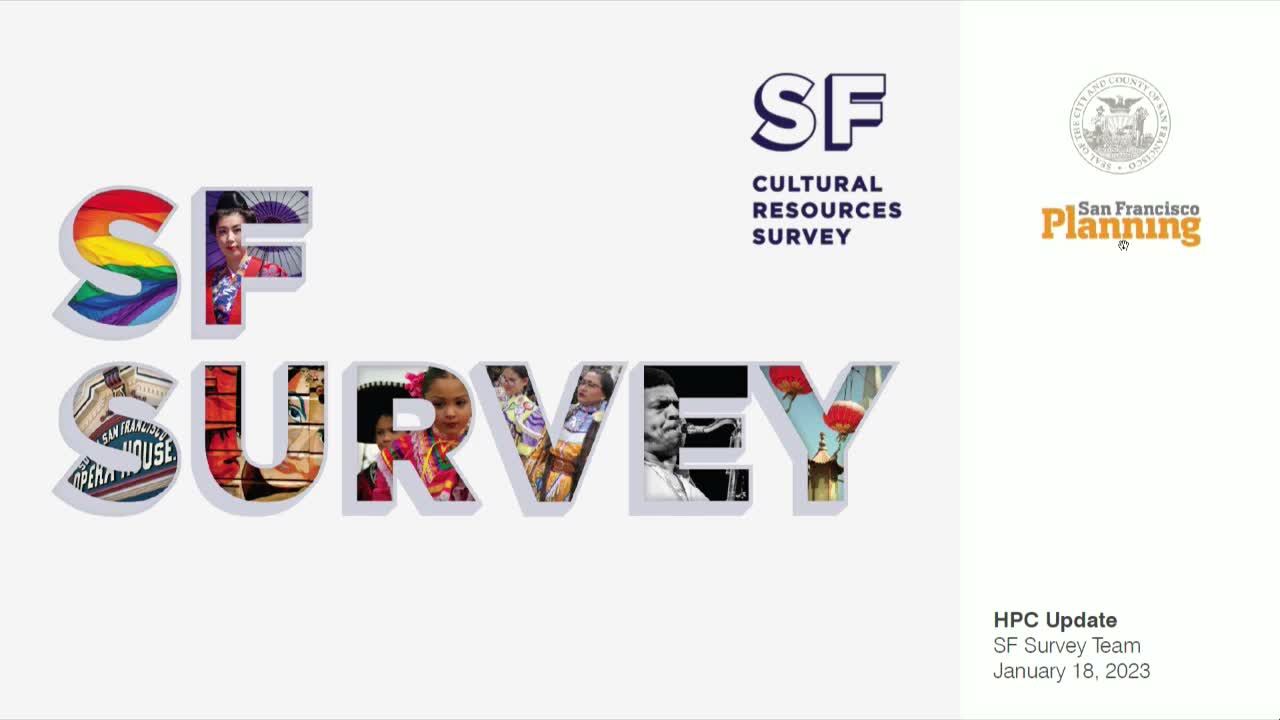
The Historic Preservation Commission on Jan. 18 unanimously adopted two historic context statements that will be used to guide the citywide cultural-resources survey (SF Survey) and future property evaluations.
Staff presented the Flats and Small Apartment Buildings (1915–1978) context statement, which focuses on neighborhood-scaled multifamily typologies and provides evaluative frameworks to identify essential historic features and potential eligibility under National Register/California Register criteria. Melanie Bishop explained the document’s goals to standardize evaluations and support community-led documentation. Commissioners commended the work and adopted the resolution by unanimous vote.
The Commission also adopted the Progressive Era and Early Revival Styles context statement, covering ten architectural styles prevalent in San Francisco between about 1890 and 1930 (including Beaux-Arts, Mission Revival, Craftsman, Colonial Revival and others). Elena Moore described the evaluative frameworks and examples used to determine architectural significance and integrity. Commissioners discussed cross-references to other context statements (for example, the 1906 earthquake and reconstruction document) and praised the practical utility of the statements for staff, property owners and realtors.
Separately, Maggie Smith presented an SF Survey update: pilot fieldwork has begun in Japantown, the survey team is prioritizing neighborhood commercial areas in equity geographies, and the department plans to publish draft findings by phase. Staff emphasized community engagement strategies, a living cultural-resources inventory, and next steps including refining methodologies for districts and intangible cultural heritage.
Staff presented the Flats and Small Apartment Buildings (1915–1978) context statement, which focuses on neighborhood-scaled multifamily typologies and provides evaluative frameworks to identify essential historic features and potential eligibility under National Register/California Register criteria. Melanie Bishop explained the document’s goals to standardize evaluations and support community-led documentation. Commissioners commended the work and adopted the resolution by unanimous vote.
The Commission also adopted the Progressive Era and Early Revival Styles context statement, covering ten architectural styles prevalent in San Francisco between about 1890 and 1930 (including Beaux-Arts, Mission Revival, Craftsman, Colonial Revival and others). Elena Moore described the evaluative frameworks and examples used to determine architectural significance and integrity. Commissioners discussed cross-references to other context statements (for example, the 1906 earthquake and reconstruction document) and praised the practical utility of the statements for staff, property owners and realtors.
Separately, Maggie Smith presented an SF Survey update: pilot fieldwork has begun in Japantown, the survey team is prioritizing neighborhood commercial areas in equity geographies, and the department plans to publish draft findings by phase. Staff emphasized community engagement strategies, a living cultural-resources inventory, and next steps including refining methodologies for districts and intangible cultural heritage.
Don't Miss a Word: See the Full Meeting!
Go beyond summaries. Unlock every video, transcript, and key insight with a Founder Membership.
✓
Get instant access to full meeting videos
✓
Search and clip any phrase from complete transcripts
✓
Receive AI-powered summaries & custom alerts
✓
Enjoy lifetime, unrestricted access to government data
30-day money-back guarantee
