Historic Preservation Commission backs amendment to Castro Theatre landmark to include interior seating configuration
February 01, 2023 | San Francisco City, San Francisco County, California
This article was created by AI summarizing key points discussed. AI makes mistakes, so for full details and context, please refer to the video of the full meeting. Please report any errors so we can fix them. Report an error »
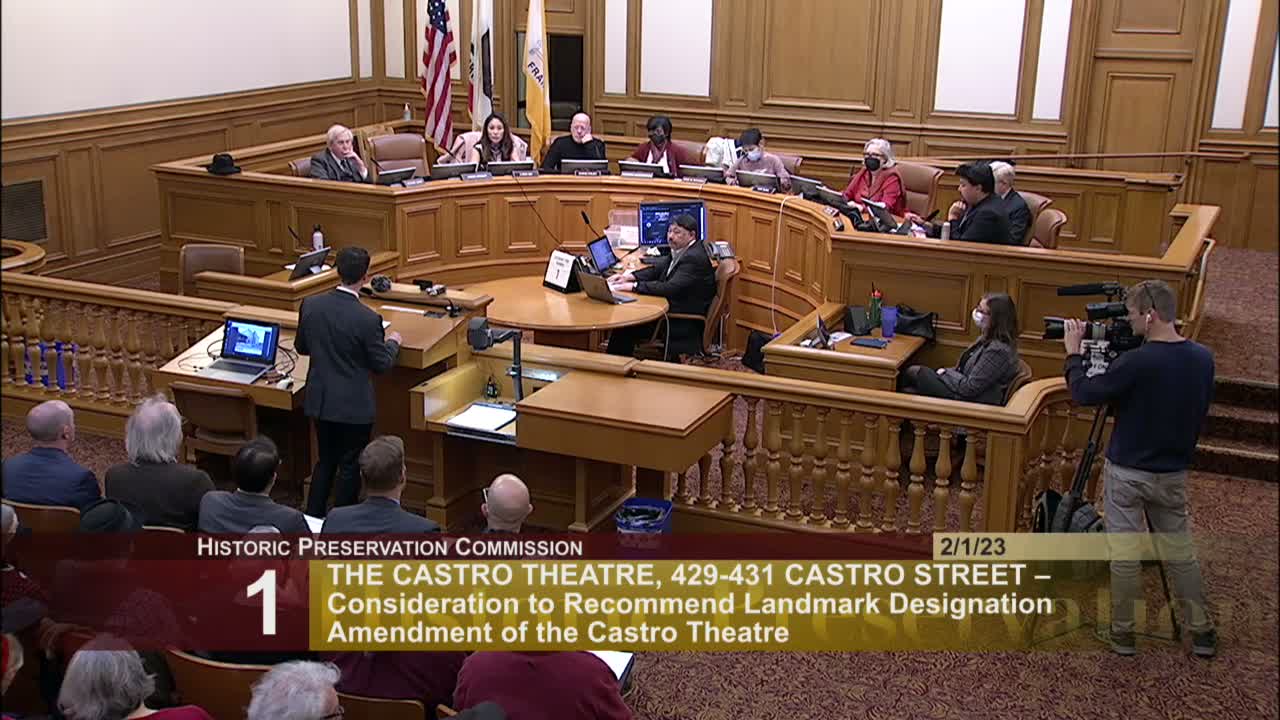
The San Francisco Historic Preservation Commission on Feb. 1 voted unanimously to recommend that the Board of Supervisors amend the Castro Theatre’s landmark designation to include specific interior character-defining features, after a five-hour public-comment session that sharply divided neighborhood residents, preservationists and the theater’s prospective operator.
Planning Department staff recommended that the amendment recognize the theater’s interior — including the raked orchestra floor, aisles and other interior details tied to its importance to LGBTQ history — in addition to the exterior landmark protections the theater has held since 1977. The commission’s recommendation adds clarifying language proposed by community historians to specify “fixed theatrical seating configured in movie palace style,” and the commission also agreed to include 1922-era upper-tier balcony seats in the list of protected interior features. The motion passed 6–0; Commissioner Wright had been recused earlier in the hearing.
Why this matters: The Castro Theatre, built in 1922 and central to the city’s LGBTQ cultural life for decades, is prized both for its physical interior (murals, proscenium, sloped auditorium and seating configuration) and for the communal film-going traditions it supports. Supporters of interior designation say naming the seating configuration as character-defining will help protect the theater’s film and festival programming; opponents say a legally fixed seating requirement could make some restoration or modernization plans financially unworkable.
Planning staff presented the nomination, citing historical periods of significance tied to the original 1922–1937 construction and a second period identified for 1976–2004 that reflects the theater’s central role in queer cultural life. Staff noted receipt of more than 700 written public comments and summarized the findings that supported an interior amendment.
Public comment: The hearing drew long lines in City Hall and dozens of remote callers. Preservation advocates — including historians, the Castro Theater Conservancy and San Francisco Heritage — urged precise language to avoid a vague standard that they said could permit wholesale removal of the auditorium’s historic configuration. Historian Gerard Koskovich submitted a draft motion urging deletion of the phrase “presence of seating” from the fact sheet and replacement with “fixed theatrical seating configured in movie palace style,” saying the vague phrase could be read to allow removal of the character-defining orchestra configuration.
Opponents of a fixed-seat requirement — including the building’s counsel and a set of local merchants and event operators — argued that the theater is not currently economically viable under its present configuration and that flexible or mechanized seating would allow the venue to host a broader mix of events while improving ventilation and ADA access. Jim Abrams, counsel for the Nassar family (owners of the property), told the commission the family “strongly opposes any amendment to the ordinance in front of you that would landmark the seats as a fix to the orchestra floor,” saying such a restriction could limit stewardship options and raise the risk of closure.
Both sides offered data and examples: the Conservancy cited a petition with more than 10,000 signatories and emphasized the theater’s unique role for film festivals and community events; proponents of the operator’s plan said mechanized or removable seating can accommodate films while enabling more accessible layouts and financially sustainable programming.
Commission action and next steps: During deliberations commissioners emphasized the limited scope of their role — they make a recommendation to the Board of Supervisors, which makes the final landmark decision. Commissioners proposed and adopted amendments to the staff recommendation to align the HPC resolution with the Board of Supervisors’ language and to explicitly reference the 1922 upper-tier balcony seats as character-defining. The commission voted to forward the amended recommendation to the Board of Supervisors. A joint public hearing with the Planning Commission was proposed for April.
What was not decided: The commission emphasized it was not deciding on the proposed renovation project itself (the design and permits for changes would be considered in separate project-level hearings). Commissioners and staff repeatedly declined to consider economic viability of specific operator scenarios in making the historic-designation recommendation.
The Board of Supervisors will receive the commission’s recommendation and decide whether to enact the landmark amendment. If the board approves the change, any future renovation or operator plan would be reviewed for consistency with the amended designation and the city’s historic-preservation standards.
Planning Department staff recommended that the amendment recognize the theater’s interior — including the raked orchestra floor, aisles and other interior details tied to its importance to LGBTQ history — in addition to the exterior landmark protections the theater has held since 1977. The commission’s recommendation adds clarifying language proposed by community historians to specify “fixed theatrical seating configured in movie palace style,” and the commission also agreed to include 1922-era upper-tier balcony seats in the list of protected interior features. The motion passed 6–0; Commissioner Wright had been recused earlier in the hearing.
Why this matters: The Castro Theatre, built in 1922 and central to the city’s LGBTQ cultural life for decades, is prized both for its physical interior (murals, proscenium, sloped auditorium and seating configuration) and for the communal film-going traditions it supports. Supporters of interior designation say naming the seating configuration as character-defining will help protect the theater’s film and festival programming; opponents say a legally fixed seating requirement could make some restoration or modernization plans financially unworkable.
Planning staff presented the nomination, citing historical periods of significance tied to the original 1922–1937 construction and a second period identified for 1976–2004 that reflects the theater’s central role in queer cultural life. Staff noted receipt of more than 700 written public comments and summarized the findings that supported an interior amendment.
Public comment: The hearing drew long lines in City Hall and dozens of remote callers. Preservation advocates — including historians, the Castro Theater Conservancy and San Francisco Heritage — urged precise language to avoid a vague standard that they said could permit wholesale removal of the auditorium’s historic configuration. Historian Gerard Koskovich submitted a draft motion urging deletion of the phrase “presence of seating” from the fact sheet and replacement with “fixed theatrical seating configured in movie palace style,” saying the vague phrase could be read to allow removal of the character-defining orchestra configuration.
Opponents of a fixed-seat requirement — including the building’s counsel and a set of local merchants and event operators — argued that the theater is not currently economically viable under its present configuration and that flexible or mechanized seating would allow the venue to host a broader mix of events while improving ventilation and ADA access. Jim Abrams, counsel for the Nassar family (owners of the property), told the commission the family “strongly opposes any amendment to the ordinance in front of you that would landmark the seats as a fix to the orchestra floor,” saying such a restriction could limit stewardship options and raise the risk of closure.
Both sides offered data and examples: the Conservancy cited a petition with more than 10,000 signatories and emphasized the theater’s unique role for film festivals and community events; proponents of the operator’s plan said mechanized or removable seating can accommodate films while enabling more accessible layouts and financially sustainable programming.
Commission action and next steps: During deliberations commissioners emphasized the limited scope of their role — they make a recommendation to the Board of Supervisors, which makes the final landmark decision. Commissioners proposed and adopted amendments to the staff recommendation to align the HPC resolution with the Board of Supervisors’ language and to explicitly reference the 1922 upper-tier balcony seats as character-defining. The commission voted to forward the amended recommendation to the Board of Supervisors. A joint public hearing with the Planning Commission was proposed for April.
What was not decided: The commission emphasized it was not deciding on the proposed renovation project itself (the design and permits for changes would be considered in separate project-level hearings). Commissioners and staff repeatedly declined to consider economic viability of specific operator scenarios in making the historic-designation recommendation.
The Board of Supervisors will receive the commission’s recommendation and decide whether to enact the landmark amendment. If the board approves the change, any future renovation or operator plan would be reviewed for consistency with the amended designation and the city’s historic-preservation standards.
View the Full Meeting & All Its Details
This article offers just a summary. Unlock complete video, transcripts, and insights as a Founder Member.
✓
Watch full, unedited meeting videos
✓
Search every word spoken in unlimited transcripts
✓
AI summaries & real-time alerts (all government levels)
✓
Permanent access to expanding government content
30-day money-back guarantee
