Historic Preservation Commission recommends landmarking of Colombo Market Arch despite owner opposition
June 21, 2023 | San Francisco City, San Francisco County, California
This article was created by AI summarizing key points discussed. AI makes mistakes, so for full details and context, please refer to the video of the full meeting. Please report any errors so we can fix them. Report an error »
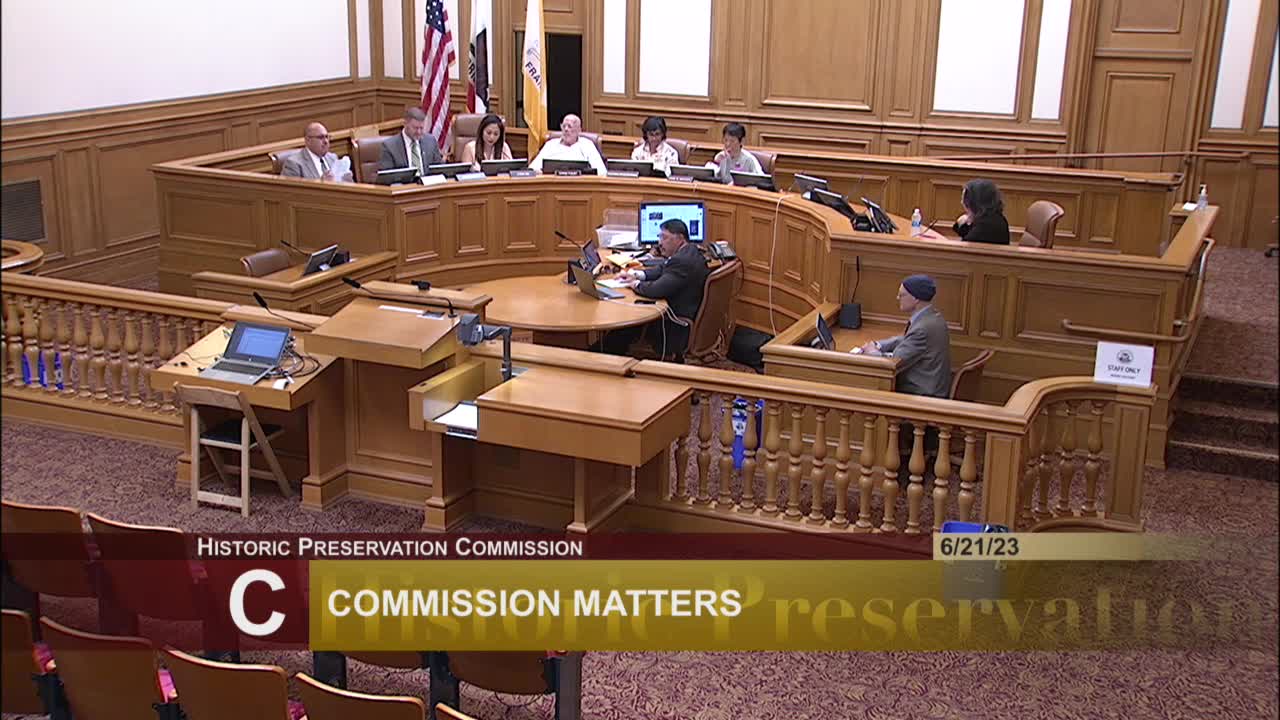
The San Francisco Historic Preservation Commission voted unanimously on June 21 to recommend that the Board of Supervisors designate the Colombo Market Arch in Sydney Walton Square as a city landmark.
Department staff, speaking by Elizabeth Junk on behalf of Pilar LaValley, told the commission the arch is the sole surviving remnant of the Colombo Market Building (constructed 1894, reconstructed 1906 and largely demolished in the early 1960s) and recommended landmark designation on grounds including the arch’s association with the city’s Italian American community and the historic Produce District. "Staff believes that the Colombo Market Arch meets eligibility requirements for landmark designation," Junk said during the presentation.
Richard Brandy, the historian who prepared the nomination, described available documentary and photographic evidence and noted conservation issues. "At one point, there was ivy on the arch. It was completely covered in ivy," Brandy said, adding that there are faint paint markings now but no clear surviving full signage.
Public testimony was split. Chris Madrid French, director of advocacy and programs at San Francisco Heritage, voiced support for designation: "San Francisco Heritage strongly supports this landmark designation," he said, citing the arch's interpretive potential to tell the story of the Produce District and Italian American workers. By contrast, Matthew Bernstein, representing the Golden Gateway Center (the park owner), urged against landmarking. "The arch is not historically significant," Bernstein said, calling it a fragment that "does not convey the design of the Colombo Market" and warning that designating such a remnant could create a troubling precedent; he offered alternatives including designation as a structure of merit, a plaque, repainting and lighting upgrades.
Commissioners questioned staff and Brandy about technical points, including the difference between a "structure of merit" and formal landmarking (staff said structures of merit can receive recognition and plaques while landmarking invokes a certificate of appropriateness process), California Environmental Quality Act (CEQA) implications for alterations, and the period of significance (the staff report used 1906–1960). Commissioners also discussed whether to describe the arch as "freestanding" in the character-defining features and whether any original paint remnants should be investigated before repainting.
After deliberation, a motion to recommend the landmark designation was amended to strike "freestanding" from the listed physical features, to include a finding noting the area's redevelopment history, to suggest an interpretive panel at the site, and to request consideration of any remaining original paint as part of future conservation work. The motion passed on a roll call vote recorded as 6–0.
The commission’s recommendation will be forwarded to the Board of Supervisors, which makes the final determination on landmark status. The hearing concluded with the chair noting the commission’s support and adjourning the brief meeting.
Department staff, speaking by Elizabeth Junk on behalf of Pilar LaValley, told the commission the arch is the sole surviving remnant of the Colombo Market Building (constructed 1894, reconstructed 1906 and largely demolished in the early 1960s) and recommended landmark designation on grounds including the arch’s association with the city’s Italian American community and the historic Produce District. "Staff believes that the Colombo Market Arch meets eligibility requirements for landmark designation," Junk said during the presentation.
Richard Brandy, the historian who prepared the nomination, described available documentary and photographic evidence and noted conservation issues. "At one point, there was ivy on the arch. It was completely covered in ivy," Brandy said, adding that there are faint paint markings now but no clear surviving full signage.
Public testimony was split. Chris Madrid French, director of advocacy and programs at San Francisco Heritage, voiced support for designation: "San Francisco Heritage strongly supports this landmark designation," he said, citing the arch's interpretive potential to tell the story of the Produce District and Italian American workers. By contrast, Matthew Bernstein, representing the Golden Gateway Center (the park owner), urged against landmarking. "The arch is not historically significant," Bernstein said, calling it a fragment that "does not convey the design of the Colombo Market" and warning that designating such a remnant could create a troubling precedent; he offered alternatives including designation as a structure of merit, a plaque, repainting and lighting upgrades.
Commissioners questioned staff and Brandy about technical points, including the difference between a "structure of merit" and formal landmarking (staff said structures of merit can receive recognition and plaques while landmarking invokes a certificate of appropriateness process), California Environmental Quality Act (CEQA) implications for alterations, and the period of significance (the staff report used 1906–1960). Commissioners also discussed whether to describe the arch as "freestanding" in the character-defining features and whether any original paint remnants should be investigated before repainting.
After deliberation, a motion to recommend the landmark designation was amended to strike "freestanding" from the listed physical features, to include a finding noting the area's redevelopment history, to suggest an interpretive panel at the site, and to request consideration of any remaining original paint as part of future conservation work. The motion passed on a roll call vote recorded as 6–0.
The commission’s recommendation will be forwarded to the Board of Supervisors, which makes the final determination on landmark status. The hearing concluded with the chair noting the commission’s support and adjourning the brief meeting.
View the Full Meeting & All Its Details
This article offers just a summary. Unlock complete video, transcripts, and insights as a Founder Member.
✓
Watch full, unedited meeting videos
✓
Search every word spoken in unlimited transcripts
✓
AI summaries & real-time alerts (all government levels)
✓
Permanent access to expanding government content
30-day money-back guarantee
