Planning briefing outlines Cultural Districts program, funding and coordination
July 19, 2023 | San Francisco City, San Francisco County, California
This article was created by AI summarizing key points discussed. AI makes mistakes, so for full details and context, please refer to the video of the full meeting. Please report any errors so we can fix them. Report an error »
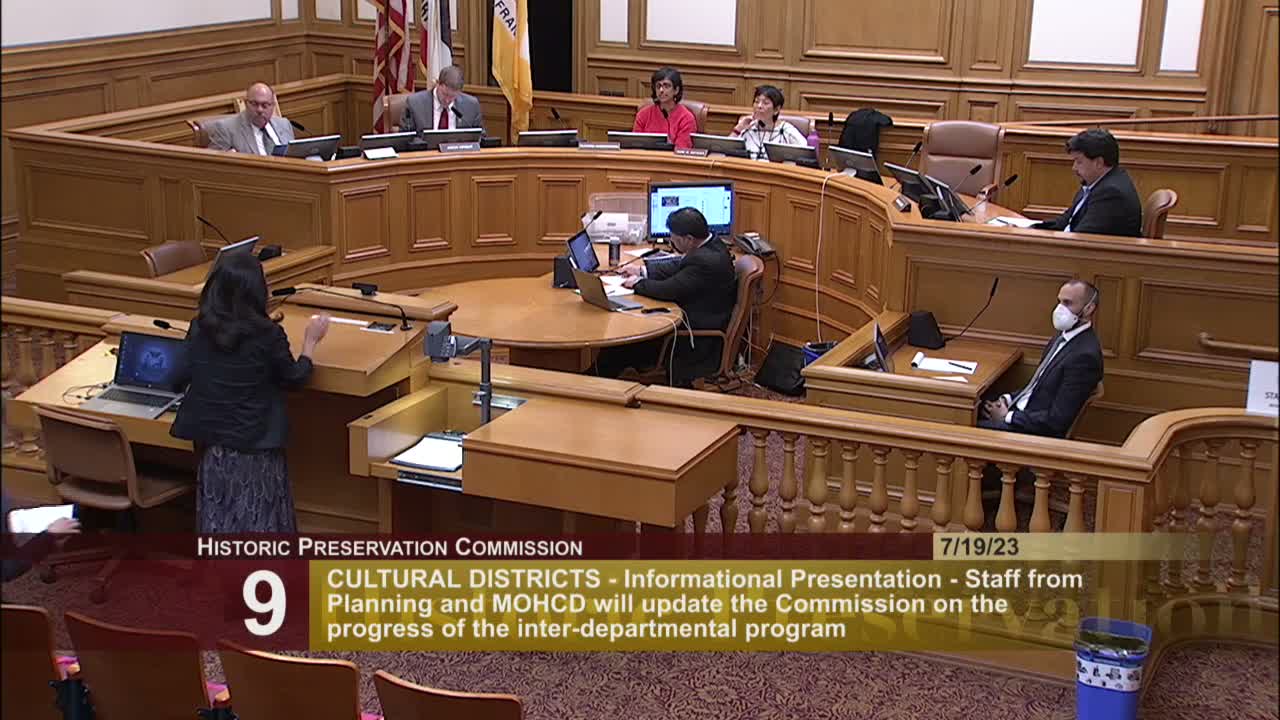
City planning staff and the Mayor's Office of Housing and Community Development briefed the Historic Preservation Commission on July 19 on San Francisco's Cultural Districts program, established by the Board of Supervisors in 2018 to stabilize and support communities facing displacement.
Grace Jeeyun Lee (MOHCD) summarized the program: a cultural district is a designated geographic area that "embodies a unique cultural heritage" with a concentration of culturally significant businesses, arts and residents of a specific cultural community. She noted that voters approved Proposition E in November 2018, which dedicates a portion of hotel-tax revenue to the program; staff said the city is targeting roughly $3 million a year from that source and is encumbering base funding of about $230,000 per district for operations.
Julia Samori (Planning) described the CHESS requirement (cultural history, housing and economic sustainability strategies) and the department's role as a steering‑committee member that provides data, policy support and a planning liaison for each district. Staff outlined examples of district activities—mural projects, vendor legalization, small-business supports and community-led housing strategies—and said two districts (Japantown and Soma Pilipinas) have completed CHESS reports approved by the Board of Supervisors and are beginning implementation work.
Commissioners asked how cultural districts reach constituencies beyond their geographic boundaries, whether districts may overlap, how they are notified of projects, and how the commission might be more proactively informed about culturally sensitive projects in historic areas. Staff said liaisons in planning coordinate notifications, districts attend monthly meetings, and departments collaborate to share project information. Staff cautioned that the hotel-tax funding pot is finite and that adding more districts reduces the base allocation per district unless the funding pot increases.
Commissioners requested ongoing briefings and suggested that a representative of the commission be invited to cultural district meetings so districts know how to contact HPC about matters affecting historic properties.
Grace Jeeyun Lee (MOHCD) summarized the program: a cultural district is a designated geographic area that "embodies a unique cultural heritage" with a concentration of culturally significant businesses, arts and residents of a specific cultural community. She noted that voters approved Proposition E in November 2018, which dedicates a portion of hotel-tax revenue to the program; staff said the city is targeting roughly $3 million a year from that source and is encumbering base funding of about $230,000 per district for operations.
Julia Samori (Planning) described the CHESS requirement (cultural history, housing and economic sustainability strategies) and the department's role as a steering‑committee member that provides data, policy support and a planning liaison for each district. Staff outlined examples of district activities—mural projects, vendor legalization, small-business supports and community-led housing strategies—and said two districts (Japantown and Soma Pilipinas) have completed CHESS reports approved by the Board of Supervisors and are beginning implementation work.
Commissioners asked how cultural districts reach constituencies beyond their geographic boundaries, whether districts may overlap, how they are notified of projects, and how the commission might be more proactively informed about culturally sensitive projects in historic areas. Staff said liaisons in planning coordinate notifications, districts attend monthly meetings, and departments collaborate to share project information. Staff cautioned that the hotel-tax funding pot is finite and that adding more districts reduces the base allocation per district unless the funding pot increases.
Commissioners requested ongoing briefings and suggested that a representative of the commission be invited to cultural district meetings so districts know how to contact HPC about matters affecting historic properties.
Don't Miss a Word: See the Full Meeting!
Go beyond summaries. Unlock every video, transcript, and key insight with a Founder Membership.
✓
Get instant access to full meeting videos
✓
Search and clip any phrase from complete transcripts
✓
Receive AI-powered summaries & custom alerts
✓
Enjoy lifetime, unrestricted access to government data
30-day money-back guarantee
