Historic Preservation Commission approves amended Mills Act priorities and nonrenewal policy
January 17, 2024 | San Francisco City, San Francisco County, California
This article was created by AI summarizing key points discussed. AI makes mistakes, so for full details and context, please refer to the video of the full meeting. Please report any errors so we can fix them. Report an error »
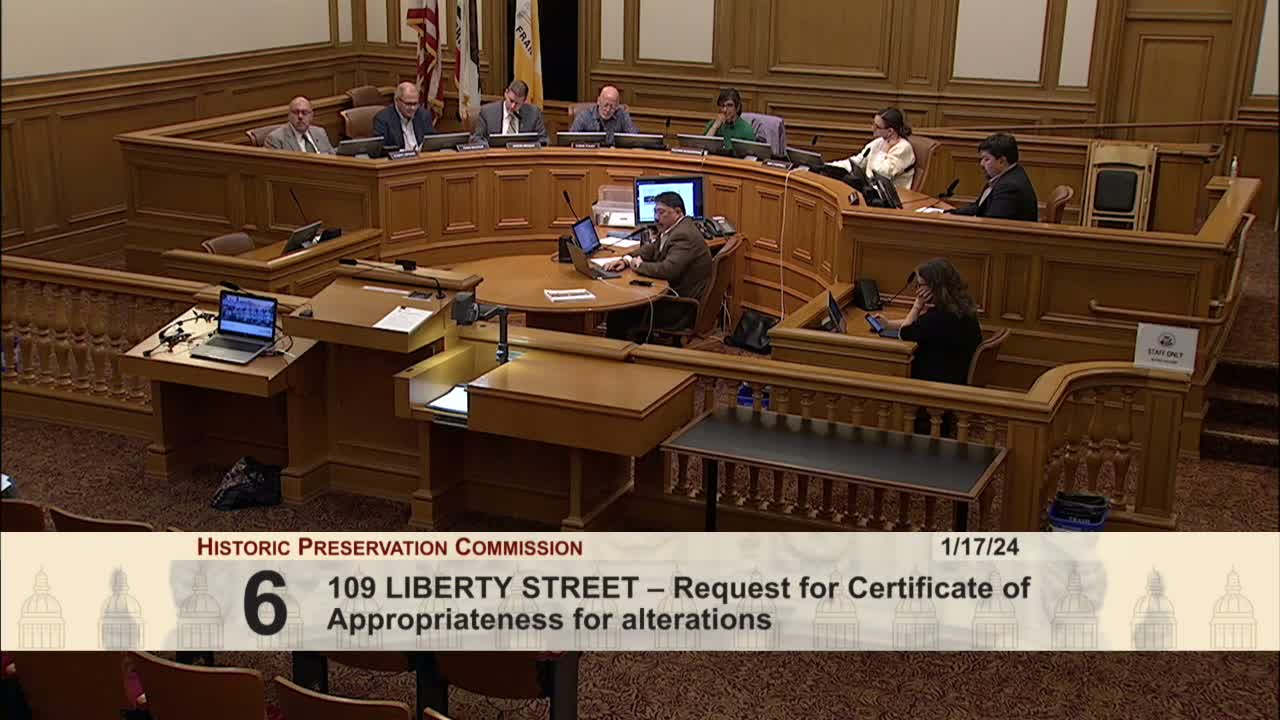
San Francisco’s Historic Preservation Commission on Jan. 17 approved amended policy guidance for the Mills Act, the local property‑tax incentive used to support historic rehabilitation, voting 5–1 after hearing a staff audit and public comment.
Planning Department staff presented a two‑phase audit showing the program is unevenly distributed across the city, heavily concentrated in supervisorial District 8 and in single‑family, owner‑occupied properties. Staff said San Francisco currently holds 48 Mills Act contracts and that about 42% of contracts have completed the rehabilitation scopes outlined in their agreements. The department recommended two main changes: adopt clearer, objective priority criteria for new applications and place future contracts into nonrenewal status in year 11 of the rolling 10‑year contract cycle.
"The Mills Act legislation authorizes local governments to enter into contracts with private owners of qualified historic properties," Planning staff said in the presentation, describing eligibility tied to listings on the California or National Registers and to articles 10 and 11 of the city planning code. Staff detailed eligibility valuation thresholds—$3,000,000 for single‑family homes and $5,000,000 for multifamily, commercial and industrial properties—and said the assessor uses a three‑way valuation test to determine taxable value under the program.
Under the amendments the commission adopted, new priority considerations would include office‑to‑residential conversions, location in a designated priority equity geography, multifamily housing, recently designated city landmarks, legacy businesses and an estimated rehabilitation cost threshold (staff proposed more than $200,000 for single‑family dwellings and more than $500,000 for multiunit properties). Staff also recommended placing future contracts into nonrenewal status beginning in year 11 so contracts do not automatically roll in perpetuity.
Woody Labounty of San Francisco Heritage urged the commission to rethink the program, arguing the Mills Act ‘‘probably won’t benefit you at all’’ in its current form and calling the incentive difficult to access. "There are 48 contracts in the city," Labounty said, adding that the program's benefits are concentrated in wealthier neighborhoods and that translating materials alone would not resolve structural access barriers.
Several commissioners supported the staff approach as a way to provide clarity and to align the program with housing and equity objectives. Commissioner Foley, who said staff had assisted him when he previously applied for a Mills Act contract, said he was "supportive of the changes" and of doing outreach to under‑resourced communities. Commissioner Wright expressed concern about changing terms for existing contract holders and urged careful notification; staff said they will conduct targeted outreach and notify current Mills Act owners before forwarding legislation to the Board of Supervisors.
The commission approved an amendment clarifying that meeting at least one of the new priority criteria would give an application priority recommendation from staff (vote 6–0), and, after adding a requirement to notify current Mills Act holders and to request a three‑year program review, adopted the amended package 5–1 (Commissioner Wright opposed).
Next steps: staff said the Board of Supervisors will review related nonrenewal legislation and that the Planning Department will undertake targeted outreach to eligible property owners in adaptive reuse areas and in priority equity geographies. The commission asked staff for annual reports on program implementation and a three‑year benchmark evaluation.
The commission also noted the legal limits of local authority: formal changes to Mills Act contracts or nonrenewal status will require action by the Board of Supervisors.
Planning Department staff presented a two‑phase audit showing the program is unevenly distributed across the city, heavily concentrated in supervisorial District 8 and in single‑family, owner‑occupied properties. Staff said San Francisco currently holds 48 Mills Act contracts and that about 42% of contracts have completed the rehabilitation scopes outlined in their agreements. The department recommended two main changes: adopt clearer, objective priority criteria for new applications and place future contracts into nonrenewal status in year 11 of the rolling 10‑year contract cycle.
"The Mills Act legislation authorizes local governments to enter into contracts with private owners of qualified historic properties," Planning staff said in the presentation, describing eligibility tied to listings on the California or National Registers and to articles 10 and 11 of the city planning code. Staff detailed eligibility valuation thresholds—$3,000,000 for single‑family homes and $5,000,000 for multifamily, commercial and industrial properties—and said the assessor uses a three‑way valuation test to determine taxable value under the program.
Under the amendments the commission adopted, new priority considerations would include office‑to‑residential conversions, location in a designated priority equity geography, multifamily housing, recently designated city landmarks, legacy businesses and an estimated rehabilitation cost threshold (staff proposed more than $200,000 for single‑family dwellings and more than $500,000 for multiunit properties). Staff also recommended placing future contracts into nonrenewal status beginning in year 11 so contracts do not automatically roll in perpetuity.
Woody Labounty of San Francisco Heritage urged the commission to rethink the program, arguing the Mills Act ‘‘probably won’t benefit you at all’’ in its current form and calling the incentive difficult to access. "There are 48 contracts in the city," Labounty said, adding that the program's benefits are concentrated in wealthier neighborhoods and that translating materials alone would not resolve structural access barriers.
Several commissioners supported the staff approach as a way to provide clarity and to align the program with housing and equity objectives. Commissioner Foley, who said staff had assisted him when he previously applied for a Mills Act contract, said he was "supportive of the changes" and of doing outreach to under‑resourced communities. Commissioner Wright expressed concern about changing terms for existing contract holders and urged careful notification; staff said they will conduct targeted outreach and notify current Mills Act owners before forwarding legislation to the Board of Supervisors.
The commission approved an amendment clarifying that meeting at least one of the new priority criteria would give an application priority recommendation from staff (vote 6–0), and, after adding a requirement to notify current Mills Act holders and to request a three‑year program review, adopted the amended package 5–1 (Commissioner Wright opposed).
Next steps: staff said the Board of Supervisors will review related nonrenewal legislation and that the Planning Department will undertake targeted outreach to eligible property owners in adaptive reuse areas and in priority equity geographies. The commission asked staff for annual reports on program implementation and a three‑year benchmark evaluation.
The commission also noted the legal limits of local authority: formal changes to Mills Act contracts or nonrenewal status will require action by the Board of Supervisors.
View the Full Meeting & All Its Details
This article offers just a summary. Unlock complete video, transcripts, and insights as a Founder Member.
✓
Watch full, unedited meeting videos
✓
Search every word spoken in unlimited transcripts
✓
AI summaries & real-time alerts (all government levels)
✓
Permanent access to expanding government content
30-day money-back guarantee
