Commission postpones decision on new enforcement‑penalty guidelines after extended debate
December 06, 2023 | San Francisco City, San Francisco County, California
This article was created by AI summarizing key points discussed. AI makes mistakes, so for full details and context, please refer to the video of the full meeting. Please report any errors so we can fix them. Report an error »
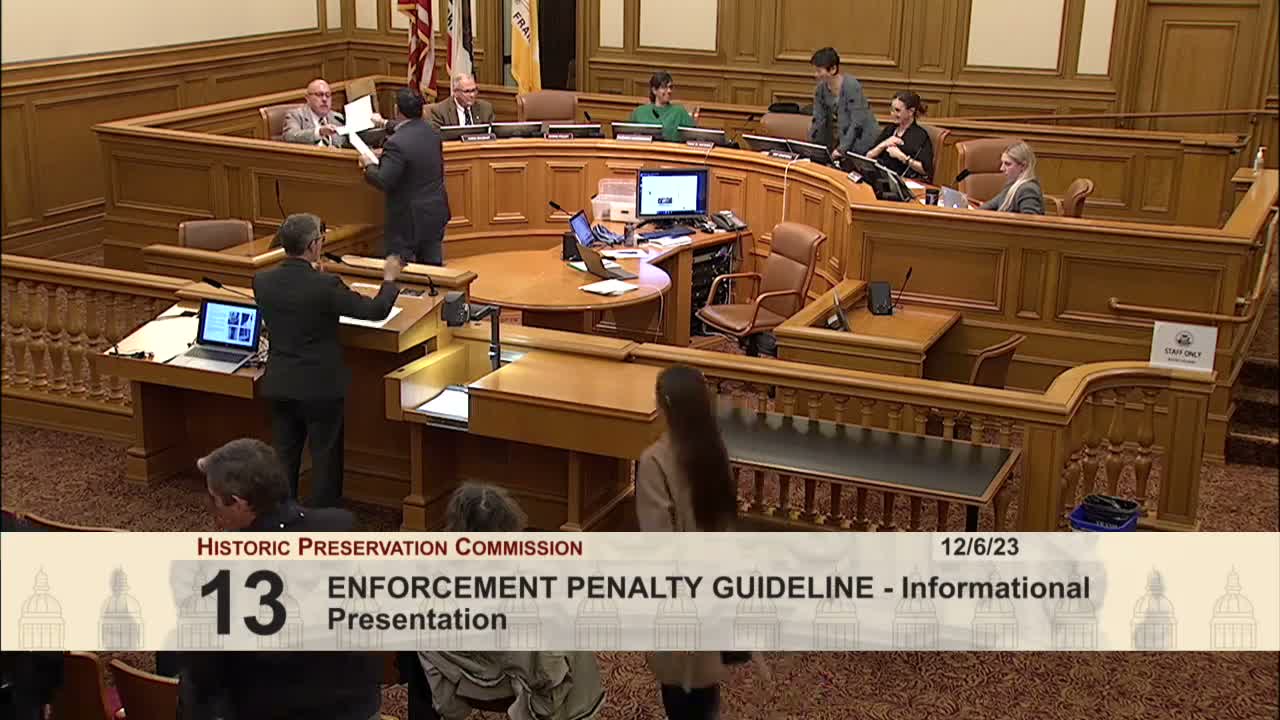
The Historic Preservation Commission took no final action Dec. 6 on staff recommendations that would define thresholds and factors for newly authorized enforcement penalties, instead voting to continue the item for further consideration after an extensive discussion.
Zoning Administrator Corey Teague and Code Enforcement Manager Kelly Wong outlined the new enforcement tools adopted by ordinance earlier in the year: the authority for the zoning administrator to assess a one‑time penalty of up to $500,000 for unauthorized demolition or significant alteration of certain qualifying historic resources, and up to $250,000 for unauthorized removal of dwelling units or creation of multiple unauthorized units. Staff proposed thresholds (for example, removal percentages of exterior walls or structural framework) that would trigger eligibility for those high penalties and recommended 11 factors for the zoning administrator to weigh in setting penalty amounts.
Public commenters and commissioners pressed staff on multiple fronts: whether the thresholds (percentages) were appropriately calibrated, how interior versus exterior demolition was defined and when HPC has purview, whether ability to pay should factor into penalty decisions, the legal defensibility of large one‑time fines, and the staffing and resource burdens of documenting and defending high penalty assessments in appeals or lawsuits. Georgia Shudish cited the Willis Polk House enforcement example and asked for more stringent demolition thresholds to close calculation loopholes used in previous enforcement cases.
After a lengthy exchange about legal risk, equity (differential impacts by property owner wealth), and administrative capacity, commissioners voted to continue the item to a future hearing to allow additional review and to provide full commission participation. The continued date was set for the commission’s next scheduled meeting on Dec. 20.
Next steps: Planning staff will return with additional materials and clarifications for HPC review; the zoning administrator indicated the department will track and report early cases if and when penalties are assessed to inform future calibration.
Zoning Administrator Corey Teague and Code Enforcement Manager Kelly Wong outlined the new enforcement tools adopted by ordinance earlier in the year: the authority for the zoning administrator to assess a one‑time penalty of up to $500,000 for unauthorized demolition or significant alteration of certain qualifying historic resources, and up to $250,000 for unauthorized removal of dwelling units or creation of multiple unauthorized units. Staff proposed thresholds (for example, removal percentages of exterior walls or structural framework) that would trigger eligibility for those high penalties and recommended 11 factors for the zoning administrator to weigh in setting penalty amounts.
Public commenters and commissioners pressed staff on multiple fronts: whether the thresholds (percentages) were appropriately calibrated, how interior versus exterior demolition was defined and when HPC has purview, whether ability to pay should factor into penalty decisions, the legal defensibility of large one‑time fines, and the staffing and resource burdens of documenting and defending high penalty assessments in appeals or lawsuits. Georgia Shudish cited the Willis Polk House enforcement example and asked for more stringent demolition thresholds to close calculation loopholes used in previous enforcement cases.
After a lengthy exchange about legal risk, equity (differential impacts by property owner wealth), and administrative capacity, commissioners voted to continue the item to a future hearing to allow additional review and to provide full commission participation. The continued date was set for the commission’s next scheduled meeting on Dec. 20.
Next steps: Planning staff will return with additional materials and clarifications for HPC review; the zoning administrator indicated the department will track and report early cases if and when penalties are assessed to inform future calibration.
Don't Miss a Word: See the Full Meeting!
Go beyond summaries. Unlock every video, transcript, and key insight with a Founder Membership.
✓
Get instant access to full meeting videos
✓
Search and clip any phrase from complete transcripts
✓
Receive AI-powered summaries & custom alerts
✓
Enjoy lifetime, unrestricted access to government data
30-day money-back guarantee
