Commission approves seismic upgrades for 20 Franklin Street, preserving 70-unit affordable building
February 21, 2024 | San Francisco City, San Francisco County, California
This article was created by AI summarizing key points discussed. AI makes mistakes, so for full details and context, please refer to the video of the full meeting. Please report any errors so we can fix them. Report an error »
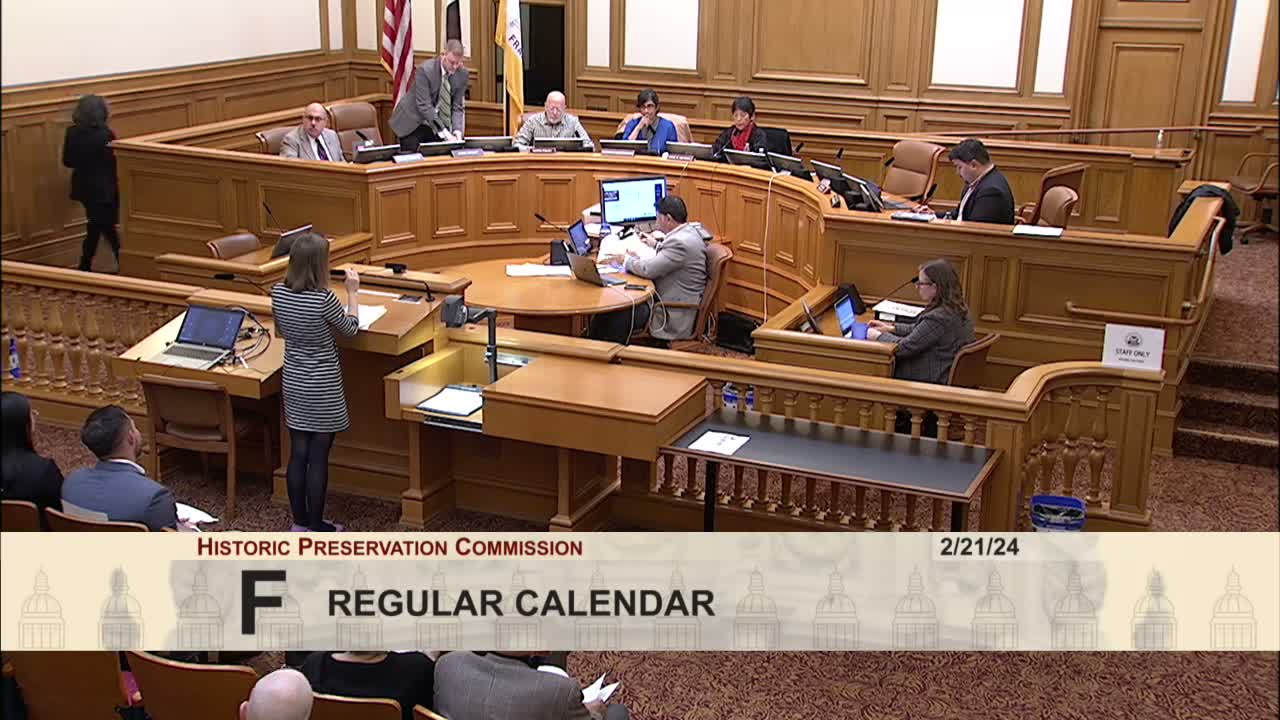
The San Francisco Historic Preservation Commission on Feb. 21 approved a certificate of appropriateness for seismic and preservation work at 20 Franklin Street, a 1917 contributor to the Market Street Masonry Historic District. Planning staff recommended approval with conditions, and the commission voted unanimously to adopt the recommendation.
Planning staff told the commission the project's scope includes voluntary seismic upgrades—primarily exterior steel moment frames in two light wells and minimally visible brace frames at secondary elevations—mechanical, electrical and plumbing upgrades, installation of through-wall vents and replacement of a nonhistoric security gate. Rebecca Salgado, planning staff, said the work will conform to Article 10 and the Secretary of the Interior's Standards for Rehabilitation and would not change the building's retail or residential uses.
The building sponsor, Mercy Housing, said the property is 100% affordable housing for adults with HIV/AIDS and comprises 70 units. Lilia Roman, an assistant project manager at Mercy Housing, said the retrofit is required to satisfy state TCAC funding requirements while preserving existing unit layouts.
Eric Robinson, the project architect, explained the team studied options that retained structure interiorly but concluded that some exterior moment frames were necessary to balance seismic safety with habitability. He said the frames were designed to be set back from the street, painted to match surrounding brick, and reversible if future removal were desired. "We really worked a balance between having some of the seismic on the interior and some of the common areas ... and putting some of the structure on the exterior," Robinson said.
Commissioners asked about reversibility, waterproofing where frames penetrate brick, and masonry repair methodology. The project team said the retrofit is designed to be reversible, will use masonry subcontractors for repointing and to reuse brick, and will provide mock-ups for preservation review.
The commission approved the COA with conditions to require product cut sheets, mock-ups, and monitoring, and recorded the vote as unanimous among participating commissioners (the architect and sponsor will pursue building permits and further review required by planning staff). The decision preserves the building's affordable use while allowing structural work intended to protect a vulnerable tenant population.
The commission's approval places emphasis on minimizing visible alterations to the historic façade, requiring staff oversight and mock-ups to ensure preservation standards are met.
Planning staff told the commission the project's scope includes voluntary seismic upgrades—primarily exterior steel moment frames in two light wells and minimally visible brace frames at secondary elevations—mechanical, electrical and plumbing upgrades, installation of through-wall vents and replacement of a nonhistoric security gate. Rebecca Salgado, planning staff, said the work will conform to Article 10 and the Secretary of the Interior's Standards for Rehabilitation and would not change the building's retail or residential uses.
The building sponsor, Mercy Housing, said the property is 100% affordable housing for adults with HIV/AIDS and comprises 70 units. Lilia Roman, an assistant project manager at Mercy Housing, said the retrofit is required to satisfy state TCAC funding requirements while preserving existing unit layouts.
Eric Robinson, the project architect, explained the team studied options that retained structure interiorly but concluded that some exterior moment frames were necessary to balance seismic safety with habitability. He said the frames were designed to be set back from the street, painted to match surrounding brick, and reversible if future removal were desired. "We really worked a balance between having some of the seismic on the interior and some of the common areas ... and putting some of the structure on the exterior," Robinson said.
Commissioners asked about reversibility, waterproofing where frames penetrate brick, and masonry repair methodology. The project team said the retrofit is designed to be reversible, will use masonry subcontractors for repointing and to reuse brick, and will provide mock-ups for preservation review.
The commission approved the COA with conditions to require product cut sheets, mock-ups, and monitoring, and recorded the vote as unanimous among participating commissioners (the architect and sponsor will pursue building permits and further review required by planning staff). The decision preserves the building's affordable use while allowing structural work intended to protect a vulnerable tenant population.
The commission's approval places emphasis on minimizing visible alterations to the historic façade, requiring staff oversight and mock-ups to ensure preservation standards are met.
View the Full Meeting & All Its Details
This article offers just a summary. Unlock complete video, transcripts, and insights as a Founder Member.
✓
Watch full, unedited meeting videos
✓
Search every word spoken in unlimited transcripts
✓
AI summaries & real-time alerts (all government levels)
✓
Permanent access to expanding government content
30-day money-back guarantee
