Commission recommends landmark designation for Greg Angelo Museum after extensive public debate
March 20, 2024 | San Francisco City, San Francisco County, California
This article was created by AI summarizing key points discussed. AI makes mistakes, so for full details and context, please refer to the video of the full meeting. Please report any errors so we can fix them. Report an error »
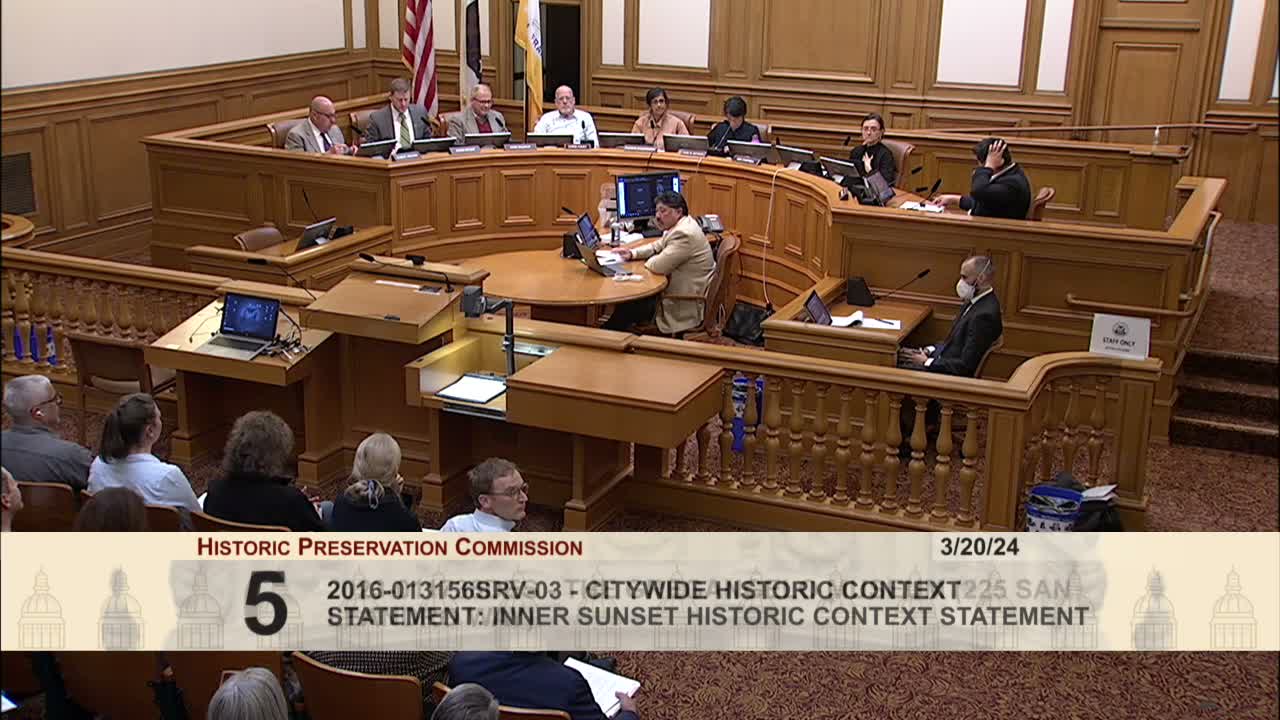
The Historic Preservation Commission voted March 20 to recommend local landmark designation for the Greg Angelo Museum at 225 San Leandro Way, forwarding the nomination to the Board of Supervisors after an extended public-comment period and deliberation.
Supervisor Mirna Melgar’s legislative aide, Emma Heikin, opened the item and described the museum’s role in arts and community engagement. Planning staff told commissioners that the department found the property eligible for local landmark designation under Article 10 for its cultural and artistic significance and identified character‑defining features including interior installations and exterior ornamentation. "The department believes that the Gargangela Museum meet established eligibility requirements and landmark status is warranted," planning staff said in the presentation.
The hearing drew intense neighborhood engagement. Dozens of Balboa Terrace residents and members of the Balboa Terrace Homes Association voiced opposition, citing recent commercialization, outdoor lines, the presence of buses, trash and noise, and concerns that a designation would be used to justify expanded commercial operations. One neighbor told commissioners the house had not been operated as a commercial entertainment venue for the claimed four decades and said the recent changes "pose a nuisance on the neighborhood."
At the same time, more than a hundred artists, former staff and arts‑sector witnesses testified in support, describing the museum as an incubator and mentor for local artists, a site of community programming and a rare family‑friendly cultural resource. Supporters included arts organizations and planning‑department heritage staff who said the museum provides training, jobs and creative opportunities. "It's a place where artists from around the country and around the globe meet, collaborate, grow, and share," said a supporting commenter who identified themself as working with the museum.
Commissioners framed their role narrowly around Article 10 criteria — whether the property meets local landmark eligibility and whether the character‑defining features were correctly identified — and stressed that review of future operational or zoning changes (conditional use authorization) falls to other boards and commissions. Planning staff explained Article 10 processes for protecting character‑defining features, the use of a notice of special restriction recorded against the property, and the certificate‑of‑appropriateness process for future alterations. Staff also noted that landmarks can be delisted if altered and that enforcement tools exist for illegal work.
The Commission debated a continuance request from several commissioners who sought more time to tour the property and for neighbor mediation; the motion to continue failed. The Commission then voted to adopt a recommendation in favor of designation and will forward that recommendation to the Board of Supervisors and later to the Land Use Committee, where any conditional‑use authorization would be considered separately.
The record shows strong community division: supporters stressed cultural, educational and artist‑support functions; neighbors argued the designation could be used to expand a commercial use that altered neighborhood character. The Commission’s recommendation does not itself change land use; any change in operations or conditional‑use approvals will be considered through separate Planning Commission and Board of Supervisors processes.
Supervisor Mirna Melgar’s legislative aide, Emma Heikin, opened the item and described the museum’s role in arts and community engagement. Planning staff told commissioners that the department found the property eligible for local landmark designation under Article 10 for its cultural and artistic significance and identified character‑defining features including interior installations and exterior ornamentation. "The department believes that the Gargangela Museum meet established eligibility requirements and landmark status is warranted," planning staff said in the presentation.
The hearing drew intense neighborhood engagement. Dozens of Balboa Terrace residents and members of the Balboa Terrace Homes Association voiced opposition, citing recent commercialization, outdoor lines, the presence of buses, trash and noise, and concerns that a designation would be used to justify expanded commercial operations. One neighbor told commissioners the house had not been operated as a commercial entertainment venue for the claimed four decades and said the recent changes "pose a nuisance on the neighborhood."
At the same time, more than a hundred artists, former staff and arts‑sector witnesses testified in support, describing the museum as an incubator and mentor for local artists, a site of community programming and a rare family‑friendly cultural resource. Supporters included arts organizations and planning‑department heritage staff who said the museum provides training, jobs and creative opportunities. "It's a place where artists from around the country and around the globe meet, collaborate, grow, and share," said a supporting commenter who identified themself as working with the museum.
Commissioners framed their role narrowly around Article 10 criteria — whether the property meets local landmark eligibility and whether the character‑defining features were correctly identified — and stressed that review of future operational or zoning changes (conditional use authorization) falls to other boards and commissions. Planning staff explained Article 10 processes for protecting character‑defining features, the use of a notice of special restriction recorded against the property, and the certificate‑of‑appropriateness process for future alterations. Staff also noted that landmarks can be delisted if altered and that enforcement tools exist for illegal work.
The Commission debated a continuance request from several commissioners who sought more time to tour the property and for neighbor mediation; the motion to continue failed. The Commission then voted to adopt a recommendation in favor of designation and will forward that recommendation to the Board of Supervisors and later to the Land Use Committee, where any conditional‑use authorization would be considered separately.
The record shows strong community division: supporters stressed cultural, educational and artist‑support functions; neighbors argued the designation could be used to expand a commercial use that altered neighborhood character. The Commission’s recommendation does not itself change land use; any change in operations or conditional‑use approvals will be considered through separate Planning Commission and Board of Supervisors processes.
View the Full Meeting & All Its Details
This article offers just a summary. Unlock complete video, transcripts, and insights as a Founder Member.
✓
Watch full, unedited meeting videos
✓
Search every word spoken in unlimited transcripts
✓
AI summaries & real-time alerts (all government levels)
✓
Permanent access to expanding government content
30-day money-back guarantee
