Historic Preservation Commission recommends landmarking Gilbert Baker’s rainbow flag at Harvey Milk Plaza
May 15, 2024 | San Francisco City, San Francisco County, California
This article was created by AI summarizing key points discussed. AI makes mistakes, so for full details and context, please refer to the video of the full meeting. Please report any errors so we can fix them. Report an error »
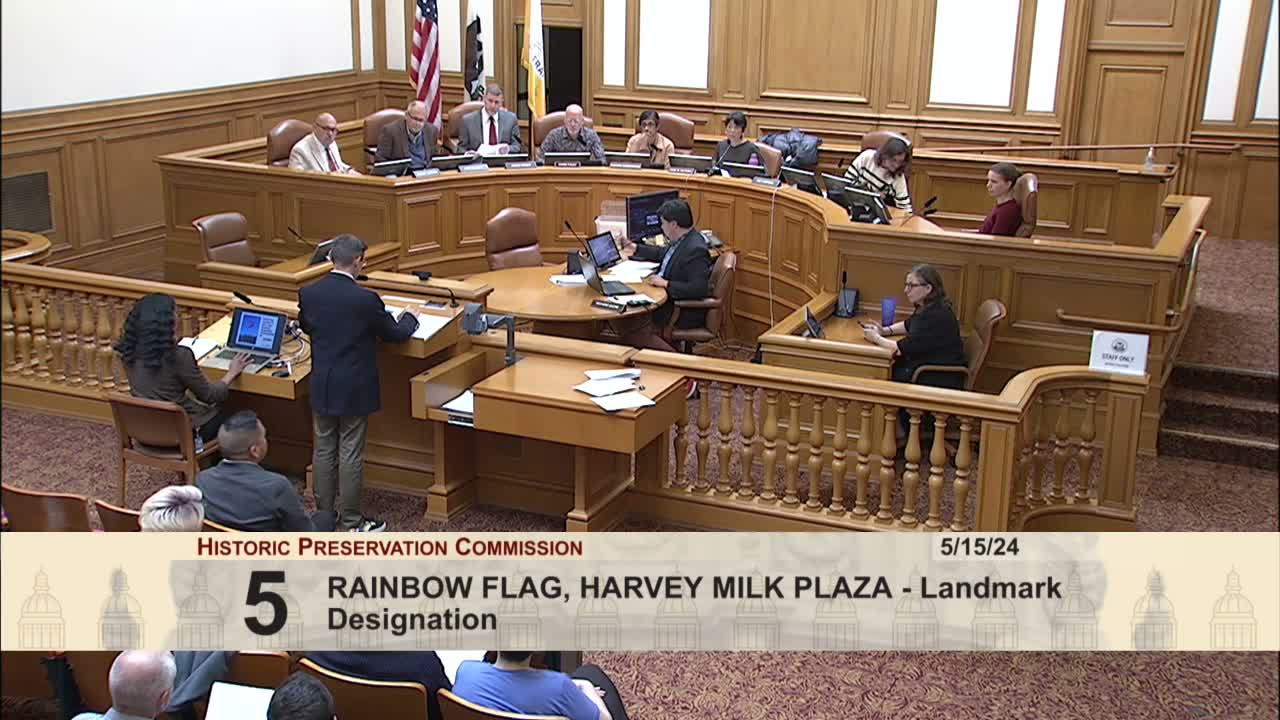
The San Francisco Historic Preservation Commission on May 15 recommended that the Board of Supervisors designate Gilbert Baker’s rainbow flag installation at Harvey Milk Plaza as a landmark.
Planning staff told commissioners the installation qualifies as a traditional cultural place under National Register Criterion A and as a significant artwork under Criterion C. "The rainbow flag qualifies as a traditional cultural place under National Register criterion A," Moses Courrette, planning department staff, said during the presentation. Courrette laid out the proposed ordinance’s character-defining features, which include the flagpole and plinth, the metal plaque, the internal halyard, and the large fabric flag.
Supporters told the Commission the installation is globally recognized and locally meaningful. Charlie Beal, president of the Gilbert Baker Foundation, said the flag has become a "beacon of hope and liberation" and urged the Commission to protect it: "I implore you, please save the most important rainbow flag in the world by landmarking this great work of art." Several neighborhood organizations, arts advocates and LGBTQ+ leaders also urged a positive recommendation.
Staff noted operational details the ordinance would preserve: ownership now resides with the Department of Public Works; flags wear out and are typically replaced about four times a year; routine replacement is defined as ordinary maintenance and would not require separate review. The ordinance as drafted allows for limited staff-level administrative certificates of appropriateness for some temporary flag variants and reserves larger changes (for example, flying different contemporary pride flags) for a full certificate of appropriateness review with notice to this Commission.
Commissioners asked how requests to fly alternate flag variants would be handled, who controls requests to Public Works, and how maintenance would be managed going forward. Staff said the arts commission would be a consulting body for artwork on public property and that any significant alteration would require a certificate of appropriateness with public notice.
The Commission voted 7–0 to recommend the landmark designation to the Board of Supervisors, a formal step that moves the draft ordinance to the Land Use Committee and then to the full Board for two readings and the mayor’s signature.
Planning staff told commissioners the installation qualifies as a traditional cultural place under National Register Criterion A and as a significant artwork under Criterion C. "The rainbow flag qualifies as a traditional cultural place under National Register criterion A," Moses Courrette, planning department staff, said during the presentation. Courrette laid out the proposed ordinance’s character-defining features, which include the flagpole and plinth, the metal plaque, the internal halyard, and the large fabric flag.
Supporters told the Commission the installation is globally recognized and locally meaningful. Charlie Beal, president of the Gilbert Baker Foundation, said the flag has become a "beacon of hope and liberation" and urged the Commission to protect it: "I implore you, please save the most important rainbow flag in the world by landmarking this great work of art." Several neighborhood organizations, arts advocates and LGBTQ+ leaders also urged a positive recommendation.
Staff noted operational details the ordinance would preserve: ownership now resides with the Department of Public Works; flags wear out and are typically replaced about four times a year; routine replacement is defined as ordinary maintenance and would not require separate review. The ordinance as drafted allows for limited staff-level administrative certificates of appropriateness for some temporary flag variants and reserves larger changes (for example, flying different contemporary pride flags) for a full certificate of appropriateness review with notice to this Commission.
Commissioners asked how requests to fly alternate flag variants would be handled, who controls requests to Public Works, and how maintenance would be managed going forward. Staff said the arts commission would be a consulting body for artwork on public property and that any significant alteration would require a certificate of appropriateness with public notice.
The Commission voted 7–0 to recommend the landmark designation to the Board of Supervisors, a formal step that moves the draft ordinance to the Land Use Committee and then to the full Board for two readings and the mayor’s signature.
Don't Miss a Word: See the Full Meeting!
Go beyond summaries. Unlock every video, transcript, and key insight with a Founder Membership.
✓
Get instant access to full meeting videos
✓
Search and clip any phrase from complete transcripts
✓
Receive AI-powered summaries & custom alerts
✓
Enjoy lifetime, unrestricted access to government data
30-day money-back guarantee
