Planning staff briefs commission on state density bonus law and limits on local preservation discretion
October 18, 2023 | San Francisco City, San Francisco County, California
This article was created by AI summarizing key points discussed. AI makes mistakes, so for full details and context, please refer to the video of the full meeting. Please report any errors so we can fix them. Report an error »
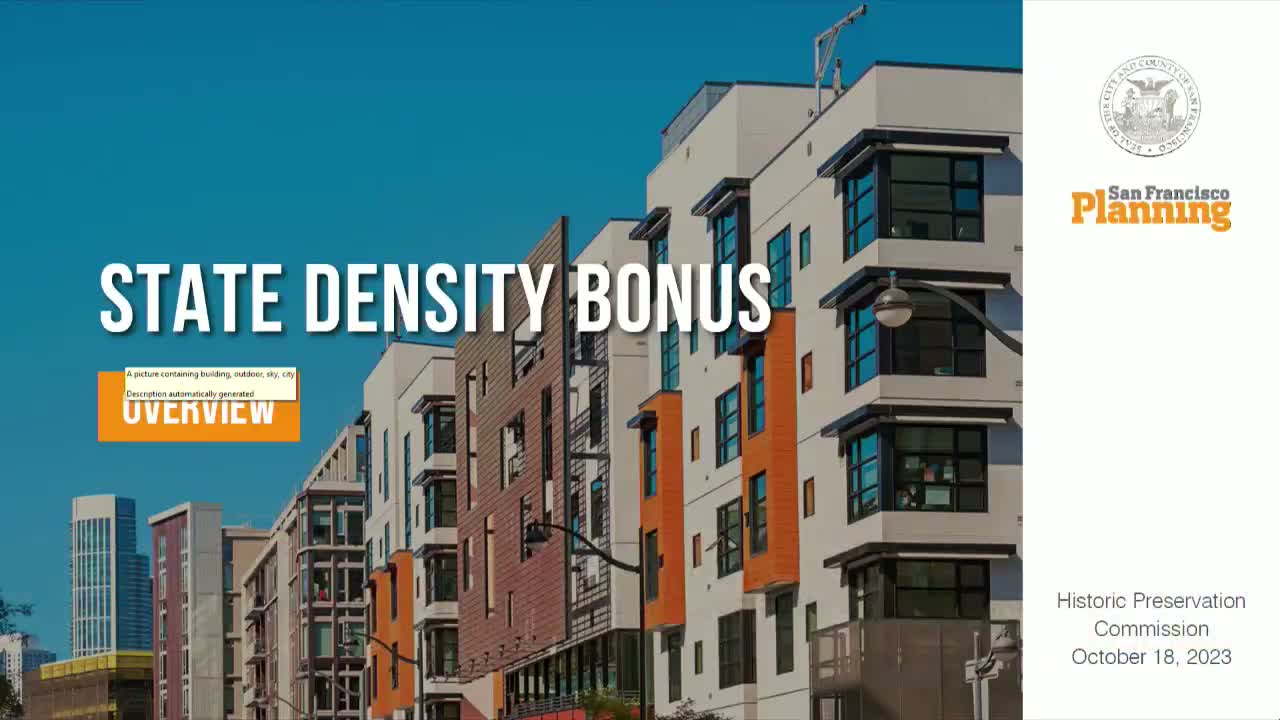
Planning Department staff told the Historic Preservation Commission on Oct. 18 that California’s state density bonus law and the Housing Accountability Act substantially limit local discretion over certain housing projects, including waivers and incentives often sought in exchange for affordable units.
"The city is incredibly limited in its discretion and can only deny an incentive or a concession if it does not result in actual cost reductions, or if it would have a specific adverse impact on public health or safety or on a resource that is listed on the California Register," planner Kate Connor said, summarizing the department’s interpretation.
Connor described the law’s mechanics: projects of five or more units that provide on-site affordable units may be entitled to density bonuses, and incentives or waivers (for example, reduced ground-floor ceiling height or additional height) are granted based on demonstrated cost reductions or other project specifics. She said the Planning Department has published Planning Director Bulletin 6 to set out San Francisco’s interpretations and processing steps for state density bonus projects.
Connor explained the definition commissioners must apply: a "specific adverse impact" is a "significant, quantifiable, direct, and unavoidable impact based on objective identified written public health or safety standards" present when an application was deemed complete. She noted that state density bonus projects, including requested waivers and incentives, are often treated as code-compliant under the Housing Accountability Act, and wrongful denials could expose a jurisdiction to fines of up to $10,000 per unit under recent amendments.
Commissioners asked several follow-up questions: how many San Francisco properties are on the California Register (Commissioner Vergara said his research found 222), how listings feed into the city’s databases, and whether local designation could be used to strengthen protection. Staff said the department has internal SF Survey data already uploaded to PIM and is working to import data into Arches for public access. Planning staff agreed to request a map from state staff, to explore the legislative option of seeking amendments to state law, and to add a future agenda item and potential letter on California Register designation.
Commissioners also asked about demolition safeguards under CEQA; staff said CEQA treats demolition of a historic resource as a significant and unavoidable impact that requires disclosure and mitigation analysis but does not categorically prevent demolition. Staff offered to return with further materials and a list of resources for the commission to review.
"The city is incredibly limited in its discretion and can only deny an incentive or a concession if it does not result in actual cost reductions, or if it would have a specific adverse impact on public health or safety or on a resource that is listed on the California Register," planner Kate Connor said, summarizing the department’s interpretation.
Connor described the law’s mechanics: projects of five or more units that provide on-site affordable units may be entitled to density bonuses, and incentives or waivers (for example, reduced ground-floor ceiling height or additional height) are granted based on demonstrated cost reductions or other project specifics. She said the Planning Department has published Planning Director Bulletin 6 to set out San Francisco’s interpretations and processing steps for state density bonus projects.
Connor explained the definition commissioners must apply: a "specific adverse impact" is a "significant, quantifiable, direct, and unavoidable impact based on objective identified written public health or safety standards" present when an application was deemed complete. She noted that state density bonus projects, including requested waivers and incentives, are often treated as code-compliant under the Housing Accountability Act, and wrongful denials could expose a jurisdiction to fines of up to $10,000 per unit under recent amendments.
Commissioners asked several follow-up questions: how many San Francisco properties are on the California Register (Commissioner Vergara said his research found 222), how listings feed into the city’s databases, and whether local designation could be used to strengthen protection. Staff said the department has internal SF Survey data already uploaded to PIM and is working to import data into Arches for public access. Planning staff agreed to request a map from state staff, to explore the legislative option of seeking amendments to state law, and to add a future agenda item and potential letter on California Register designation.
Commissioners also asked about demolition safeguards under CEQA; staff said CEQA treats demolition of a historic resource as a significant and unavoidable impact that requires disclosure and mitigation analysis but does not categorically prevent demolition. Staff offered to return with further materials and a list of resources for the commission to review.
View the Full Meeting & All Its Details
This article offers just a summary. Unlock complete video, transcripts, and insights as a Founder Member.
✓
Watch full, unedited meeting videos
✓
Search every word spoken in unlimited transcripts
✓
AI summaries & real-time alerts (all government levels)
✓
Permanent access to expanding government content
30-day money-back guarantee
