SFHSS credits open‑enrollment gains amid staffing strains and systems work
December 08, 2022 | San Francisco City, San Francisco County, California
This article was created by AI summarizing key points discussed. AI makes mistakes, so for full details and context, please refer to the video of the full meeting. Please report any errors so we can fix them. Report an error »
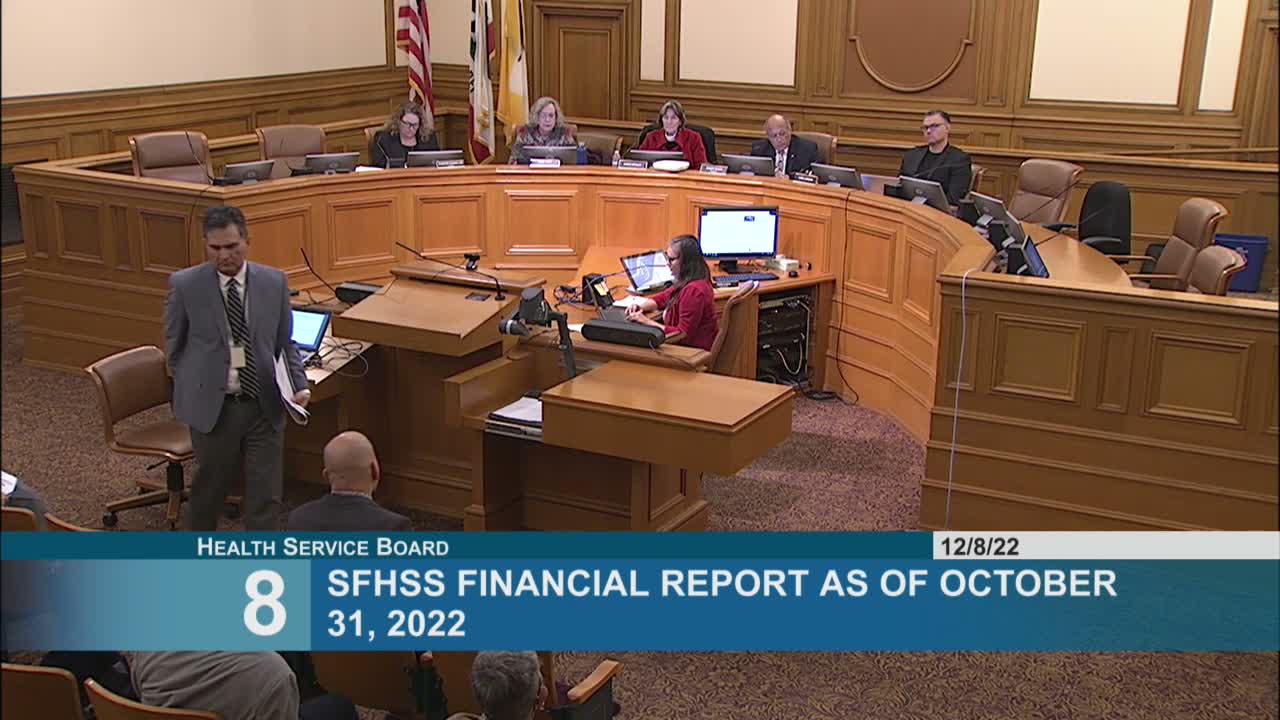
The San Francisco Health Service System reported improvements from its Oct. 3–31 open‑enrollment period but warned that staffing shortages and external payroll problems have created service delays for members.
Ray Guillen, SFHSS chief operating officer, said the system covers “slightly over 77,000 members” including active employees, retirees and school‑district staff, and that open‑enrollment changes become effective Jan. 1, 2023. Guillen and other staff highlighted a drive to shift members to online enrollment (eBenefits), reduce paper applications and ease a transition of so‑called split Medicare families onto new UnitedHealthcare EPO plans to simplify administration.
“The vast majority of enrollments are now submitted via eBenefits,” said Jessica Shee, communications director. Shee told the board the agency mailed about 76,000 open‑enrollment packets and ran six weekly emails and multiple vendor webinars to guide members.
SFHSS also reported financial and operational context for the outreach. Iftikhar Hussain, chief financial officer, said October brought a $4 million pharmacy rebate and left the trust fund roughly $14.7 million ahead of target; the health sustainability fund is expected to finish the year at about $2.7 million.
Despite those results, staff repeatedly told the board that vacancies constrained service during the critical month. Abby Yant, SFHSS executive director, said “we continue to experience personnel shortages” and that roughly one in three HSS positions was vacant leading up to and during October. The staffing shortfall and routine absences contributed to long wait times: staff handled more than 7,000 member calls in October and reported average wait times in the report’s period of roughly eight and a half minutes.
“That’s significantly higher than we would like,” Guillen said, adding that the agency will benchmark call performance against carrier partners and consider operational changes, including different scheduling of enrollment windows.
Staff also described service work beyond member calls. Ryn Coleridge, director of enterprise systems and analytics, said teams reconfigured PeopleSoft and other interfaces to accommodate two new EPO plans, pre‑enrolled split families into aligned plans and reran nightly batch jobs to ingest documents into members’ digital files. Project manager Brian Rodriguez stressed the cross‑team coordination needed to move rates, communications, data and vendor logistics.
Public comment and commissioners’ remarks underscored practical impacts. Retiree caller Richard Lawson told the board he faced coordination problems between VSP and his ophthalmologist, saying prescriptions weren’t accessible online and urging SFHSS to require vendor data integration. “If VSP can’t provide online service, then it’s time to go back to Kaiser,” Lawson said.
In response to rising demand for in‑person services, HSS revived health fairs and flu clinics. Carrie Beshears, well‑being manager, said staff ran 25 flu clinics at 24 locations and piloted two COVID booster clinics that administered 82 boosters; about 2,300 flu vaccines were delivered, a modest increase from the prior year but below pre‑pandemic levels.
Board members praised staff for heavy workloads and asked staff to pursue compensation and classification reviews with the Department of Human Resources to improve recruitment and retention. Yant said SFHSS is meeting weekly with San Francisco Unified School District leadership to address payroll issues that have dropped benefits for some employees and that the agency is triaging individual cases when callers report missing coverage.
SFHSS said it will bring a full report from a Dec. 6 mental‑health forum to the board in early 2023 and will continue refining communications and systems for the next open‑enrollment cycle.
Ray Guillen, SFHSS chief operating officer, said the system covers “slightly over 77,000 members” including active employees, retirees and school‑district staff, and that open‑enrollment changes become effective Jan. 1, 2023. Guillen and other staff highlighted a drive to shift members to online enrollment (eBenefits), reduce paper applications and ease a transition of so‑called split Medicare families onto new UnitedHealthcare EPO plans to simplify administration.
“The vast majority of enrollments are now submitted via eBenefits,” said Jessica Shee, communications director. Shee told the board the agency mailed about 76,000 open‑enrollment packets and ran six weekly emails and multiple vendor webinars to guide members.
SFHSS also reported financial and operational context for the outreach. Iftikhar Hussain, chief financial officer, said October brought a $4 million pharmacy rebate and left the trust fund roughly $14.7 million ahead of target; the health sustainability fund is expected to finish the year at about $2.7 million.
Despite those results, staff repeatedly told the board that vacancies constrained service during the critical month. Abby Yant, SFHSS executive director, said “we continue to experience personnel shortages” and that roughly one in three HSS positions was vacant leading up to and during October. The staffing shortfall and routine absences contributed to long wait times: staff handled more than 7,000 member calls in October and reported average wait times in the report’s period of roughly eight and a half minutes.
“That’s significantly higher than we would like,” Guillen said, adding that the agency will benchmark call performance against carrier partners and consider operational changes, including different scheduling of enrollment windows.
Staff also described service work beyond member calls. Ryn Coleridge, director of enterprise systems and analytics, said teams reconfigured PeopleSoft and other interfaces to accommodate two new EPO plans, pre‑enrolled split families into aligned plans and reran nightly batch jobs to ingest documents into members’ digital files. Project manager Brian Rodriguez stressed the cross‑team coordination needed to move rates, communications, data and vendor logistics.
Public comment and commissioners’ remarks underscored practical impacts. Retiree caller Richard Lawson told the board he faced coordination problems between VSP and his ophthalmologist, saying prescriptions weren’t accessible online and urging SFHSS to require vendor data integration. “If VSP can’t provide online service, then it’s time to go back to Kaiser,” Lawson said.
In response to rising demand for in‑person services, HSS revived health fairs and flu clinics. Carrie Beshears, well‑being manager, said staff ran 25 flu clinics at 24 locations and piloted two COVID booster clinics that administered 82 boosters; about 2,300 flu vaccines were delivered, a modest increase from the prior year but below pre‑pandemic levels.
Board members praised staff for heavy workloads and asked staff to pursue compensation and classification reviews with the Department of Human Resources to improve recruitment and retention. Yant said SFHSS is meeting weekly with San Francisco Unified School District leadership to address payroll issues that have dropped benefits for some employees and that the agency is triaging individual cases when callers report missing coverage.
SFHSS said it will bring a full report from a Dec. 6 mental‑health forum to the board in early 2023 and will continue refining communications and systems for the next open‑enrollment cycle.
View the Full Meeting & All Its Details
This article offers just a summary. Unlock complete video, transcripts, and insights as a Founder Member.
✓
Watch full, unedited meeting videos
✓
Search every word spoken in unlimited transcripts
✓
AI summaries & real-time alerts (all government levels)
✓
Permanent access to expanding government content
30-day money-back guarantee
