Board hears Aon benchmarking and charter formula that drives retiree costs
November 09, 2023 | San Francisco City, San Francisco County, California
This article was created by AI summarizing key points discussed. AI makes mistakes, so for full details and context, please refer to the video of the full meeting. Please report any errors so we can fix them. Report an error »
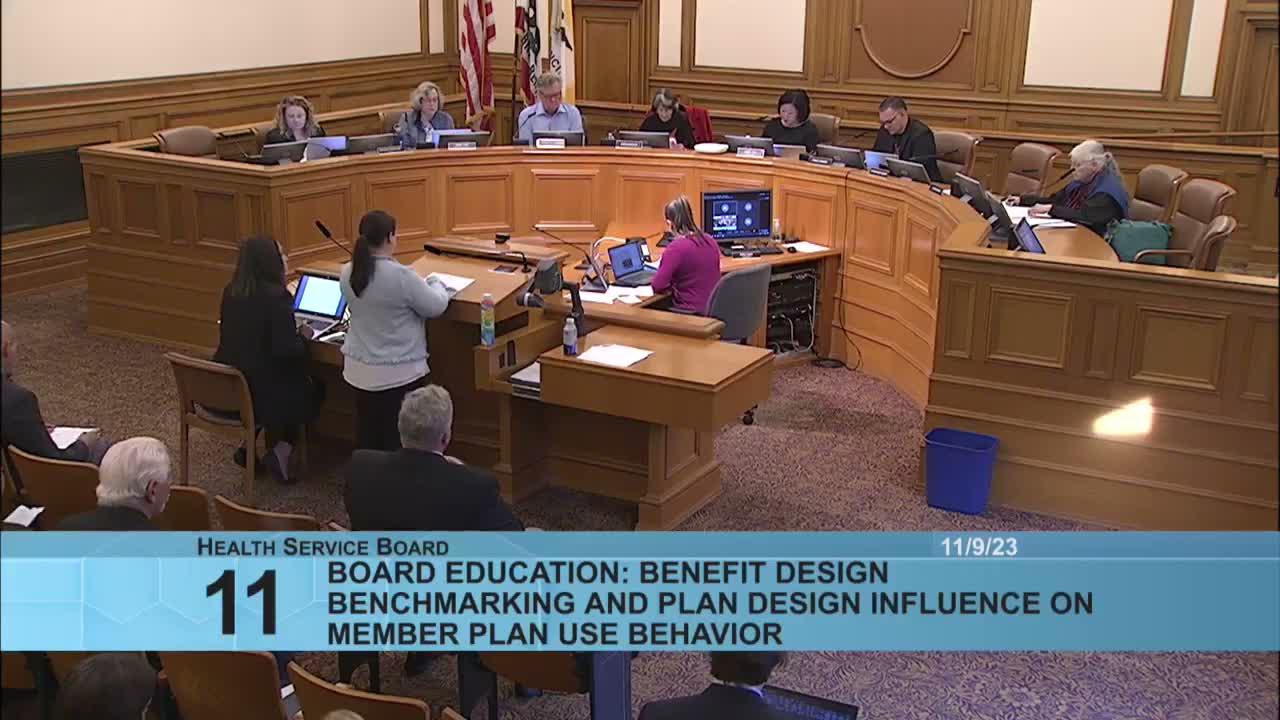
San Francisco — The Health Service Board received two Aon educational modules on Nov. 9 that examined how benefit design shapes member behavior and how the City charter determines contributions to retiree medical plans.
Anne Thompson (Aon) reviewed benchmarking and research, including RAND findings that cost sharing reduces overall use (both effective and less‑effective services), and emphasized that SFHSS plan designs rely more on employer contributions than member cost sharing compared with many national benchmarks. Mike Clark (Aon) showed local comparisons to CalPERS and a 10‑county survey and presented utilization data from Kaiser and Blue Shield showing SFHSS utilization above broader plan averages in some categories.
On city contributions, Clark summarized the three charter elements that determine retiree contributions: the 10‑county benchmark base, the ‘‘actual difference’’ between retiree and active rates, and the Prop E component that partially funds the first dependent. He illustrated how Medicare Advantage retirees frequently receive a zero retiree‑only contribution because the 10‑county benchmark can fully fund that tier, while early retirees often face larger out‑of‑pocket contributions for dependent coverage. Commissioners and public commenters urged earlier and broader pre‑retirement education for workers to understand likely future costs.
Aon said additional modules and follow‑up data (urgent‑care maps, utilization detail) will be presented in future meetings.
Anne Thompson (Aon) reviewed benchmarking and research, including RAND findings that cost sharing reduces overall use (both effective and less‑effective services), and emphasized that SFHSS plan designs rely more on employer contributions than member cost sharing compared with many national benchmarks. Mike Clark (Aon) showed local comparisons to CalPERS and a 10‑county survey and presented utilization data from Kaiser and Blue Shield showing SFHSS utilization above broader plan averages in some categories.
On city contributions, Clark summarized the three charter elements that determine retiree contributions: the 10‑county benchmark base, the ‘‘actual difference’’ between retiree and active rates, and the Prop E component that partially funds the first dependent. He illustrated how Medicare Advantage retirees frequently receive a zero retiree‑only contribution because the 10‑county benchmark can fully fund that tier, while early retirees often face larger out‑of‑pocket contributions for dependent coverage. Commissioners and public commenters urged earlier and broader pre‑retirement education for workers to understand likely future costs.
Aon said additional modules and follow‑up data (urgent‑care maps, utilization detail) will be presented in future meetings.
View the Full Meeting & All Its Details
This article offers just a summary. Unlock complete video, transcripts, and insights as a Founder Member.
✓
Watch full, unedited meeting videos
✓
Search every word spoken in unlimited transcripts
✓
AI summaries & real-time alerts (all government levels)
✓
Permanent access to expanding government content
30-day money-back guarantee
