Health Commission approves resolution to address American Indian and Alaska Native health disparities
January 04, 2022 | San Francisco City, San Francisco County, California
This article was created by AI summarizing key points discussed. AI makes mistakes, so for full details and context, please refer to the video of the full meeting. Please report any errors so we can fix them. Report an error »
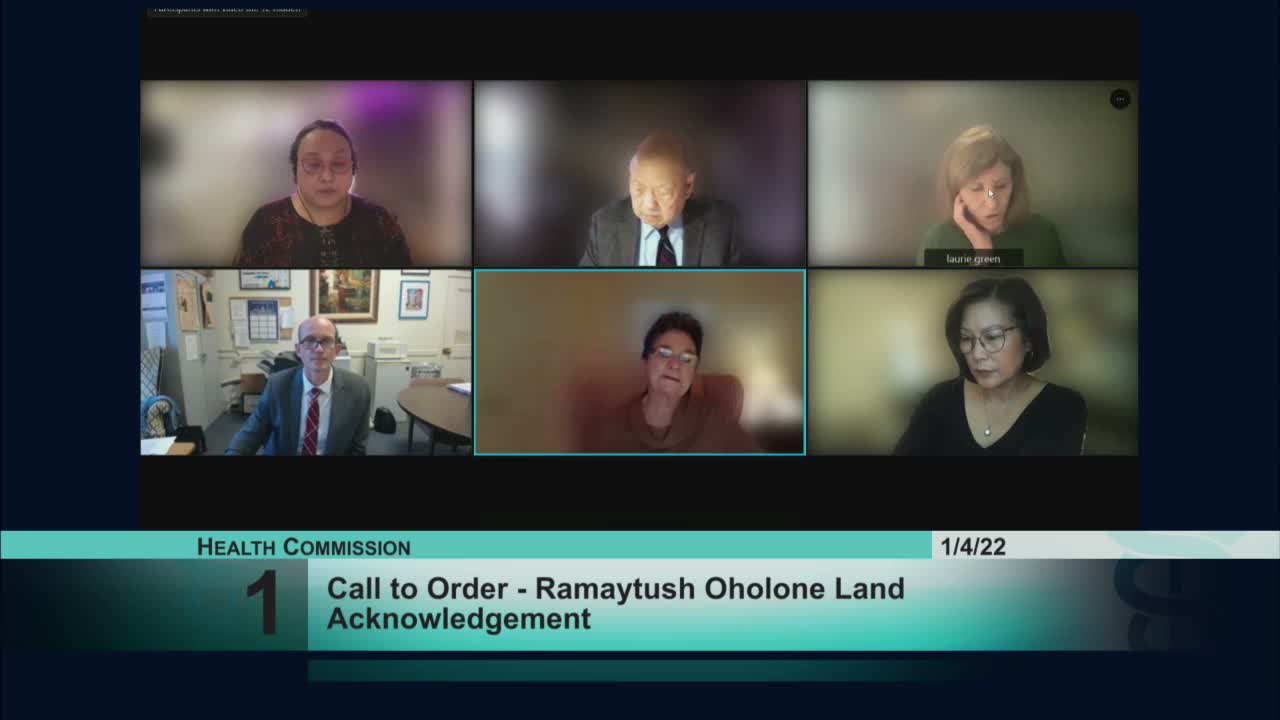
The San Francisco Health Commission voted unanimously to adopt a resolution directing the Department of Public Health (DPH) to work with local American Indian and Alaska Native organizations to identify public‑health priorities, improve data collection, and report back within six months and again at one year.
The resolution, presented by Secretary Morwitz and discussed at the Commission’s meeting, calls for DPH to include accurate, disaggregated American Indian and Alaska Native race and ethnicity categories where possible and to add a footnote to any race/ethnicity tables explaining limitations caused by small sample sizes. It notes longstanding disparities — higher rates of diabetes, heart disease, suicide, homelessness and COVID‑19 mortality — and cites the San Francisco Human Rights Commission’s 2007 report on discrimination against Native Americans in the city.
Community leaders who participated in the public comment period urged commissioners to move beyond symbolic language. "American Indians have some of the highest health disparity rates with diabetes, with COVID, with suicide...we haven't seen this reflected in our policy changes," said Sheree Fuza, executive director of the American Indian Cultural District, who called the resolution an important step and asked the Commission to ensure funding and policy follow‑through.
Mary Travis Allen, advisory board president for the American Indian Cultural District, called the resolution "a modern day promise and treaty" and urged commissioners not to leave the measure as "words on paper." April McGill, executive director of the American Indian Cultural Center and a cofounder of the American Indian Cultural District, thanked the Commission and named partner organizations including the California Consortium for Urban Indian Health, Friendship House and the Native American Health Center.
Commissioners praised the resolution and the community input used to draft it. Commissioner Chung referenced prior Human Rights Commission hearings and said it is "heartening" to see the issue being addressed. After discussion the Commission took a roll‑call vote; all members present voted yes and the resolution passed.
The resolution directs DPH to "establish meaningful and ongoing partnerships" with local tribal and Native organizations, include disaggregated Native data and related public reporting where feasible, add explanatory footnotes to race/ethnicity reporting when data are insufficient, and present an update to the Commission within six months along with a summary report in one year. The Commission did not appropriate new funds as part of the vote; implementation planning and any resulting budget requests will be part of DPH’s follow‑up reporting.
The most recent step is the Commission’s formal adoption; DPH staff and community partners will now begin the outreach, data work and internal planning specified in the resolution.
The resolution, presented by Secretary Morwitz and discussed at the Commission’s meeting, calls for DPH to include accurate, disaggregated American Indian and Alaska Native race and ethnicity categories where possible and to add a footnote to any race/ethnicity tables explaining limitations caused by small sample sizes. It notes longstanding disparities — higher rates of diabetes, heart disease, suicide, homelessness and COVID‑19 mortality — and cites the San Francisco Human Rights Commission’s 2007 report on discrimination against Native Americans in the city.
Community leaders who participated in the public comment period urged commissioners to move beyond symbolic language. "American Indians have some of the highest health disparity rates with diabetes, with COVID, with suicide...we haven't seen this reflected in our policy changes," said Sheree Fuza, executive director of the American Indian Cultural District, who called the resolution an important step and asked the Commission to ensure funding and policy follow‑through.
Mary Travis Allen, advisory board president for the American Indian Cultural District, called the resolution "a modern day promise and treaty" and urged commissioners not to leave the measure as "words on paper." April McGill, executive director of the American Indian Cultural Center and a cofounder of the American Indian Cultural District, thanked the Commission and named partner organizations including the California Consortium for Urban Indian Health, Friendship House and the Native American Health Center.
Commissioners praised the resolution and the community input used to draft it. Commissioner Chung referenced prior Human Rights Commission hearings and said it is "heartening" to see the issue being addressed. After discussion the Commission took a roll‑call vote; all members present voted yes and the resolution passed.
The resolution directs DPH to "establish meaningful and ongoing partnerships" with local tribal and Native organizations, include disaggregated Native data and related public reporting where feasible, add explanatory footnotes to race/ethnicity reporting when data are insufficient, and present an update to the Commission within six months along with a summary report in one year. The Commission did not appropriate new funds as part of the vote; implementation planning and any resulting budget requests will be part of DPH’s follow‑up reporting.
The most recent step is the Commission’s formal adoption; DPH staff and community partners will now begin the outreach, data work and internal planning specified in the resolution.
Don't Miss a Word: See the Full Meeting!
Go beyond summaries. Unlock every video, transcript, and key insight with a Founder Membership.
✓
Get instant access to full meeting videos
✓
Search and clip any phrase from complete transcripts
✓
Receive AI-powered summaries & custom alerts
✓
Enjoy lifetime, unrestricted access to government data
30-day money-back guarantee
