San Francisco Health Commission: COVID cases fall as Health Network outlines CalAIM rollout
March 15, 2022 | San Francisco City, San Francisco County, California
This article was created by AI summarizing key points discussed. AI makes mistakes, so for full details and context, please refer to the video of the full meeting. Please report any errors so we can fix them. Report an error »
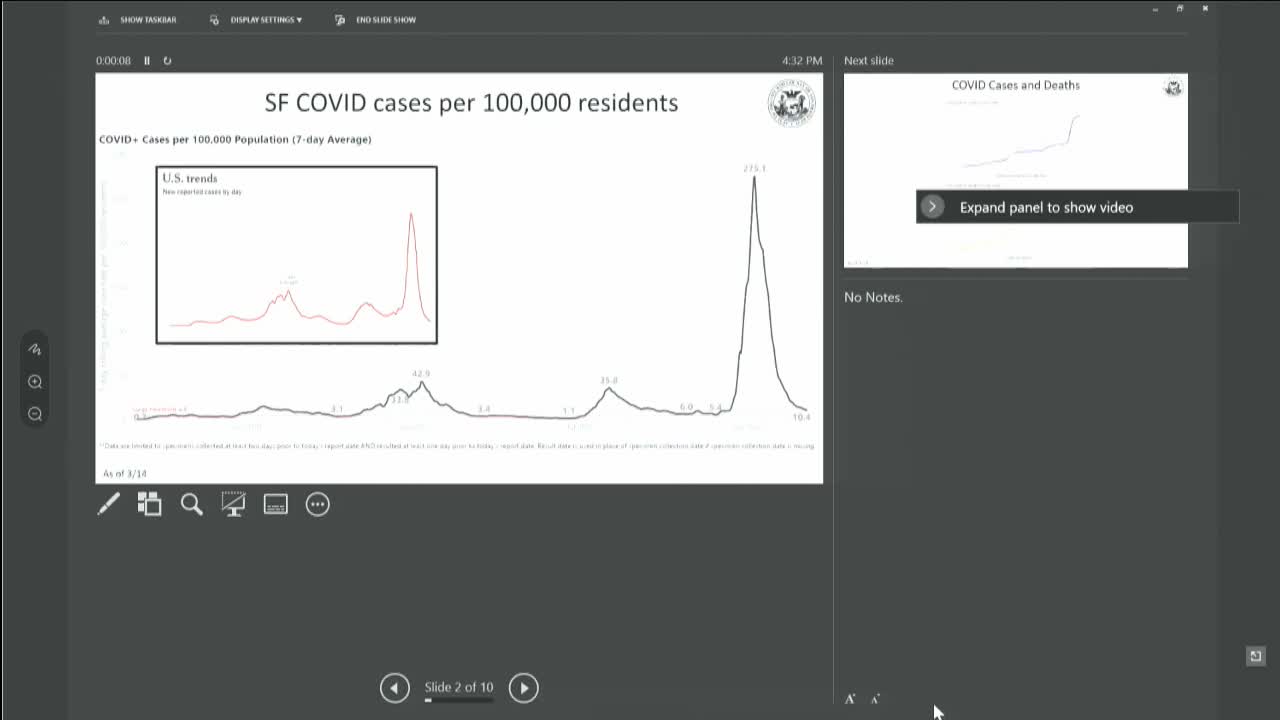
Director of Health Grant Colfax told the San Francisco Health Commission on March 15 that COVID-19 cases and hospitalizations have declined sharply since the Omicron surge, reporting a current case rate of 10.4 per 100,000 residents and citing a cumulative case count the presentation described as “over a hundred and 22,000.” Colfax said hospitals across the city reported 46 people with COVID-19 and nine patients in intensive care as of March 11, and he extended condolences to the 827 people the presentation listed as COVID-related deaths.
Colfax also said San Francisco’s vaccine and booster coverage remain higher than state and national averages but that the city’s 65% booster rate had plateaued; he urged eligible residents to get boosters and noted continuing alignment with state public‑health orders (as of March 11, indoor businesses no longer required proof of vaccination or negative tests, though masking was still recommended).
Roland Pickens, director of the San Francisco Health Network, presented a winter 2022 status report on the network’s recovery and strategic planning. Pickens said many performance measures were deferred during the pandemic but that leadership resumed strategic planning in late 2021 and will adopt revised True North metrics effective July 1 for fiscal year 2022–23. He described LEAN management as the network’s framework for reestablishing operational goals and tracking outcomes.
Pickens and Chief Medical Officer Dr. Claire Horton described the county’s early implementation of CalAIM, the state Medi‑Cal initiative. They said enhanced care management had been launched and that the network was actively engaging patients (the presentation noted about 139 patients being actively engaged or triaged into these teams). Community supports — including medical respite and sobering‑center reimbursement, which the presenters said Medi‑Cal will now cover — are planned to scale in July. Horton said the program will expand populations served over the coming year to include justice‑involved people and patients discharged to long‑term care where applicable.
Pickens summarized operational lessons from the pandemic at system facilities: Zuckerberg San Francisco General and Laguna Honda faced deferred performance metrics but also made targeted gains (for example, process changes that saved exam room hours at urgent care). He said ambulatory clinics shifted heavily to telehealth during the response and that staffing vacancies remain a constraint as some staff did not return after disaster‑service deployments. Pickens said network HR will prioritize filling vacancies so services can return to pre‑pandemic levels.
Commissioners pressed for specific, measurable progress indicators tied to CalAIM. Pickens and Horton said the network will align local True North metrics with CalAIM reporting goals where appropriate (examples cited included enrollment in enhanced care management, housing sustainment for people placed via housing navigation, utilization measures that reflect reductions in avoidable emergency care, and follow‑up after behavioral‑health emergency visits). They said those metrics will be part of the network’s performance dashboard going forward.
The commission did not take a formal action on CalAIM at this meeting; staff said they will report back with implementation details and updated performance metrics.
Sources: presentation and Q&A during the San Francisco Health Commission hybrid meeting, March 15, 2022.
Colfax also said San Francisco’s vaccine and booster coverage remain higher than state and national averages but that the city’s 65% booster rate had plateaued; he urged eligible residents to get boosters and noted continuing alignment with state public‑health orders (as of March 11, indoor businesses no longer required proof of vaccination or negative tests, though masking was still recommended).
Roland Pickens, director of the San Francisco Health Network, presented a winter 2022 status report on the network’s recovery and strategic planning. Pickens said many performance measures were deferred during the pandemic but that leadership resumed strategic planning in late 2021 and will adopt revised True North metrics effective July 1 for fiscal year 2022–23. He described LEAN management as the network’s framework for reestablishing operational goals and tracking outcomes.
Pickens and Chief Medical Officer Dr. Claire Horton described the county’s early implementation of CalAIM, the state Medi‑Cal initiative. They said enhanced care management had been launched and that the network was actively engaging patients (the presentation noted about 139 patients being actively engaged or triaged into these teams). Community supports — including medical respite and sobering‑center reimbursement, which the presenters said Medi‑Cal will now cover — are planned to scale in July. Horton said the program will expand populations served over the coming year to include justice‑involved people and patients discharged to long‑term care where applicable.
Pickens summarized operational lessons from the pandemic at system facilities: Zuckerberg San Francisco General and Laguna Honda faced deferred performance metrics but also made targeted gains (for example, process changes that saved exam room hours at urgent care). He said ambulatory clinics shifted heavily to telehealth during the response and that staffing vacancies remain a constraint as some staff did not return after disaster‑service deployments. Pickens said network HR will prioritize filling vacancies so services can return to pre‑pandemic levels.
Commissioners pressed for specific, measurable progress indicators tied to CalAIM. Pickens and Horton said the network will align local True North metrics with CalAIM reporting goals where appropriate (examples cited included enrollment in enhanced care management, housing sustainment for people placed via housing navigation, utilization measures that reflect reductions in avoidable emergency care, and follow‑up after behavioral‑health emergency visits). They said those metrics will be part of the network’s performance dashboard going forward.
The commission did not take a formal action on CalAIM at this meeting; staff said they will report back with implementation details and updated performance metrics.
Sources: presentation and Q&A during the San Francisco Health Commission hybrid meeting, March 15, 2022.
Don't Miss a Word: See the Full Meeting!
Go beyond summaries. Unlock every video, transcript, and key insight with a Founder Membership.
✓
Get instant access to full meeting videos
✓
Search and clip any phrase from complete transcripts
✓
Receive AI-powered summaries & custom alerts
✓
Enjoy lifetime, unrestricted access to government data
30-day money-back guarantee
