San Francisco says monkeypox cases concentrated in men aged 25–54 and vaccine supply lags demand
July 19, 2022 | San Francisco City, San Francisco County, California
This article was created by AI summarizing key points discussed. AI makes mistakes, so for full details and context, please refer to the video of the full meeting. Please report any errors so we can fix them. Report an error »
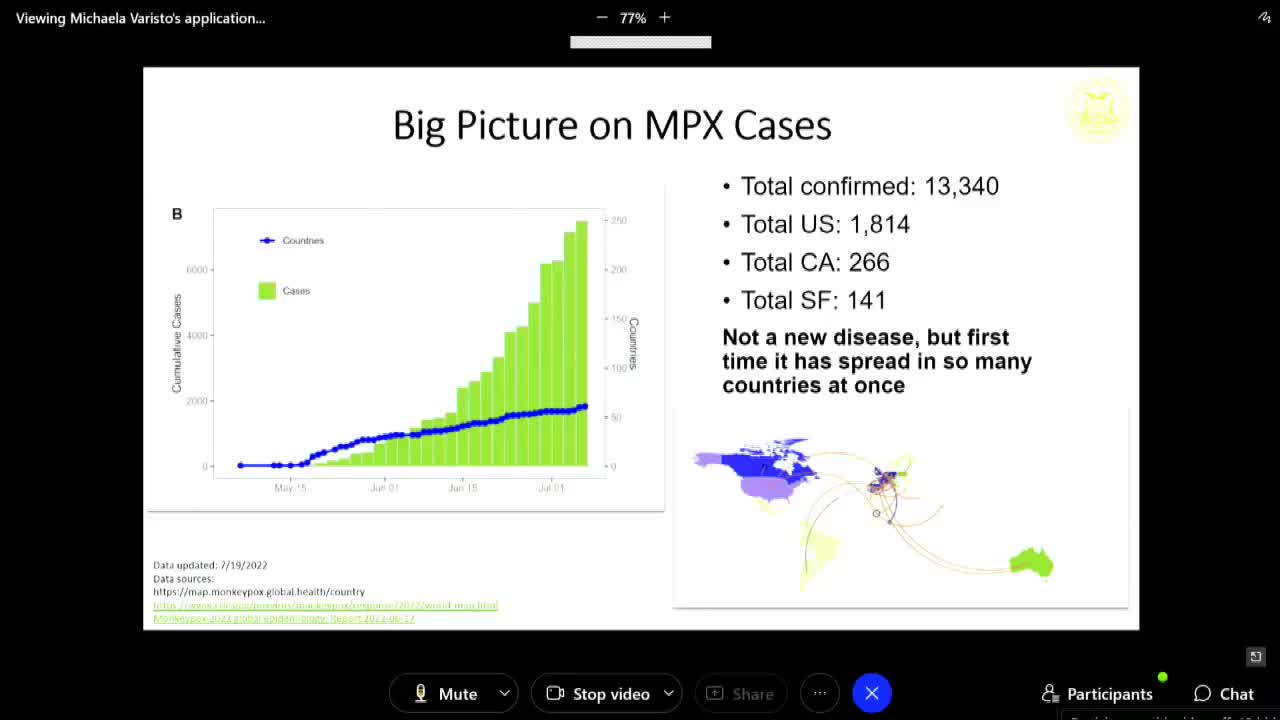
San Francisco Department of Public Health officials reported an expanding monkeypox outbreak and a shortage of vaccine supply during a July 19 Health Commission presentation.
Dr. Susan Philip said the city had identified 141 cases among residents (data snapshot) and that the demographic breakdown shows the outbreak is concentrated in people aged 25–54 and overwhelmingly among people who identify as male and gay, lesbian or same‑gender‑loving in the available dataset. City investigators presented a partial demographic sample (86 cases as of the previous Friday) to illustrate disparities by age, gender and race/ethnicity.
Vaccine supply remains the constraining factor. Colfax and Dr. Philip said San Francisco has requested 35,000 JYNNEOS doses to meet apparent need; to date the department had received about 7,000 total doses and had pushed roughly 95 percent of those to clinics and community partners. Dr. Philip summarized the supply and prioritization challenge: “What we have received, as of last week was about 3,600 doses, and then just today we have received our newest allocation, which is 4,163 doses. So overall … we have received about 7,000 doses.”
Testing capacity has increased: the public health laboratory and national labs (LabCorp, Quest) returned testing capability and the city lab reached a capacity of roughly 188 specimens per day, improving turnaround from up to seven days to a matter of days for many patients. Treatment options are limited; tecovirimat (TPOXX) is available only under investigational protocols and through a few providers, and is prioritized for the most severe cases.
Officials outlined an equity‑focused vaccination strategy that prioritizes gay, bisexual and other men who have sex with men, transgender persons and people working in venues with increased risk, and described a mix of appointment‑based, drop‑in and pop‑up clinics and strong partnerships with community organizations such as the San Francisco AIDS Foundation. Dr. Philip said the city reserved doses for high‑risk contacts, pregnant people and children who may be exposed.
The department urged people at risk to seek vaccination if eligible and underscored outreach efforts including translation of toolkits into Spanish, Chinese and Filipino and targeted media in affected neighborhoods. No changes to eligibility rules beyond the announced expansion were voted on by the commission at the hearing.
Dr. Susan Philip said the city had identified 141 cases among residents (data snapshot) and that the demographic breakdown shows the outbreak is concentrated in people aged 25–54 and overwhelmingly among people who identify as male and gay, lesbian or same‑gender‑loving in the available dataset. City investigators presented a partial demographic sample (86 cases as of the previous Friday) to illustrate disparities by age, gender and race/ethnicity.
Vaccine supply remains the constraining factor. Colfax and Dr. Philip said San Francisco has requested 35,000 JYNNEOS doses to meet apparent need; to date the department had received about 7,000 total doses and had pushed roughly 95 percent of those to clinics and community partners. Dr. Philip summarized the supply and prioritization challenge: “What we have received, as of last week was about 3,600 doses, and then just today we have received our newest allocation, which is 4,163 doses. So overall … we have received about 7,000 doses.”
Testing capacity has increased: the public health laboratory and national labs (LabCorp, Quest) returned testing capability and the city lab reached a capacity of roughly 188 specimens per day, improving turnaround from up to seven days to a matter of days for many patients. Treatment options are limited; tecovirimat (TPOXX) is available only under investigational protocols and through a few providers, and is prioritized for the most severe cases.
Officials outlined an equity‑focused vaccination strategy that prioritizes gay, bisexual and other men who have sex with men, transgender persons and people working in venues with increased risk, and described a mix of appointment‑based, drop‑in and pop‑up clinics and strong partnerships with community organizations such as the San Francisco AIDS Foundation. Dr. Philip said the city reserved doses for high‑risk contacts, pregnant people and children who may be exposed.
The department urged people at risk to seek vaccination if eligible and underscored outreach efforts including translation of toolkits into Spanish, Chinese and Filipino and targeted media in affected neighborhoods. No changes to eligibility rules beyond the announced expansion were voted on by the commission at the hearing.
Don't Miss a Word: See the Full Meeting!
Go beyond summaries. Unlock every video, transcript, and key insight with a Founder Membership.
✓
Get instant access to full meeting videos
✓
Search and clip any phrase from complete transcripts
✓
Receive AI-powered summaries & custom alerts
✓
Enjoy lifetime, unrestricted access to government data
30-day money-back guarantee
