Laguna Honda closure plan and CMS recertification briefed as community warns transfers risk patient harm
July 19, 2022 | San Francisco City, San Francisco County, California
This article was created by AI summarizing key points discussed. AI makes mistakes, so for full details and context, please refer to the video of the full meeting. Please report any errors so we can fix them. Report an error »
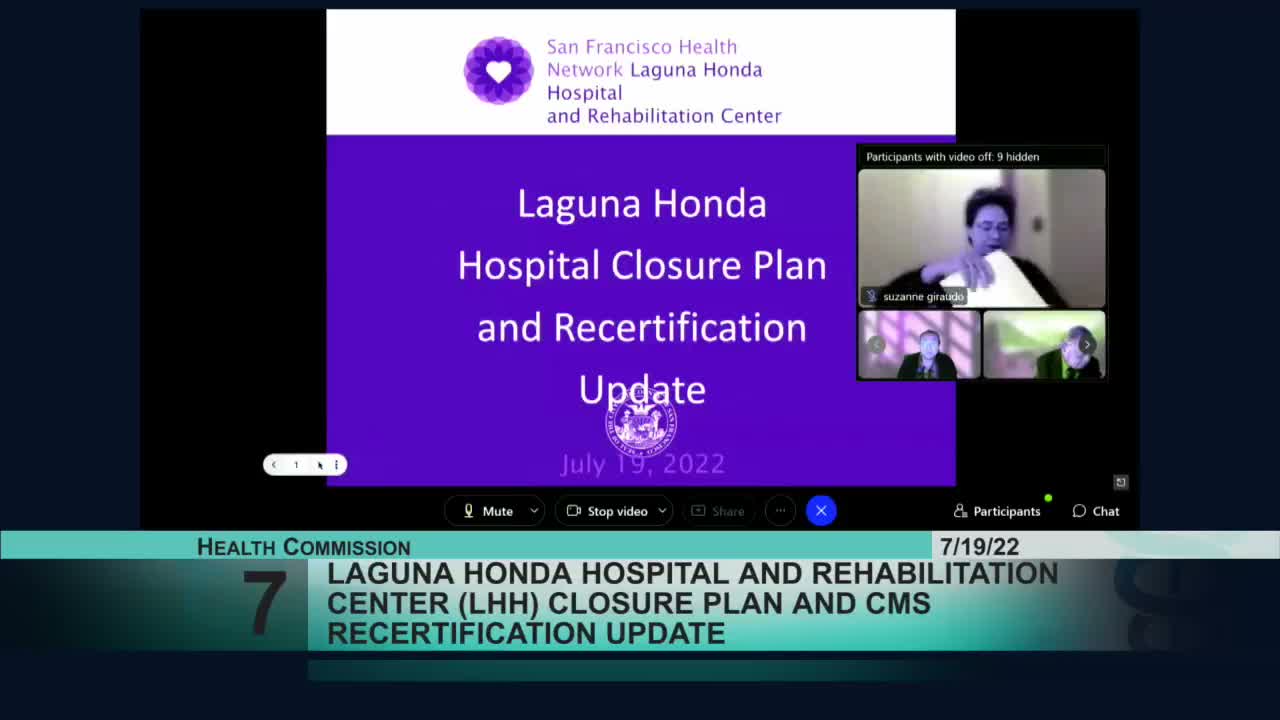
Laguna Honda Hospital and Rehabilitation Center leaders updated the Health Commission on July 19 about the facility’s closure plan required after Centers for Medicare and Medicaid Services (CMS) ended Laguna Honda’s participation and on progress toward CMS recertification.
Baljeet Sanghai, acting as incident commander for recertification efforts, and Dr. Wilmy Hathaway, chief medical officer, told the commission CMS terminated Laguna Honda’s participation effective April 14, 2022. Dr. Hathaway said the CMS and California Department of Public Health (CDPH)‑approved closure and transfer plan was submitted and approved on May 13, which enabled reimbursement through mid‑September while the hospital implements the plan. “Centers for Medicare and Medicaid Services or CMS ended Laguna Honda's participation on April fourteenth of this year. These programs pay for nearly all patient care at Laguna Honda, nearly $550,000 per day,” Dr. Hathaway said.
Presenters reviewed a four‑step closure process (notification, patient care management, closure operations, and placement), daily outreach and assessment efforts and a public dashboard that tracks census, assessments, referrals, meetings and transfers. They reported the unit census and case metrics and said teams made thousands of calls to identify placements; to date the facility had transferred 35 patients to skilled nursing facilities (1 in San Francisco, 3 in Alameda and 31 in San Mateo) and discharged other residents to community placements when appropriate.
Officials described mock surveys and corrective actions: Laguna Honda completed a first mock survey in late June and identified infection‑control, resident‑rights and freedom‑from‑abuse issues that require corrective actions, additional training, infection prevention reviews with consultants, and system‑level changes. A major compliance requirement—federal regulations limiting bedrooms to no more than two residents—will force conversion of three‑person rooms to two‑person rooms and reduce Laguna Honda’s licensed bed count by 120 (the acute care beds were not impacted). Presenters said residents would be moved within Laguna Honda where possible to meet the rule.
Public comment after the presentation was extensive and strongly critical of transfers. Family members, clinicians and advocates described transfers to out‑of‑county facilities and even shelters, reported at least three deaths of residents after transfer, and called the transfers forced rather than voluntary. Joseph Urban, a consultant and petition organizer, warned that the “means are killing people” under the current relocation plan and urged the city to press CMS to decouple recertification from relocation requirements. Frontline nurses and representatives of Senior and Disability Action, Grey Panthers and others urged the commission to halt transfers, to publish post‑transfer outcomes on the dashboard (including post‑discharge deaths), to seek waivers to preserve beds and to assume payment if CMS discontinues reimbursement for a safe transition period.
Laguna Honda leadership said transfers and discharges are being handled with resident assessments, family meetings and the state appeals process available for patients who wish to appeal discharge decisions. The commission scheduled continued reporting on closure and recertification progress at subsequent meetings.
Baljeet Sanghai, acting as incident commander for recertification efforts, and Dr. Wilmy Hathaway, chief medical officer, told the commission CMS terminated Laguna Honda’s participation effective April 14, 2022. Dr. Hathaway said the CMS and California Department of Public Health (CDPH)‑approved closure and transfer plan was submitted and approved on May 13, which enabled reimbursement through mid‑September while the hospital implements the plan. “Centers for Medicare and Medicaid Services or CMS ended Laguna Honda's participation on April fourteenth of this year. These programs pay for nearly all patient care at Laguna Honda, nearly $550,000 per day,” Dr. Hathaway said.
Presenters reviewed a four‑step closure process (notification, patient care management, closure operations, and placement), daily outreach and assessment efforts and a public dashboard that tracks census, assessments, referrals, meetings and transfers. They reported the unit census and case metrics and said teams made thousands of calls to identify placements; to date the facility had transferred 35 patients to skilled nursing facilities (1 in San Francisco, 3 in Alameda and 31 in San Mateo) and discharged other residents to community placements when appropriate.
Officials described mock surveys and corrective actions: Laguna Honda completed a first mock survey in late June and identified infection‑control, resident‑rights and freedom‑from‑abuse issues that require corrective actions, additional training, infection prevention reviews with consultants, and system‑level changes. A major compliance requirement—federal regulations limiting bedrooms to no more than two residents—will force conversion of three‑person rooms to two‑person rooms and reduce Laguna Honda’s licensed bed count by 120 (the acute care beds were not impacted). Presenters said residents would be moved within Laguna Honda where possible to meet the rule.
Public comment after the presentation was extensive and strongly critical of transfers. Family members, clinicians and advocates described transfers to out‑of‑county facilities and even shelters, reported at least three deaths of residents after transfer, and called the transfers forced rather than voluntary. Joseph Urban, a consultant and petition organizer, warned that the “means are killing people” under the current relocation plan and urged the city to press CMS to decouple recertification from relocation requirements. Frontline nurses and representatives of Senior and Disability Action, Grey Panthers and others urged the commission to halt transfers, to publish post‑transfer outcomes on the dashboard (including post‑discharge deaths), to seek waivers to preserve beds and to assume payment if CMS discontinues reimbursement for a safe transition period.
Laguna Honda leadership said transfers and discharges are being handled with resident assessments, family meetings and the state appeals process available for patients who wish to appeal discharge decisions. The commission scheduled continued reporting on closure and recertification progress at subsequent meetings.
Don't Miss a Word: See the Full Meeting!
Go beyond summaries. Unlock every video, transcript, and key insight with a Founder Membership.
✓
Get instant access to full meeting videos
✓
Search and clip any phrase from complete transcripts
✓
Receive AI-powered summaries & custom alerts
✓
Enjoy lifetime, unrestricted access to government data
30-day money-back guarantee
