Health Commission urged to act as Laguna Honda recertification proceeds and callers demand Prop Q hearing
April 04, 2023 | San Francisco City, San Francisco County, California
This article was created by AI summarizing key points discussed. AI makes mistakes, so for full details and context, please refer to the video of the full meeting. Please report any errors so we can fix them. Report an error »
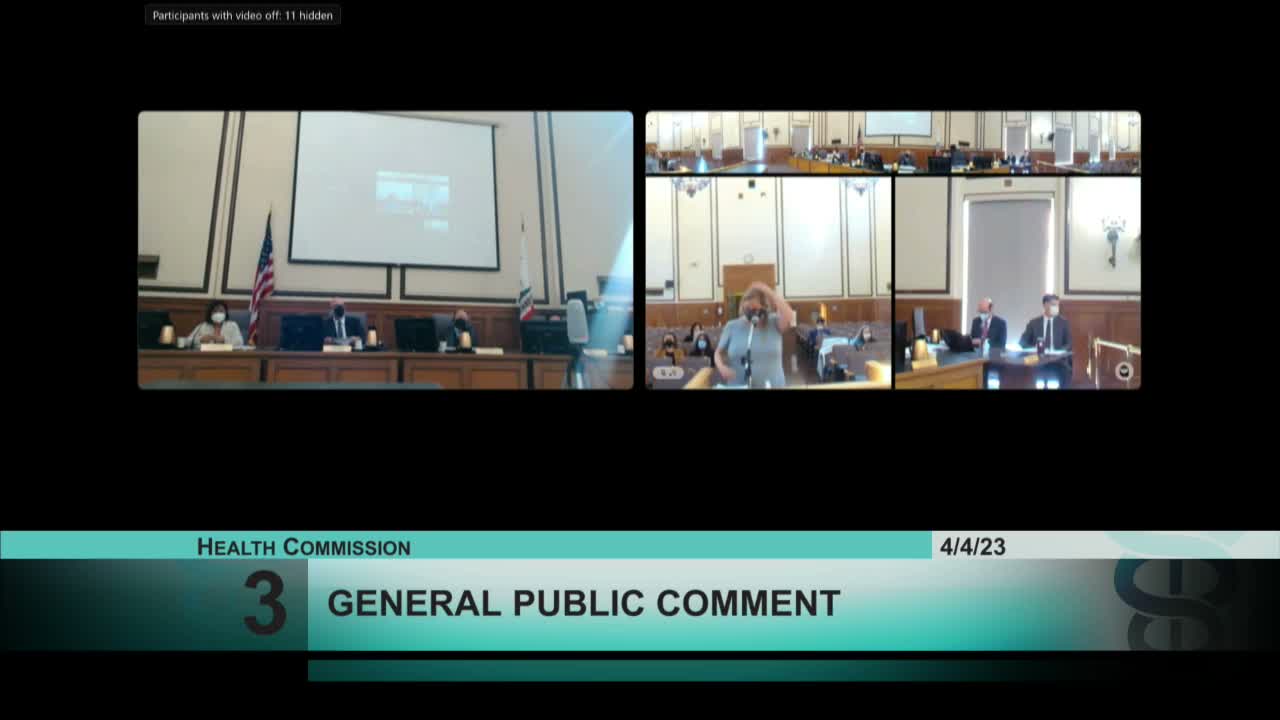
Public commenters and clinicians asked the San Francisco Health Commission on Tuesday to press hospitals and city leaders to restore hospital-based warm-water therapeutic programs and to schedule a Proposition Q hearing on service closures.
"The warm water exercise program was the best medicine I could ever have," said Billie Jean Wall, a longtime participant, who described worsening mobility, increased procedures and more frequent pain since the program stopped. Colette Hughes and other callers made similar appeals, saying aquatic therapy at hospital-based pools had provided medically supervised rehabilitation for elders and people with disabilities and should not be dropped for budgetary reasons.
Director of Health Grant Colfax told commissioners the Department of Public Health remains "fully committed to CMS recertification and the long-term stability of Laguna Honda," and that DPH will continue to complete required action-plan milestones before applying for recertification. Colfax said the department had seen a marked reduction in deficiencies between a first and second 90-day monitoring survey but acknowledged more work is needed.
Colfax also gave a timeline update: DPH has not received approval of the facility's closure plan from CMS and the state, and he said the earliest transfers from Laguna Honda would not resume before May 19. That pause, he said, means the department is not currently able to transfer residents from Laguna Honda until an approved closure plan exists.
Members of the public tied the pool closures to broader concerns about post-acute care capacity. "These are low cost services that are needed by the community," said one clinician caller urging the Commission to schedule a Prop Q hearing. Several callers alleged that hospital operators were reducing therapeutic programs for financial reasons; Director Colfax and staff did not adopt that characterization but said they would continue seeking clarity and appropriate remedies.
Commissioners asked staff for follow-up: they requested clearer documentation on why pools and programs were closed, and for staff to provide options for a Prop Q hearing or other public process that would allow deeper review. The Commission also urged DPH to continue pressing CMS and state partners for an expedited review of Laguna Honda's closure plan and recertification steps so residents and families could be informed as soon as possible.
The meeting record shows strong public concern about the community consequences of reduced therapeutic and nursing capacity and a departmental commitment to finish regulatory milestones before resuming transfers.
What happens next: DPH will continue work on action-plan milestones, seek clarity from CMS and the state about the closure plan approval, and return with updates requested by commissioners; members of the public asked the Commission to schedule a Prop Q hearing to examine decisions that affected hospital-based aquatic therapy programs.
"The warm water exercise program was the best medicine I could ever have," said Billie Jean Wall, a longtime participant, who described worsening mobility, increased procedures and more frequent pain since the program stopped. Colette Hughes and other callers made similar appeals, saying aquatic therapy at hospital-based pools had provided medically supervised rehabilitation for elders and people with disabilities and should not be dropped for budgetary reasons.
Director of Health Grant Colfax told commissioners the Department of Public Health remains "fully committed to CMS recertification and the long-term stability of Laguna Honda," and that DPH will continue to complete required action-plan milestones before applying for recertification. Colfax said the department had seen a marked reduction in deficiencies between a first and second 90-day monitoring survey but acknowledged more work is needed.
Colfax also gave a timeline update: DPH has not received approval of the facility's closure plan from CMS and the state, and he said the earliest transfers from Laguna Honda would not resume before May 19. That pause, he said, means the department is not currently able to transfer residents from Laguna Honda until an approved closure plan exists.
Members of the public tied the pool closures to broader concerns about post-acute care capacity. "These are low cost services that are needed by the community," said one clinician caller urging the Commission to schedule a Prop Q hearing. Several callers alleged that hospital operators were reducing therapeutic programs for financial reasons; Director Colfax and staff did not adopt that characterization but said they would continue seeking clarity and appropriate remedies.
Commissioners asked staff for follow-up: they requested clearer documentation on why pools and programs were closed, and for staff to provide options for a Prop Q hearing or other public process that would allow deeper review. The Commission also urged DPH to continue pressing CMS and state partners for an expedited review of Laguna Honda's closure plan and recertification steps so residents and families could be informed as soon as possible.
The meeting record shows strong public concern about the community consequences of reduced therapeutic and nursing capacity and a departmental commitment to finish regulatory milestones before resuming transfers.
What happens next: DPH will continue work on action-plan milestones, seek clarity from CMS and the state about the closure plan approval, and return with updates requested by commissioners; members of the public asked the Commission to schedule a Prop Q hearing to examine decisions that affected hospital-based aquatic therapy programs.
View the Full Meeting & All Its Details
This article offers just a summary. Unlock complete video, transcripts, and insights as a Founder Member.
✓
Watch full, unedited meeting videos
✓
Search every word spoken in unlimited transcripts
✓
AI summaries & real-time alerts (all government levels)
✓
Permanent access to expanding government content
30-day money-back guarantee
