Mayor�s Office on Disability explains 'first access' for remote commenters; some members of public say the system discourages participation
May 16, 2023 | San Francisco City, San Francisco County, California
This article was created by AI summarizing key points discussed. AI makes mistakes, so for full details and context, please refer to the video of the full meeting. Please report any errors so we can fix them. Report an error »
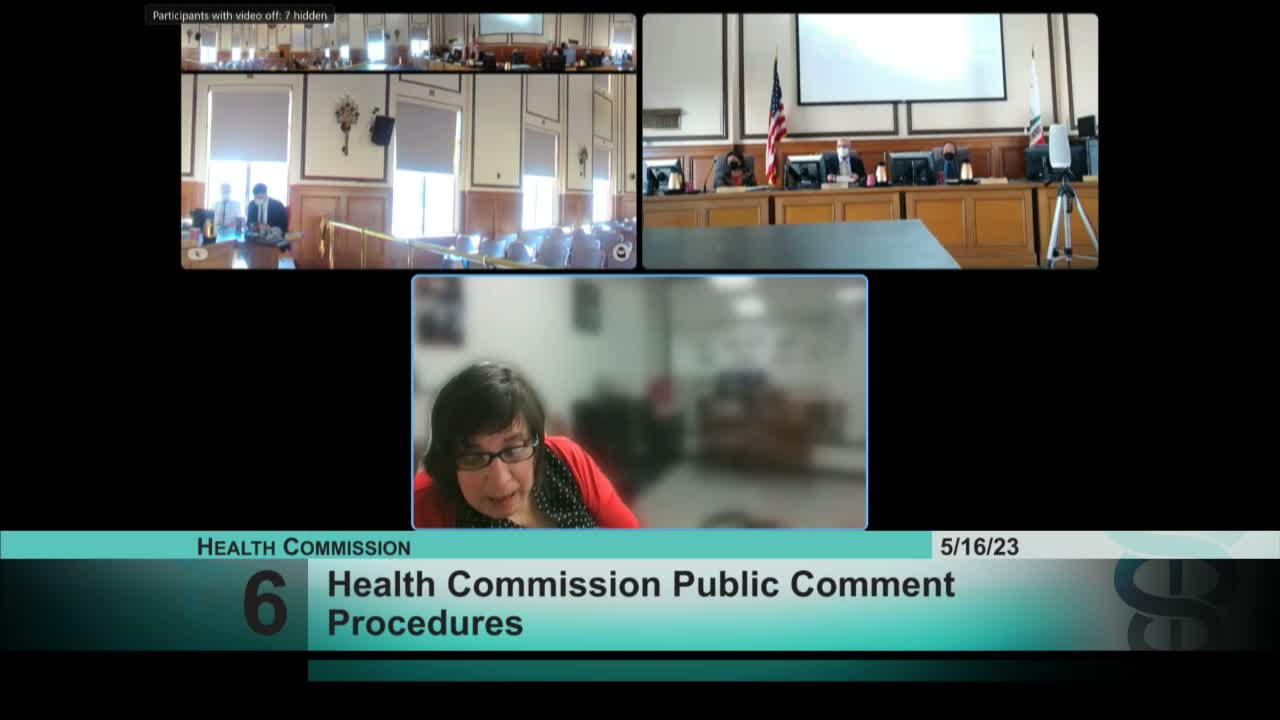
Nicole Vaughn, director of the Mayors Office on Disability, spoke to the Health Commission on May 16 about guidance the city has circulated for remote public comment intended to expand access for people with disabilities.
Vaughn said the guidance requires commissions to provide a process by which people with disabilities can participate and that the goal is to make public meetings usable and accessible. "There's been talk and concern ... that the request to have persons with disabilities participate first ... is somehow not something we want to be promoting," she said, adding that "when we are talking about disability and having folks with disabilities identify that they would like to provide comment ... it is okay to identify as a person with a disability." Vaughn also described alternative language such as "first access" or "priority access" to reduce stigma.
Public commenters voiced concern that the three-tiered queue (priority access for people with disabilities, a limited remote time window for general public comment, and an in-person queue) had reduced participation. One frequent commenter said requiring people to self-identify as disabled puts an unfair public label on them and urged the commission to standardize processes across boards. A clinician said the tiered approach has had a chilling effect and recommended encouraging but not requiring identification for accommodations.
Vaughn told commissioners that the guidance was developed in consultation with disability advocates, city counsel and commission secretaries and that practices vary by commission. She said some commissions have chosen no time limits for general public comment while others have chosen 10, 15 or 20 minutes as a practical starting point. The mayors office recommended that requests for accommodation be taken at face value and accommodated whenever possible.
Commissioners discussed whether different wording or larger public outreach could reduce confusion and minimize perceived tiers. Several commissioners thanked the mayors office for the presentation and noted that the policy is iterative and could be adjusted if inequities are identified.
What happens next: The Health Commission will continue to implement remote-comment procedures with attention to accessibility, consider alternate wording such as "first access" and monitor whether the practice discourages participation; broader standardization across city bodies was urged by several public commenters.
Vaughn said the guidance requires commissions to provide a process by which people with disabilities can participate and that the goal is to make public meetings usable and accessible. "There's been talk and concern ... that the request to have persons with disabilities participate first ... is somehow not something we want to be promoting," she said, adding that "when we are talking about disability and having folks with disabilities identify that they would like to provide comment ... it is okay to identify as a person with a disability." Vaughn also described alternative language such as "first access" or "priority access" to reduce stigma.
Public commenters voiced concern that the three-tiered queue (priority access for people with disabilities, a limited remote time window for general public comment, and an in-person queue) had reduced participation. One frequent commenter said requiring people to self-identify as disabled puts an unfair public label on them and urged the commission to standardize processes across boards. A clinician said the tiered approach has had a chilling effect and recommended encouraging but not requiring identification for accommodations.
Vaughn told commissioners that the guidance was developed in consultation with disability advocates, city counsel and commission secretaries and that practices vary by commission. She said some commissions have chosen no time limits for general public comment while others have chosen 10, 15 or 20 minutes as a practical starting point. The mayors office recommended that requests for accommodation be taken at face value and accommodated whenever possible.
Commissioners discussed whether different wording or larger public outreach could reduce confusion and minimize perceived tiers. Several commissioners thanked the mayors office for the presentation and noted that the policy is iterative and could be adjusted if inequities are identified.
What happens next: The Health Commission will continue to implement remote-comment procedures with attention to accessibility, consider alternate wording such as "first access" and monitor whether the practice discourages participation; broader standardization across city bodies was urged by several public commenters.
View the Full Meeting & All Its Details
This article offers just a summary. Unlock complete video, transcripts, and insights as a Founder Member.
✓
Watch full, unedited meeting videos
✓
Search every word spoken in unlimited transcripts
✓
AI summaries & real-time alerts (all government levels)
✓
Permanent access to expanding government content
30-day money-back guarantee
