Health Commission approves DPH plan to submit $100M two‑year savings proposal to mayor
April 18, 2023 | San Francisco City, San Francisco County, California
This article was created by AI summarizing key points discussed. AI makes mistakes, so for full details and context, please refer to the video of the full meeting. Please report any errors so we can fix them. Report an error »
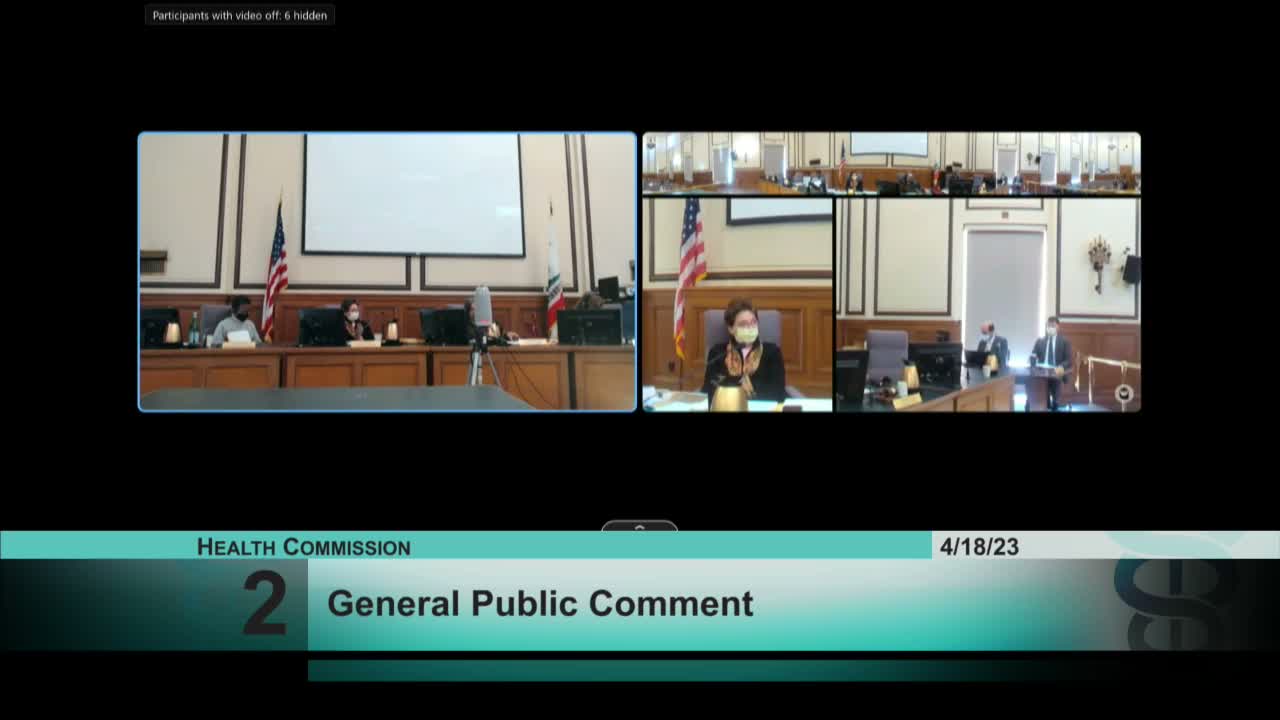
The San Francisco Health Commission on April 18 approved a Department of Public Health (DPH) plan to submit additional budget proposals intended to help close a projected $100 million shortfall over the city’s next two‑year budget cycle. Jenny Louie, DPH chief financial officer, told the commission the department’s updated five‑year forecast showed a $51.5 million deterioration in revenue projections and rising pension and benefit costs, prompting mayoral instructions for a 5% per‑year general‑fund reduction across departments.
Louie summarized the department’s preliminary proposals: roughly $85 million in candidate savings across four categories (stepping down COVID‑19 operating costs, contract realignments, leveraging interest income, and one‑time fund closeouts), targeted ongoing reductions in testing and vaccination contract spending, elimination of temporary surge staffing, and review of vacant positions. She said DPH expects to realize about $20 million in interest income after moving city option funds into the city treasury and identified $7.5 million of current‑year one‑time savings that could be liquidated to help bridge the gap.
Why it matters: City budgets are negotiated on a tight timeline. Louie said the mayor’s office will consider departmental submissions ahead of a June 1 balanced budget proposal and subsequent budget hearings. The reductions and revenue shifts Louie outlined would affect how DPH allocates resources for testing, vaccine distribution and some temporary pandemic support positions, though she repeatedly said the department’s aim is to avoid service cuts and layoffs.
Details and safeguards: Louie said testing demand has dropped sharply (DPH performed about 1,100 tests January–March 2023 vs. roughly 135,000 in the same period a year earlier) and proposed reducing testing contracts by $2 million ongoing (a $3 million reduction from a previous assumption). She estimated eliminating about 14 requested civil‑service FTEs tied to pandemic response, closing several one‑time projects that total about $6.9 million, and realizing $7.2 million from the refuse lien program. Louie said DPH will continue to refine the proposals and return to the commission if any material adjustments are required.
Commission action and next steps: After commissioner questions and a short public‑comment period, a motion to approve submitting the DPH proposals to the Mayor’s Office passed on a voice vote. The department will work with the Mayor’s Office, the controller and Board of Supervisors budget staff as the city prepares a balanced budget and holds hearings in June and July.
What remained unresolved: Louie and commissioners noted several items were contingent on external decisions (for example, whether certain state or federal funding materializes) and that the mayor’s office would make the final determination about use of one‑time funds such as Proposition C. The exact fiscal impact by program and the formal budget language will be developed during the City’s budget process.
Louie summarized the department’s preliminary proposals: roughly $85 million in candidate savings across four categories (stepping down COVID‑19 operating costs, contract realignments, leveraging interest income, and one‑time fund closeouts), targeted ongoing reductions in testing and vaccination contract spending, elimination of temporary surge staffing, and review of vacant positions. She said DPH expects to realize about $20 million in interest income after moving city option funds into the city treasury and identified $7.5 million of current‑year one‑time savings that could be liquidated to help bridge the gap.
Why it matters: City budgets are negotiated on a tight timeline. Louie said the mayor’s office will consider departmental submissions ahead of a June 1 balanced budget proposal and subsequent budget hearings. The reductions and revenue shifts Louie outlined would affect how DPH allocates resources for testing, vaccine distribution and some temporary pandemic support positions, though she repeatedly said the department’s aim is to avoid service cuts and layoffs.
Details and safeguards: Louie said testing demand has dropped sharply (DPH performed about 1,100 tests January–March 2023 vs. roughly 135,000 in the same period a year earlier) and proposed reducing testing contracts by $2 million ongoing (a $3 million reduction from a previous assumption). She estimated eliminating about 14 requested civil‑service FTEs tied to pandemic response, closing several one‑time projects that total about $6.9 million, and realizing $7.2 million from the refuse lien program. Louie said DPH will continue to refine the proposals and return to the commission if any material adjustments are required.
Commission action and next steps: After commissioner questions and a short public‑comment period, a motion to approve submitting the DPH proposals to the Mayor’s Office passed on a voice vote. The department will work with the Mayor’s Office, the controller and Board of Supervisors budget staff as the city prepares a balanced budget and holds hearings in June and July.
What remained unresolved: Louie and commissioners noted several items were contingent on external decisions (for example, whether certain state or federal funding materializes) and that the mayor’s office would make the final determination about use of one‑time funds such as Proposition C. The exact fiscal impact by program and the formal budget language will be developed during the City’s budget process.
Don't Miss a Word: See the Full Meeting!
Go beyond summaries. Unlock every video, transcript, and key insight with a Founder Membership.
✓
Get instant access to full meeting videos
✓
Search and clip any phrase from complete transcripts
✓
Receive AI-powered summaries & custom alerts
✓
Enjoy lifetime, unrestricted access to government data
30-day money-back guarantee
