San Francisco EMS outlines AB 1544 timeline, BLS pilot and plan to cut ambulance diversion and offload delays
July 18, 2023 | San Francisco City, San Francisco County, California
This article was created by AI summarizing key points discussed. AI makes mistakes, so for full details and context, please refer to the video of the full meeting. Please report any errors so we can fix them. Report an error »
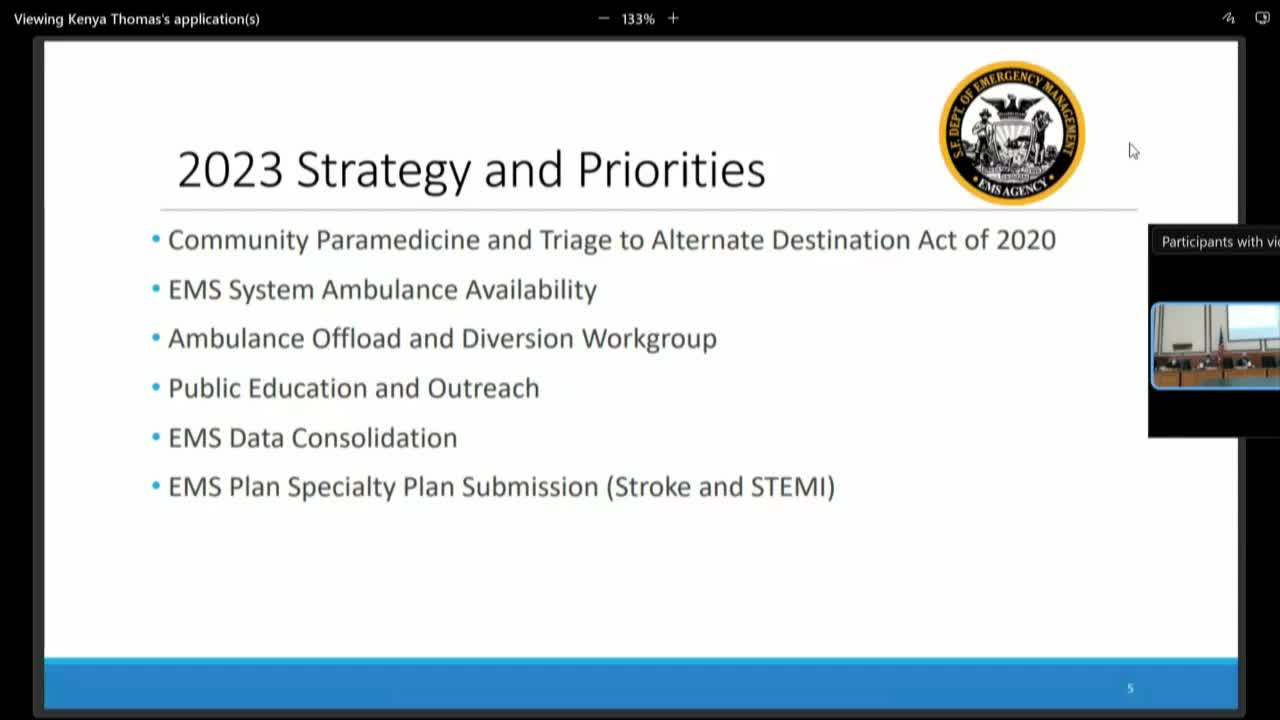
San Francisco EMS Director Andrew Holcomb and Medical Director John Brown presented an operations and quality-improvement update on July 18 that prioritized implementation of AB 1544 (the Community Paramedicine and Triage to Alternate Destination Act), reductions in ambulance diversion, and improved ambulance patient offload times.
Holcomb said the city must finalize regulatory requirements for AB 1544 by October and move several pilot programs — including the Department of Public Health sobering center and Community Paramedicine — into full program implementation, which requires agreements, training and data‑sharing. He identified ambulance availability and patient offload delays as near‑term priorities and flagged work with hospital leaders and the San Francisco Controller’s office on a system review the agency expects to publish this summer.
On diversion metrics, the agency reported a decrease from earlier highs to 37% in May, noting a goal of 30% monthly diversion; Holcomb called the change “progress toward our goal.” The EMS agency also described the ongoing BLS (basic life support) pilot implemented during COVID that adds EMT‑staffed ambulances to increase system capacity. "We've seen that BLS improves ambulance availability and helps with offload delays," Holcomb said, adding that EMT crews are safely managing many calls and that dispatch accuracy for the pilot was high (about 94% of cases did not require escalation to code 3 transport).
Dr. John Brown reviewed quality initiatives including the PulsePoint app to increase bystander CPR and AED use; PulsePoint had roughly 1,000 active users and about 800 registered AED sites in the city as of the briefing. Brown showed CARES registry cardiac-arrest survival metrics, noting San Francisco performs above national averages on some Utstein metrics but aims to increase bystander CPR (city rate below national average) and AED accessibility.
Commissioners asked about barriers to community uptake of CPR training and strategies for hospital collaboration on offload times. Holcomb and Brown emphasized outreach (including website resources and community events), daily data sharing with hospital leaders, and continuing workgroups to implement best practices. The presentation asked the commission to support efforts to reduce diversion and offload delays and flagged potential needs for additional resources for the base-hospital program that provides medical oversight to prehospital care.
Next steps: EMS will complete AB 1544 regulatory submissions, continue the BLS pilot and monitoring, publish controller’s office review when available, expand PulsePoint outreach, and report back to the commission on measured changes to offload delays and response time goals.
Holcomb said the city must finalize regulatory requirements for AB 1544 by October and move several pilot programs — including the Department of Public Health sobering center and Community Paramedicine — into full program implementation, which requires agreements, training and data‑sharing. He identified ambulance availability and patient offload delays as near‑term priorities and flagged work with hospital leaders and the San Francisco Controller’s office on a system review the agency expects to publish this summer.
On diversion metrics, the agency reported a decrease from earlier highs to 37% in May, noting a goal of 30% monthly diversion; Holcomb called the change “progress toward our goal.” The EMS agency also described the ongoing BLS (basic life support) pilot implemented during COVID that adds EMT‑staffed ambulances to increase system capacity. "We've seen that BLS improves ambulance availability and helps with offload delays," Holcomb said, adding that EMT crews are safely managing many calls and that dispatch accuracy for the pilot was high (about 94% of cases did not require escalation to code 3 transport).
Dr. John Brown reviewed quality initiatives including the PulsePoint app to increase bystander CPR and AED use; PulsePoint had roughly 1,000 active users and about 800 registered AED sites in the city as of the briefing. Brown showed CARES registry cardiac-arrest survival metrics, noting San Francisco performs above national averages on some Utstein metrics but aims to increase bystander CPR (city rate below national average) and AED accessibility.
Commissioners asked about barriers to community uptake of CPR training and strategies for hospital collaboration on offload times. Holcomb and Brown emphasized outreach (including website resources and community events), daily data sharing with hospital leaders, and continuing workgroups to implement best practices. The presentation asked the commission to support efforts to reduce diversion and offload delays and flagged potential needs for additional resources for the base-hospital program that provides medical oversight to prehospital care.
Next steps: EMS will complete AB 1544 regulatory submissions, continue the BLS pilot and monitoring, publish controller’s office review when available, expand PulsePoint outreach, and report back to the commission on measured changes to offload delays and response time goals.
View the Full Meeting & All Its Details
This article offers just a summary. Unlock complete video, transcripts, and insights as a Founder Member.
✓
Watch full, unedited meeting videos
✓
Search every word spoken in unlimited transcripts
✓
AI summaries & real-time alerts (all government levels)
✓
Permanent access to expanding government content
30-day money-back guarantee
