DPH presents HIV/STI update: declines slowed, Latinx and youth disparities highlighted; department emphasizes DoxyPEP and Health Access Points
December 05, 2023 | San Francisco City, San Francisco County, California
This article was created by AI summarizing key points discussed. AI makes mistakes, so for full details and context, please refer to the video of the full meeting. Please report any errors so we can fix them. Report an error »
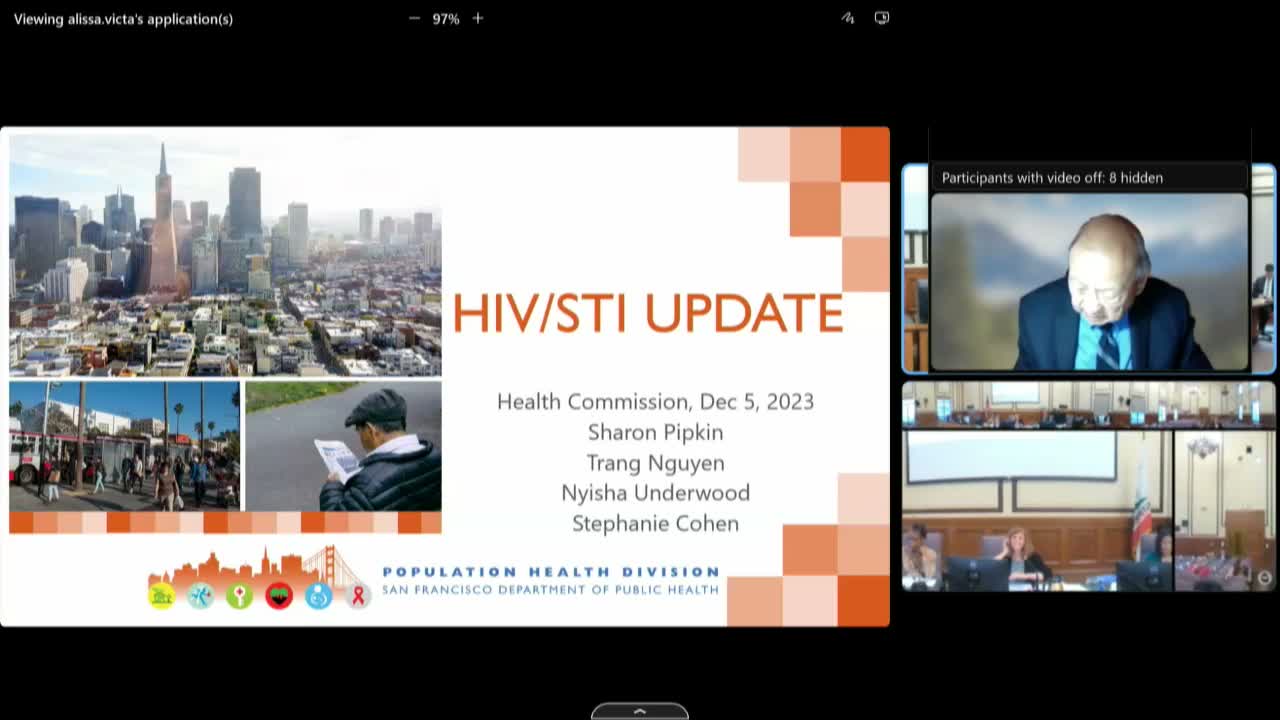
The San Francisco Department of Public Health on Dec. 5 presented its annual HIV and STI update, reporting that declines in new HIV diagnoses have slowed while disparities persist across race/ethnicity, age and homelessness status. The presentation combined epidemiology, program updates and information about new prevention tools.
Sharon Pipkin, an epidemiologist in the ARCHES branch, reported that new HIV diagnoses fell 28% from 2017–2019 but only 12% from 2019–2022, and that at the end of 2022 there were 15,537 people living with HIV in San Francisco. Pipkin noted an aging population (73% over age 50) and that overdose deaths have made up an increasing share of deaths among people living with HIV.
Pipkin and colleagues highlighted persistent disparities: in 2022 Latino men had higher rates of new HIV diagnoses than Black men for the first time, and people experiencing homelessness continued to make up a high proportion of new diagnoses. For persons diagnosed in 2022, the department reported 90% were linked to care within one month and 80% achieved viral suppression within six months of diagnosis.
Trang Nguyen (STI epidemiology) presented trends in chlamydia, gonorrhea and syphilis. While annual incidence fell between 2017 and 2022, sharp declines in 2020 — attributed to reduced screening during the early COVID‑19 pandemic — complicate interpretation. Nguyen flagged rising female syphilis and congenital syphilis as local concerns: in 2022 there were 186 female syphilis cases, 18 of whom were pregnant, and four congenital syphilis cases had been reported by the fourth quarter of 2023.
Presenters discussed mpox (monkeypox) surveillance and vaccination; as of Oct. 30, 31,501 San Francisco residents had received one mpox vaccine dose and 59% of those had received a second dose to complete the series. The department reported San Francisco has among the highest mpox rates in California and ongoing racial/ethnic disparities in case counts.
Programmatically, the department described a syndemic approach that integrates HIV, STI, hepatitis C and overdose prevention. Nyesha Underwood (acting co‑director, Community Health Equity and Promotion) described seven Health Access Points launched in July 2023 to provide low‑barrier, community‑based services targeted to priority populations; the department directed roughly half initial HAP funding to Latinx and Black access points to address disparities. The department also highlighted the 'Don't Think No' home testing program for youth and mobile outreach tailored to people experiencing homelessness and substance use.
Stephanie Cohen and other presenters discussed Doxycycline post‑exposure prophylaxis (DoxyPEP). The department noted that evidence from randomized trials shows DoxyPEP reduces STI risk in some populations (presenters summarized trial efficacy) and that San Francisco released citywide guidance in October 2022 to monitor its impact and uptake via Getting to 0's new product initiative.
Commissioners thanked staff for the detailed presentations and asked for additional age‑specific reporting on adolescents and young adults and ongoing evaluation of disparities in Latinx communities; the presenters committed to follow up and additional reporting. No public commenters spoke in opposition to the presentation.
Sharon Pipkin, an epidemiologist in the ARCHES branch, reported that new HIV diagnoses fell 28% from 2017–2019 but only 12% from 2019–2022, and that at the end of 2022 there were 15,537 people living with HIV in San Francisco. Pipkin noted an aging population (73% over age 50) and that overdose deaths have made up an increasing share of deaths among people living with HIV.
Pipkin and colleagues highlighted persistent disparities: in 2022 Latino men had higher rates of new HIV diagnoses than Black men for the first time, and people experiencing homelessness continued to make up a high proportion of new diagnoses. For persons diagnosed in 2022, the department reported 90% were linked to care within one month and 80% achieved viral suppression within six months of diagnosis.
Trang Nguyen (STI epidemiology) presented trends in chlamydia, gonorrhea and syphilis. While annual incidence fell between 2017 and 2022, sharp declines in 2020 — attributed to reduced screening during the early COVID‑19 pandemic — complicate interpretation. Nguyen flagged rising female syphilis and congenital syphilis as local concerns: in 2022 there were 186 female syphilis cases, 18 of whom were pregnant, and four congenital syphilis cases had been reported by the fourth quarter of 2023.
Presenters discussed mpox (monkeypox) surveillance and vaccination; as of Oct. 30, 31,501 San Francisco residents had received one mpox vaccine dose and 59% of those had received a second dose to complete the series. The department reported San Francisco has among the highest mpox rates in California and ongoing racial/ethnic disparities in case counts.
Programmatically, the department described a syndemic approach that integrates HIV, STI, hepatitis C and overdose prevention. Nyesha Underwood (acting co‑director, Community Health Equity and Promotion) described seven Health Access Points launched in July 2023 to provide low‑barrier, community‑based services targeted to priority populations; the department directed roughly half initial HAP funding to Latinx and Black access points to address disparities. The department also highlighted the 'Don't Think No' home testing program for youth and mobile outreach tailored to people experiencing homelessness and substance use.
Stephanie Cohen and other presenters discussed Doxycycline post‑exposure prophylaxis (DoxyPEP). The department noted that evidence from randomized trials shows DoxyPEP reduces STI risk in some populations (presenters summarized trial efficacy) and that San Francisco released citywide guidance in October 2022 to monitor its impact and uptake via Getting to 0's new product initiative.
Commissioners thanked staff for the detailed presentations and asked for additional age‑specific reporting on adolescents and young adults and ongoing evaluation of disparities in Latinx communities; the presenters committed to follow up and additional reporting. No public commenters spoke in opposition to the presentation.
Don't Miss a Word: See the Full Meeting!
Go beyond summaries. Unlock every video, transcript, and key insight with a Founder Membership.
✓
Get instant access to full meeting videos
✓
Search and clip any phrase from complete transcripts
✓
Receive AI-powered summaries & custom alerts
✓
Enjoy lifetime, unrestricted access to government data
30-day money-back guarantee
