DPH CFO reports midyear savings and ZSFG revenue gains; public presses commission on Laguna Honda recertification costs
March 05, 2024 | San Francisco City, San Francisco County, California
This article was created by AI summarizing key points discussed. AI makes mistakes, so for full details and context, please refer to the video of the full meeting. Please report any errors so we can fix them. Report an error »
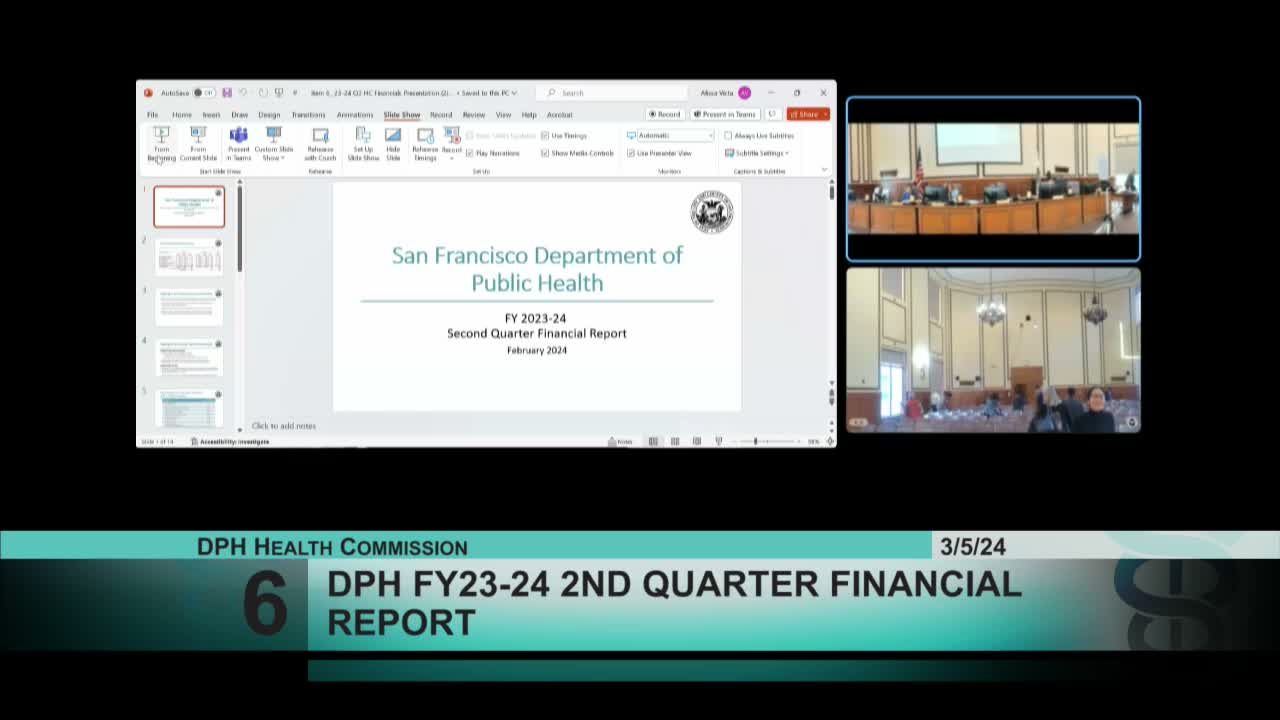
The Department of Public Health's chief financial officer, Jeni Louie, presented the DPH FY 20231 second-quarter financial report, describing midyear budget instructions from the mayor's office that produced projected savings and a favorable outlook overall, while flagging continuing uncertainty around Laguna Honda Hospital (LHH) recertification and associated costs.
Louie said midyear reductions and expected revenue swings produced roughly $98 million in total projected savings, and after adjusting for assumed one-time revenue the department estimates a projected general-fund surplus of about $67.3 million for the year. A notable driver of improved revenue was Zuckerberg San Francisco General, which Louie said is showing roughly $78 million higher-than-budgeted net patient revenue, partly from one-time settlements and partly ongoing increases.
Louie cautioned that Laguna Honda remains a major unknown: recertification work and state proposals for interim rates (DPNIF) make revenue estimates speculative. The presentation lists a projected $15.3 million over-budget expenditure at Laguna Honda tied to recertification work, registry staffing and consultant costs; Louie said the department is monitoring state interim-rate proposals and may have additional information in coming quarters.
Public commenters pressed the commission on these numbers. Patrick Monette Shaw, a frequent speaker at commission meetings, alleged a much larger running cost tied to LHH mismanagement and recertification, asserting cumulative costs approaching $150 million when accounting for prior expenses and litigation. Shaw also questioned why registry usage increased despite a reduced patient census and asserted that overall FTE counts appear unchanged while registry costs rise.
Commissioners asked follow-up questions about UCSF access for Medi-Cal behavioral-health services after the Prop Q discussion and requested clarifications on Laguna Honda's recertification timeline and the assumptions behind staffing and revenue figures. Louie said the department is pausing firm revenue assumptions for Laguna Honda until state recertification and interim-rate details are clarified and that management reserves could buffer one-time shortfalls.
The presentation covered other departmental units: behavioral health (a $10.6 million surplus driven by patient-revenue changes and one-time items), primary care (a $14.7 million surplus), jail health, population health and network services where some CalAIM and capitation revenues remained short. Louie said the department will continue to track the impact of payment reforms and one-time settlements.
Louie said midyear reductions and expected revenue swings produced roughly $98 million in total projected savings, and after adjusting for assumed one-time revenue the department estimates a projected general-fund surplus of about $67.3 million for the year. A notable driver of improved revenue was Zuckerberg San Francisco General, which Louie said is showing roughly $78 million higher-than-budgeted net patient revenue, partly from one-time settlements and partly ongoing increases.
Louie cautioned that Laguna Honda remains a major unknown: recertification work and state proposals for interim rates (DPNIF) make revenue estimates speculative. The presentation lists a projected $15.3 million over-budget expenditure at Laguna Honda tied to recertification work, registry staffing and consultant costs; Louie said the department is monitoring state interim-rate proposals and may have additional information in coming quarters.
Public commenters pressed the commission on these numbers. Patrick Monette Shaw, a frequent speaker at commission meetings, alleged a much larger running cost tied to LHH mismanagement and recertification, asserting cumulative costs approaching $150 million when accounting for prior expenses and litigation. Shaw also questioned why registry usage increased despite a reduced patient census and asserted that overall FTE counts appear unchanged while registry costs rise.
Commissioners asked follow-up questions about UCSF access for Medi-Cal behavioral-health services after the Prop Q discussion and requested clarifications on Laguna Honda's recertification timeline and the assumptions behind staffing and revenue figures. Louie said the department is pausing firm revenue assumptions for Laguna Honda until state recertification and interim-rate details are clarified and that management reserves could buffer one-time shortfalls.
The presentation covered other departmental units: behavioral health (a $10.6 million surplus driven by patient-revenue changes and one-time items), primary care (a $14.7 million surplus), jail health, population health and network services where some CalAIM and capitation revenues remained short. Louie said the department will continue to track the impact of payment reforms and one-time settlements.
Don't Miss a Word: See the Full Meeting!
Go beyond summaries. Unlock every video, transcript, and key insight with a Founder Membership.
✓
Get instant access to full meeting videos
✓
Search and clip any phrase from complete transcripts
✓
Receive AI-powered summaries & custom alerts
✓
Enjoy lifetime, unrestricted access to government data
30-day money-back guarantee
