DPH to seek board approval of Baker Places repayment deal and property purchase to cover debt
March 19, 2024 | San Francisco City, San Francisco County, California
This article was created by AI summarizing key points discussed. AI makes mistakes, so for full details and context, please refer to the video of the full meeting. Please report any errors so we can fix them. Report an error »
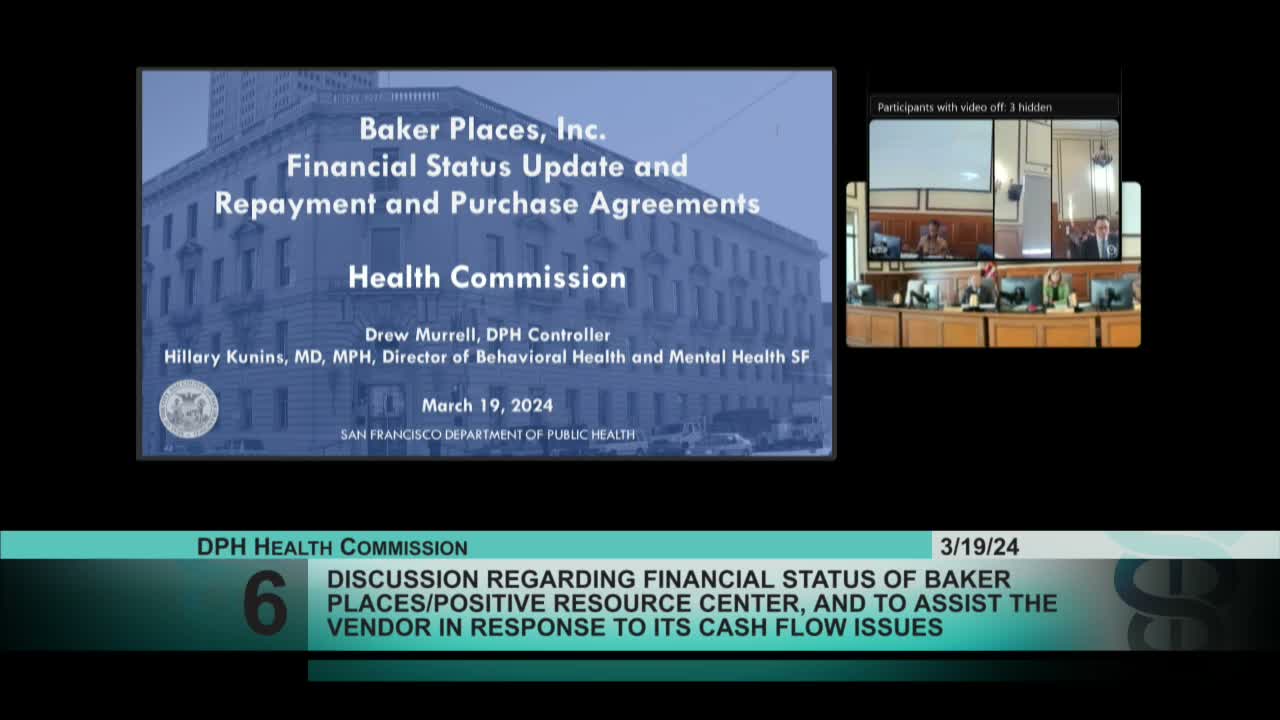
The San Francisco Department of Public Health (DPH) told the Health Commission on March 19 that it will ask the Board of Supervisors to approve a repayment agreement and a purchase-and-sale to address accumulated debt at Baker Places, a behavioral health provider.
DPH controller Drew Morrell summarized a years-long financial review of Baker and its parent organization PRC. The department said its chief goals are to preserve services and residential treatment beds for vulnerable clients while ensuring public funds are spent responsibly. DPH said interventions during 2022 — including converting some contracts from fee-for-service to cost-reimbursement, temporarily increasing allowable indirect rates, and pausing recovery of initial payments — helped preserve operations but contributed to accumulated receivables the city now seeks to resolve.
DPH described a proposed 23-year repayment agreement with monthly payments of $20,100 and interest calculated at the county pooled rate (noted in the presentation as about 1.12%). The package includes a purchase-and-sale of a Baker-owned property (listed in presentation materials as 333 Seventh Street and referenced on slides with a $3,000,000 assessed value) that DPH would credit against a portion of the debt. PRC would sign a parent guarantee to stand behind payments if Baker defaults, and two additional properties would be collateralized.
DPH staff told commissioners the total debt includes multiple components: an earlier $1.3 million identified in audit work dating to FY15–16 and substantial amounts created when the city temporarily stopped recovering initial payments to avoid service disruptions in 2022. The department said Baker began voluntary repayment on the current schedule in July 2023.
Baker and PRC executives told the commission they are pursuing diversified revenue streams, including foundation grants and fee-for-service contracts, and reported an indirect cost rate they use internally (discussed as around 21%). PRC’s CEO said the organizations are operating more efficiently after leadership turnover and that a legal merger remains a business decision to be considered.
Commissioners pressed DPH on monitoring capacity and oversight. DPH said it has reinstituted a CBO fiscal monitoring group, has increased audit and monitoring cadence, and will present further fiscal oversight proposals to the commission on May 7. DPH also said debt repayment would not be entered as an eligible reimbursable cost under cost-reimbursement contracts and that the repayment burden will ultimately rest with the provider, supported by cost-savings and operating adjustments.
The department did not seek a commission vote on the resolution at the meeting; DPH said the item will be brought to the Board of Supervisors for approval. The department described the package as designed to preserve treatment capacity while creating a structured plan to retire the accumulated liability.
Next steps: DPH will return with more detailed fiscal-monitoring proposals to the commission and will send the repayment-and-purchase resolution to the Board for approval.
DPH controller Drew Morrell summarized a years-long financial review of Baker and its parent organization PRC. The department said its chief goals are to preserve services and residential treatment beds for vulnerable clients while ensuring public funds are spent responsibly. DPH said interventions during 2022 — including converting some contracts from fee-for-service to cost-reimbursement, temporarily increasing allowable indirect rates, and pausing recovery of initial payments — helped preserve operations but contributed to accumulated receivables the city now seeks to resolve.
DPH described a proposed 23-year repayment agreement with monthly payments of $20,100 and interest calculated at the county pooled rate (noted in the presentation as about 1.12%). The package includes a purchase-and-sale of a Baker-owned property (listed in presentation materials as 333 Seventh Street and referenced on slides with a $3,000,000 assessed value) that DPH would credit against a portion of the debt. PRC would sign a parent guarantee to stand behind payments if Baker defaults, and two additional properties would be collateralized.
DPH staff told commissioners the total debt includes multiple components: an earlier $1.3 million identified in audit work dating to FY15–16 and substantial amounts created when the city temporarily stopped recovering initial payments to avoid service disruptions in 2022. The department said Baker began voluntary repayment on the current schedule in July 2023.
Baker and PRC executives told the commission they are pursuing diversified revenue streams, including foundation grants and fee-for-service contracts, and reported an indirect cost rate they use internally (discussed as around 21%). PRC’s CEO said the organizations are operating more efficiently after leadership turnover and that a legal merger remains a business decision to be considered.
Commissioners pressed DPH on monitoring capacity and oversight. DPH said it has reinstituted a CBO fiscal monitoring group, has increased audit and monitoring cadence, and will present further fiscal oversight proposals to the commission on May 7. DPH also said debt repayment would not be entered as an eligible reimbursable cost under cost-reimbursement contracts and that the repayment burden will ultimately rest with the provider, supported by cost-savings and operating adjustments.
The department did not seek a commission vote on the resolution at the meeting; DPH said the item will be brought to the Board of Supervisors for approval. The department described the package as designed to preserve treatment capacity while creating a structured plan to retire the accumulated liability.
Next steps: DPH will return with more detailed fiscal-monitoring proposals to the commission and will send the repayment-and-purchase resolution to the Board for approval.
View the Full Meeting & All Its Details
This article offers just a summary. Unlock complete video, transcripts, and insights as a Founder Member.
✓
Watch full, unedited meeting videos
✓
Search every word spoken in unlimited transcripts
✓
AI summaries & real-time alerts (all government levels)
✓
Permanent access to expanding government content
30-day money-back guarantee
