SFMTA, DPH and SFPD present Vision Zero update as pedestrian deaths rise, advocates demand faster quick builds
March 07, 2023 | San Francisco City, San Francisco County, California
This article was created by AI summarizing key points discussed. AI makes mistakes, so for full details and context, please refer to the video of the full meeting. Please report any errors so we can fix them. Report an error »
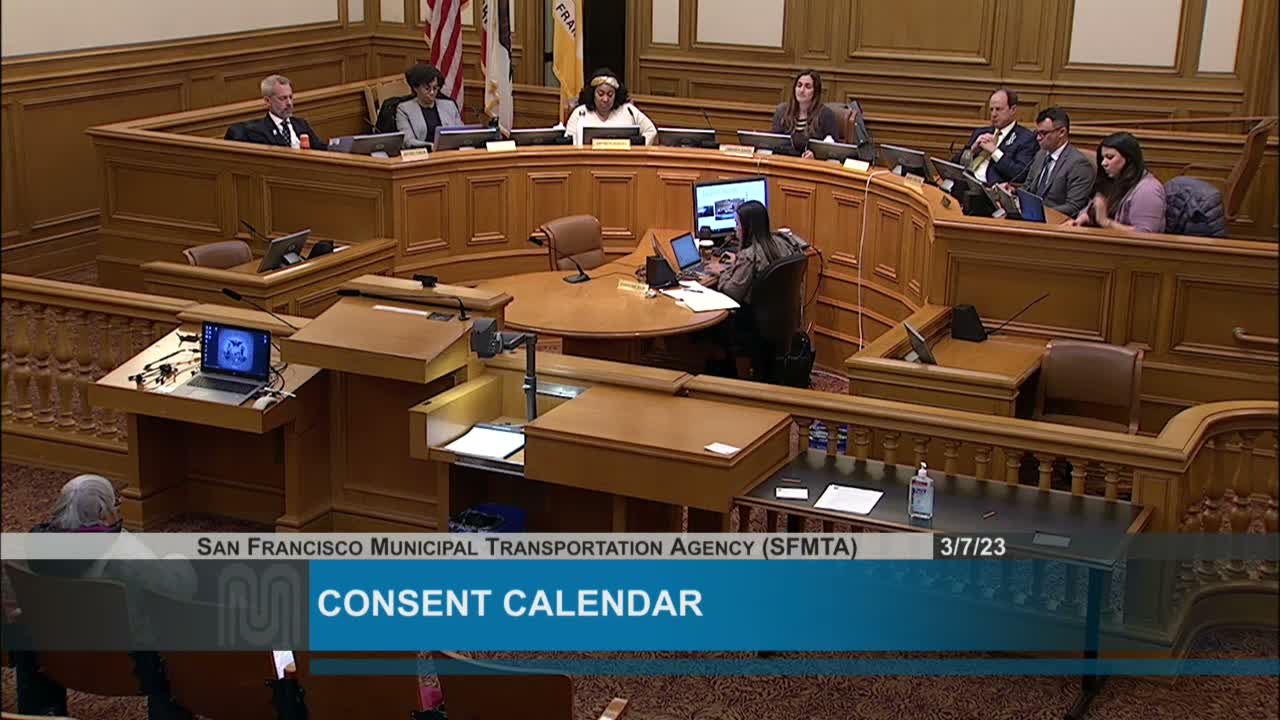
SFMTA staff, the Department of Public Health and the San Francisco Police Department delivered a quarterly Vision Zero update Wednesday that showed traffic fatalities in San Francisco rose in 2022 to 37, the highest total since 2007, driven by a jump in pedestrian deaths to 20.
Emily Ngo, acting Vision Zero program manager at SFMTA, said the agency secured a $17 million USDOT Safe Streets for All grant to fund intersection signal upgrades, radar speed signs and additional quick builds in the Western Addition. Ngo said SFMTA has installed hundreds of 20 mph signs under state law and is evaluating their effect, but that the signs alone have produced limited reductions in some corridors.
Iris Su, the Vision Zero epidemiologist at the Department of Public Health, presented preliminary numbers showing 62 percent of 2022 fatalities occurred on the high‑injury network and that older adults remained overrepresented among pedestrian deaths. ‘‘2022 saw the highest traffic fatalities on our streets since 2007,’’ Su said, adding that investigations remain open for two additional cases that could change the total.
Commander Peter Walsh of the San Francisco Police Department described a shift to directed enforcement operations focused on the ‘‘Top Five’’ collision types and the high‑injury network. Walsh told the board traffic staffing has declined since 2019 — from a historically larger complement down to roughly mid‑20s of dedicated traffic officers — and that administrative processes and body‑worn camera obligations lengthen the time required for each traffic stop.
Board members pressed staff on automated enforcement. Director Hemminger asked whether SFPD supports state legislation for automated speed enforcement; Walsh said SFPD has not opposed such laws and supports automation in principle. Streets Director Tom McGuire said SFMTA plans to expand red‑light cameras and emphasized corridor‑level solutions — for example signal timing and lane reductions — as often more effective than isolated intersection fixes.
Advocates and survivors urged faster deployment of proven engineering fixes. ‘‘Let’s not admire the problem,’’ said Julie Nicholson, a crash survivor, asking the board to publish monthly metrics and accelerate quick builds. Walk San Francisco and Families for Safe Streets speakers said enforcement alone will not reach Vision Zero and called for broad lane reductions, daylighting, pedestrian scrambles and faster implementation of quick build projects.
Tom McGuire said SFMTA is committed to applying proven tools across the high‑injury network and to expanding slow‑street and active‑community projects, but acknowledged resource and political constraints. The board asked staff to return with more granular performance measures tying enforcement activity, engineering interventions and collision outcomes.
The board did not take formal action on the presentation; members asked staff to provide more detailed recommendations on equipment purchases (such as radar speed trailers and pole‑mounted signs), a timeline for quick builds, and options for leveraging grants and city budget authority to accelerate work.
What’s next: SFMTA will post a public fact sheet on the 20‑mph signage evaluation and discuss the speed management plan at the Vision Zero public task force meeting next week. The board signaled interest in a Vision Zero subcommittee to track staffing, enforcement and infrastructure progress.
Emily Ngo, acting Vision Zero program manager at SFMTA, said the agency secured a $17 million USDOT Safe Streets for All grant to fund intersection signal upgrades, radar speed signs and additional quick builds in the Western Addition. Ngo said SFMTA has installed hundreds of 20 mph signs under state law and is evaluating their effect, but that the signs alone have produced limited reductions in some corridors.
Iris Su, the Vision Zero epidemiologist at the Department of Public Health, presented preliminary numbers showing 62 percent of 2022 fatalities occurred on the high‑injury network and that older adults remained overrepresented among pedestrian deaths. ‘‘2022 saw the highest traffic fatalities on our streets since 2007,’’ Su said, adding that investigations remain open for two additional cases that could change the total.
Commander Peter Walsh of the San Francisco Police Department described a shift to directed enforcement operations focused on the ‘‘Top Five’’ collision types and the high‑injury network. Walsh told the board traffic staffing has declined since 2019 — from a historically larger complement down to roughly mid‑20s of dedicated traffic officers — and that administrative processes and body‑worn camera obligations lengthen the time required for each traffic stop.
Board members pressed staff on automated enforcement. Director Hemminger asked whether SFPD supports state legislation for automated speed enforcement; Walsh said SFPD has not opposed such laws and supports automation in principle. Streets Director Tom McGuire said SFMTA plans to expand red‑light cameras and emphasized corridor‑level solutions — for example signal timing and lane reductions — as often more effective than isolated intersection fixes.
Advocates and survivors urged faster deployment of proven engineering fixes. ‘‘Let’s not admire the problem,’’ said Julie Nicholson, a crash survivor, asking the board to publish monthly metrics and accelerate quick builds. Walk San Francisco and Families for Safe Streets speakers said enforcement alone will not reach Vision Zero and called for broad lane reductions, daylighting, pedestrian scrambles and faster implementation of quick build projects.
Tom McGuire said SFMTA is committed to applying proven tools across the high‑injury network and to expanding slow‑street and active‑community projects, but acknowledged resource and political constraints. The board asked staff to return with more granular performance measures tying enforcement activity, engineering interventions and collision outcomes.
The board did not take formal action on the presentation; members asked staff to provide more detailed recommendations on equipment purchases (such as radar speed trailers and pole‑mounted signs), a timeline for quick builds, and options for leveraging grants and city budget authority to accelerate work.
What’s next: SFMTA will post a public fact sheet on the 20‑mph signage evaluation and discuss the speed management plan at the Vision Zero public task force meeting next week. The board signaled interest in a Vision Zero subcommittee to track staffing, enforcement and infrastructure progress.
Don't Miss a Word: See the Full Meeting!
Go beyond summaries. Unlock every video, transcript, and key insight with a Founder Membership.
✓
Get instant access to full meeting videos
✓
Search and clip any phrase from complete transcripts
✓
Receive AI-powered summaries & custom alerts
✓
Enjoy lifetime, unrestricted access to government data
30-day money-back guarantee
