Carmel Central Board weighs deeper staff cuts, sport and club reductions as 2024–25 budget gap looms
March 28, 2024 | CARMEL CENTRAL SCHOOL DISTRICT, School Districts, New York
This article was created by AI summarizing key points discussed. AI makes mistakes, so for full details and context, please refer to the video of the full meeting. Please report any errors so we can fix them. Report an error »
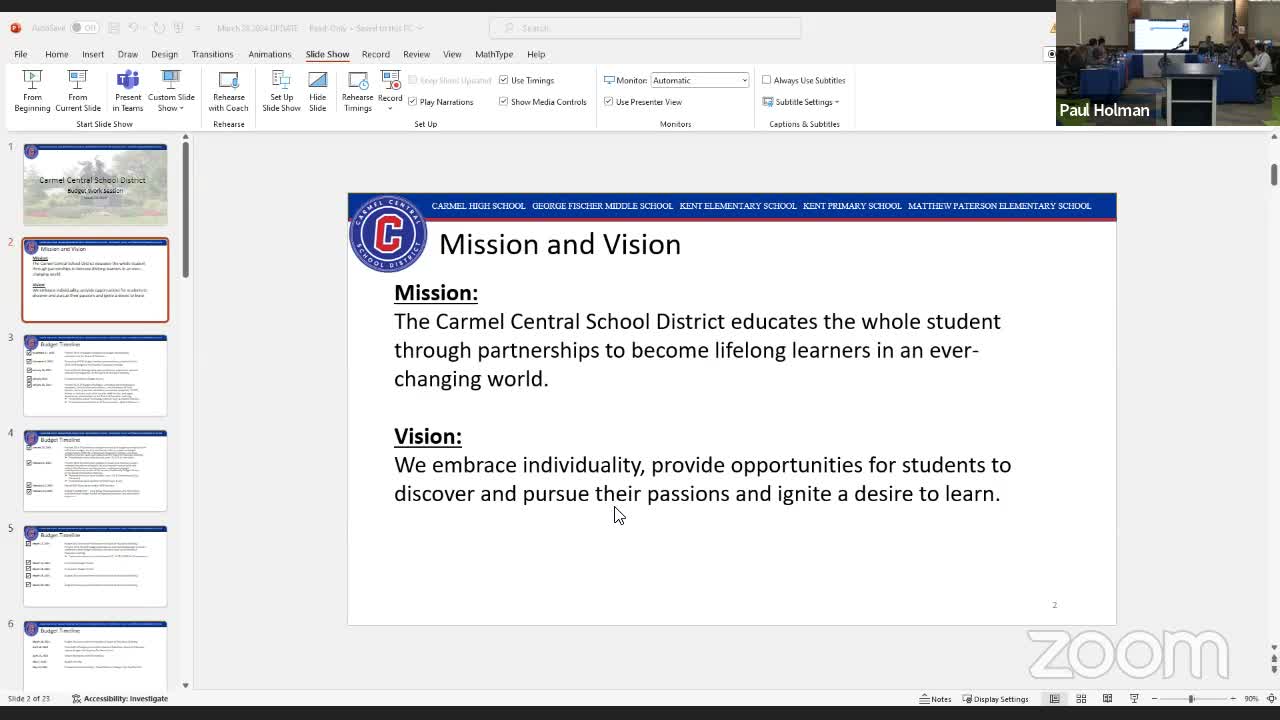
The Carmel Central School District Board of Education convened a March 28 work session to review nine scenarios to close a budget shortfall for 2024–25, with proposed reductions that range from targeted line‑item trims to cuts that would suspend extracurriculars under a contingent (0% levy) budget. Presenters said the district’s current budget sits around $140.9 million, with preliminary projections that could push toward $149.0 million depending on tax levy and fund balance choices.
Trustees spent much of the evening parsing accounting details and the effect of moving positions to grant funding. Several trustees pushed back on the notion that shifting salaries to grants represents a full “expenditure reduction,” noting the district typically retains benefit costs in the general fund. "It's not the best practice to put salaries into grants that are not going to be long‑term grants, especially salaries," Trustee Orser said, urging the board to account for short‑term grant risk in public materials.
Administration officials responded that the slide decks would be revised to separate grant revenue from expenditure reductions and to make the assumptions driving headline 'savings' clearer to the public. Mister Fink, the district finance official, said he would provide a clearer slide that explicitly deducts grant‑covered salaries from expenditure totals for transparency.
A recurring policy question concerned one two‑year RECOVER grant for a bilingual social worker. Trustees agreed the position is important for student wellness but warned that counting it as a perennial budget item when the grant is temporary risks a future staffing cliff. Presentation staff proposed a "double‑entry" accounting method — showing the position in both the general fund budget and the grant revenues — as an interim transparency step.
The board also discussed a sequence of program tradeoffs across scenarios. Early scenarios would restore some clubs and field trips and limit sports reductions; deeper cuts would eliminate modified and freshman sports and reduce class‑specific specialists. Administration said certain capital outlays and technology replacements (including a possible $180,000 student‑information system replacement) are being considered for postponement to narrow the gap. The district also outlined options on bus purchases and a security‑vendor change that could save money but may raise safety and contract‑termination costs.
Members repeatedly emphasized that some programs and positions are legally constrained. Administration reviewed contingent‑budget rules under New York law — for example, ordinary contingencies limit certain purchases and field trips would be eliminated unless fully reimbursed — and warned the board that a contingent adopted without voter approval has similar restrictions to a voter‑approved 0% in many respects. Trustees asked administration to supply official written guidance and examples so the public could better understand what a contingent budget would remove.
Public comment filled much of the night. Dozens of parents, staff and community members urged the board to preserve the district’s arts, music, clubs and the alternative high school program. Several speakers described students who rely on those programs and said cuts would produce human costs beyond the ledger. At least one staff representative described past concessions her unit made and asked for unit‑level accounting so bargaining groups and the board could discuss equitable contributions.
On staff communications, trustees criticized the way administrators had notified employees about potential reductions. Administration explained that certain written notices to teachers are required contractually and that some verbal notices were provided as courtesy, but trustees and staff said the messaging was inconsistent and caused unnecessary alarm to non‑certified employees who did not receive formal letters. The superintendent’s office said it would rectify communication gaps.
By late evening the board directed staff to model a revised "Scenario 9" that restored several student services — including the outreach coordinator, field trips, most clubs, and the alternative high school — while keeping a set of reductions elsewhere. Mister Fink reported a live recalculation that left the board roughly $1.0 million short of reaching a 0% tax levy without drawing on appropriated fund balance. Several trustees said they would not support using the district’s $1.1 million appropriated fund balance this year, warning that spending reserves now without a plan to replenish them creates a larger fiscal cliff in future years.
The board scheduled further negotiations with bargaining units and moved into executive session on collective‑bargaining matters. The administration committed to produce clearer, line‑by‑line figures and alternative scenarios that apply specific legal and equity checks — including Title IX and special‑education implications — so trustees and the public can see exact tradeoffs in upcoming meetings.
What’s next: the district will circulate revised slides and more detailed spreadsheets showing the net impact of moving salary lines to grants, the benefit costs that remain in the general fund, and unit‑level staffing numbers; trustees asked to reconvene with those data before making final budget adoption decisions.
Trustees spent much of the evening parsing accounting details and the effect of moving positions to grant funding. Several trustees pushed back on the notion that shifting salaries to grants represents a full “expenditure reduction,” noting the district typically retains benefit costs in the general fund. "It's not the best practice to put salaries into grants that are not going to be long‑term grants, especially salaries," Trustee Orser said, urging the board to account for short‑term grant risk in public materials.
Administration officials responded that the slide decks would be revised to separate grant revenue from expenditure reductions and to make the assumptions driving headline 'savings' clearer to the public. Mister Fink, the district finance official, said he would provide a clearer slide that explicitly deducts grant‑covered salaries from expenditure totals for transparency.
A recurring policy question concerned one two‑year RECOVER grant for a bilingual social worker. Trustees agreed the position is important for student wellness but warned that counting it as a perennial budget item when the grant is temporary risks a future staffing cliff. Presentation staff proposed a "double‑entry" accounting method — showing the position in both the general fund budget and the grant revenues — as an interim transparency step.
The board also discussed a sequence of program tradeoffs across scenarios. Early scenarios would restore some clubs and field trips and limit sports reductions; deeper cuts would eliminate modified and freshman sports and reduce class‑specific specialists. Administration said certain capital outlays and technology replacements (including a possible $180,000 student‑information system replacement) are being considered for postponement to narrow the gap. The district also outlined options on bus purchases and a security‑vendor change that could save money but may raise safety and contract‑termination costs.
Members repeatedly emphasized that some programs and positions are legally constrained. Administration reviewed contingent‑budget rules under New York law — for example, ordinary contingencies limit certain purchases and field trips would be eliminated unless fully reimbursed — and warned the board that a contingent adopted without voter approval has similar restrictions to a voter‑approved 0% in many respects. Trustees asked administration to supply official written guidance and examples so the public could better understand what a contingent budget would remove.
Public comment filled much of the night. Dozens of parents, staff and community members urged the board to preserve the district’s arts, music, clubs and the alternative high school program. Several speakers described students who rely on those programs and said cuts would produce human costs beyond the ledger. At least one staff representative described past concessions her unit made and asked for unit‑level accounting so bargaining groups and the board could discuss equitable contributions.
On staff communications, trustees criticized the way administrators had notified employees about potential reductions. Administration explained that certain written notices to teachers are required contractually and that some verbal notices were provided as courtesy, but trustees and staff said the messaging was inconsistent and caused unnecessary alarm to non‑certified employees who did not receive formal letters. The superintendent’s office said it would rectify communication gaps.
By late evening the board directed staff to model a revised "Scenario 9" that restored several student services — including the outreach coordinator, field trips, most clubs, and the alternative high school — while keeping a set of reductions elsewhere. Mister Fink reported a live recalculation that left the board roughly $1.0 million short of reaching a 0% tax levy without drawing on appropriated fund balance. Several trustees said they would not support using the district’s $1.1 million appropriated fund balance this year, warning that spending reserves now without a plan to replenish them creates a larger fiscal cliff in future years.
The board scheduled further negotiations with bargaining units and moved into executive session on collective‑bargaining matters. The administration committed to produce clearer, line‑by‑line figures and alternative scenarios that apply specific legal and equity checks — including Title IX and special‑education implications — so trustees and the public can see exact tradeoffs in upcoming meetings.
What’s next: the district will circulate revised slides and more detailed spreadsheets showing the net impact of moving salary lines to grants, the benefit costs that remain in the general fund, and unit‑level staffing numbers; trustees asked to reconvene with those data before making final budget adoption decisions.
Don't Miss a Word: See the Full Meeting!
Go beyond summaries. Unlock every video, transcript, and key insight with a Founder Membership.
✓
Get instant access to full meeting videos
✓
Search and clip any phrase from complete transcripts
✓
Receive AI-powered summaries & custom alerts
✓
Enjoy lifetime, unrestricted access to government data
30-day money-back guarantee
