County approves rezoning of 206 acres near Collier Road over neighbor objections
January 23, 2024 | Yellowstone, Montana
This article was created by AI summarizing key points discussed. AI makes mistakes, so for full details and context, please refer to the video of the full meeting. Please report any errors so we can fix them. Report an error »
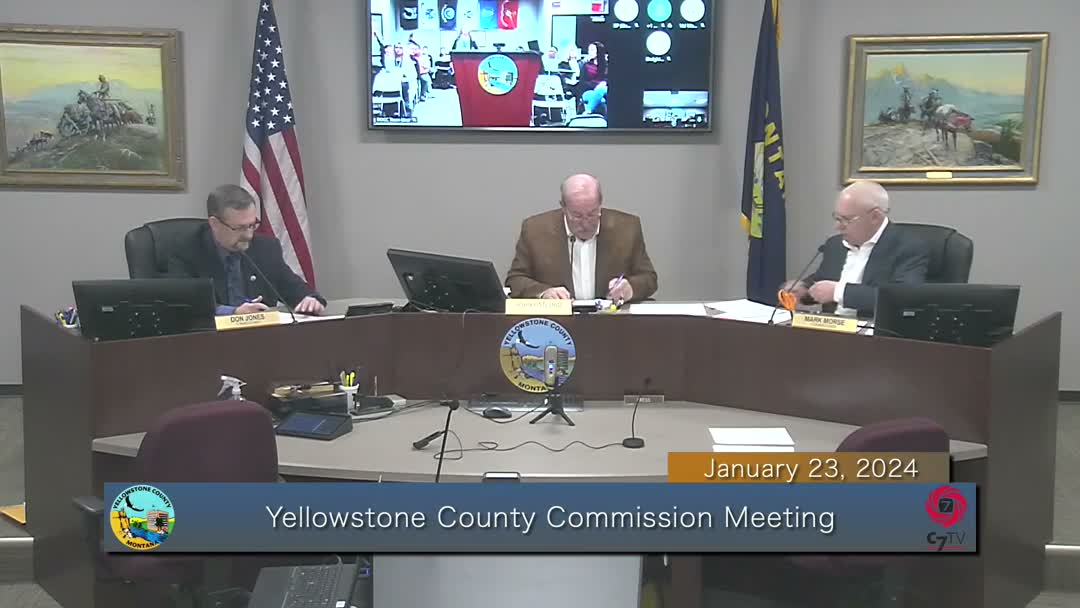
Yellowstone County commissioners voted to approve zone change application 7-22 on Feb. 20, rezoning roughly 206 acres east of Collier Road from agricultural use to Rural Residential 3 (RR3).
Nicole, a county planning staff member, told the commission the proposed rezoning reflects adjacent rural residential zoning and that the zoning commission recommended approval after a Jan. 8 hearing and application review. She said the change begins the development process rather than concluding it and noted that subdivision, traffic and stormwater studies would be required during later permitting.
Several nearby residents spoke against the rezoning during the public hearing, urging the commission to consider traffic safety on Collier Road, water supply and runoff, wildfire response and impacts to grazing and wildlife. "It's going to re-increase our property taxes," said Patrick Flanagan, a nearby property owner who objected that parts of the land were in active grazing and asked how schools, roads and water would accommodate new homes. Crystal Burkett cited recent flooding and asked where stormwater would be directed; Kathy Shaffer asked for buffers and measures to protect springs and wildlife habitat.
Anna Vickers, identified as an agent for the applicant and representing IMAG, said a zone change is a prerequisite to the studies neighbors seek. She told commissioners that subdivision regulations and Montana DEQ requirements will govern water, sewer and on-site stormwater controls; traffic impacts will be studied and developers typically contribute their proportionate share to road improvements. Vickers said the developer plans a no-build zone adjacent to Basin Creek and intends to work with Fish, Wildlife & Parks during subdivision review.
A commissioner moved to approve the zone change and adopt the staff findings under the county's 11 review criteria; the motion was seconded and carried by voice vote. County staff stressed that additional approvals — subdivision plats, site-plan review, road and stormwater mitigation and any required permits — remain before construction could begin.
The approval clears the zoning hurdle; detailed engineering, environmental and traffic studies required by subdivision and permitting rules will determine whether and how many lots can be created and what mitigation is required.
Nicole, a county planning staff member, told the commission the proposed rezoning reflects adjacent rural residential zoning and that the zoning commission recommended approval after a Jan. 8 hearing and application review. She said the change begins the development process rather than concluding it and noted that subdivision, traffic and stormwater studies would be required during later permitting.
Several nearby residents spoke against the rezoning during the public hearing, urging the commission to consider traffic safety on Collier Road, water supply and runoff, wildfire response and impacts to grazing and wildlife. "It's going to re-increase our property taxes," said Patrick Flanagan, a nearby property owner who objected that parts of the land were in active grazing and asked how schools, roads and water would accommodate new homes. Crystal Burkett cited recent flooding and asked where stormwater would be directed; Kathy Shaffer asked for buffers and measures to protect springs and wildlife habitat.
Anna Vickers, identified as an agent for the applicant and representing IMAG, said a zone change is a prerequisite to the studies neighbors seek. She told commissioners that subdivision regulations and Montana DEQ requirements will govern water, sewer and on-site stormwater controls; traffic impacts will be studied and developers typically contribute their proportionate share to road improvements. Vickers said the developer plans a no-build zone adjacent to Basin Creek and intends to work with Fish, Wildlife & Parks during subdivision review.
A commissioner moved to approve the zone change and adopt the staff findings under the county's 11 review criteria; the motion was seconded and carried by voice vote. County staff stressed that additional approvals — subdivision plats, site-plan review, road and stormwater mitigation and any required permits — remain before construction could begin.
The approval clears the zoning hurdle; detailed engineering, environmental and traffic studies required by subdivision and permitting rules will determine whether and how many lots can be created and what mitigation is required.
Don't Miss a Word: See the Full Meeting!
Go beyond summaries. Unlock every video, transcript, and key insight with a Founder Membership.
✓
Get instant access to full meeting videos
✓
Search and clip any phrase from complete transcripts
✓
Receive AI-powered summaries & custom alerts
✓
Enjoy lifetime, unrestricted access to government data
30-day money-back guarantee
