Commission forwards $750,000 recommendation to Montana Rescue Mission after competing shelter proposals
January 23, 2024 | Yellowstone, Montana
This article was created by AI summarizing key points discussed. AI makes mistakes, so for full details and context, please refer to the video of the full meeting. Please report any errors so we can fix them. Report an error »
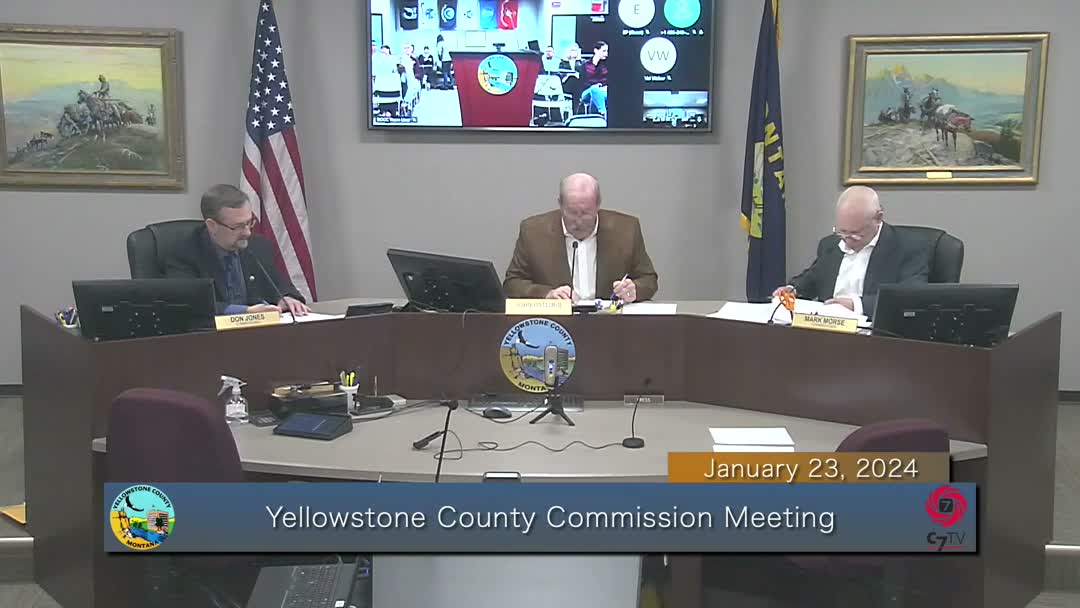
Yellowstone County commissioners on Feb. 20 voted to forward a recommendation to allocate $750,000 to the Montana Rescue Mission (MRM) for its Unified Campus project after hearing competing proposals and extensive public comment.
Ken Kerber, executive director of Off the Streets, introduced his organization's plans for a low-barrier emergency shelter and described gaps he sees in the current system. "This emergency shelter funding is just that. It's for an emergency shelter. It's to get these people sheltered when they can't," Kerber said, urging support for services aimed at people who do not fit existing program criteria.
Supporters described cases that, they said, demonstrate that low-barrier options are needed. Melanie Schwartz recounted meeting a woman with nine children who cycled through shelters and homelessness; James Mack cited the point-in-time count in January 2023 that recorded 116 people without any roof over their heads and a total homeless count of 598, arguments intended to show a service gap.
Al Rapaz, speaking for the Montana Rescue Mission Unified Campus, described a long-running development that the mission says will include 270 shelter beds, 29 low-income housing tax-credit apartments and 48 emergency beds. "Your funds supporting Montana Rescue Mission Unified Campus will help us even go further," Rapaz said.
Amanda Stonerock reminded commissioners that the Department of Commerce will make final grant awards under this program and that the county's role is to nominate and recommend applicants.
After the presentations and public comment, a commissioner moved to forward a recommendation to allocate $750,000 to the Montana Rescue Mission; the motion was seconded and approved by voice vote.
The decision to forward the recommendation does not itself award state funds; final award and grant conditions will be determined by the Department of Commerce and program requirements. Several speakers asked the county to consider expanding 24/7 low-barrier shelter capacity and to prioritize collaboration between providers if state funds become available.
Ken Kerber, executive director of Off the Streets, introduced his organization's plans for a low-barrier emergency shelter and described gaps he sees in the current system. "This emergency shelter funding is just that. It's for an emergency shelter. It's to get these people sheltered when they can't," Kerber said, urging support for services aimed at people who do not fit existing program criteria.
Supporters described cases that, they said, demonstrate that low-barrier options are needed. Melanie Schwartz recounted meeting a woman with nine children who cycled through shelters and homelessness; James Mack cited the point-in-time count in January 2023 that recorded 116 people without any roof over their heads and a total homeless count of 598, arguments intended to show a service gap.
Al Rapaz, speaking for the Montana Rescue Mission Unified Campus, described a long-running development that the mission says will include 270 shelter beds, 29 low-income housing tax-credit apartments and 48 emergency beds. "Your funds supporting Montana Rescue Mission Unified Campus will help us even go further," Rapaz said.
Amanda Stonerock reminded commissioners that the Department of Commerce will make final grant awards under this program and that the county's role is to nominate and recommend applicants.
After the presentations and public comment, a commissioner moved to forward a recommendation to allocate $750,000 to the Montana Rescue Mission; the motion was seconded and approved by voice vote.
The decision to forward the recommendation does not itself award state funds; final award and grant conditions will be determined by the Department of Commerce and program requirements. Several speakers asked the county to consider expanding 24/7 low-barrier shelter capacity and to prioritize collaboration between providers if state funds become available.
Don't Miss a Word: See the Full Meeting!
Go beyond summaries. Unlock every video, transcript, and key insight with a Founder Membership.
✓
Get instant access to full meeting videos
✓
Search and clip any phrase from complete transcripts
✓
Receive AI-powered summaries & custom alerts
✓
Enjoy lifetime, unrestricted access to government data
30-day money-back guarantee
