Yellowstone County approves 12‑month compliance window for six marijuana businesses after contested public hearing
October 24, 2023 | Yellowstone, Montana
This article was created by AI summarizing key points discussed. AI makes mistakes, so for full details and context, please refer to the video of the full meeting. Please report any errors so we can fix them. Report an error »
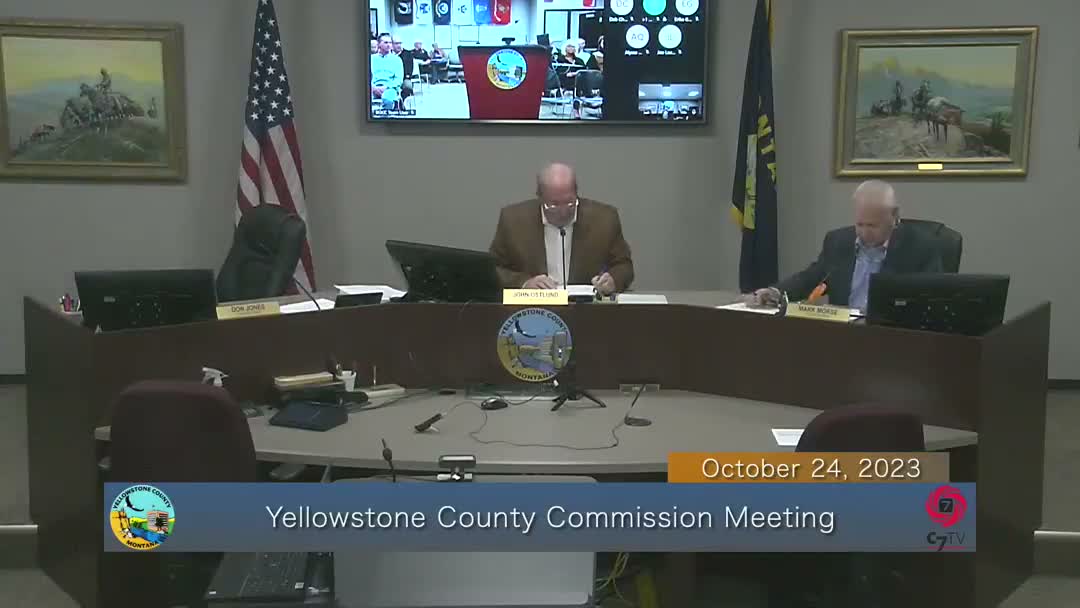
The Yellowstone County Board of County Commissioners on Oct. 24 approved a resolution that gives six marijuana businesses up to 12 months to come into compliance with the county’s zoning code or pursue zone changes, after a public hearing in which owners and an attorney warned the county could face lawsuits.
Monica, a planning division staffer who presented the resolution, told commissioners the county’s comprehensive zoning code does not allow retail marijuana uses in many agricultural and rural residential districts and that several businesses have been operating in conflict with those rules. She said Granite Peak (listed in earlier materials) was excluded from today’s resolution because it had prior written county paperwork that may qualify it as a nonconforming use. "Only the parts of the business that are illegal would have to cease," Monica said, explaining that growing may be allowed while retail or manufacturing on the same parcel may not.
The public hearing drew multiple business owners and an attorney who said county communications were inconsistent and had led owners to rely on official assurances. Katie, an attorney who said she has advocated for medical marijuana patients, told the board to expect reliance and takings claims if owners lose investments made after receiving written assurances. "The first claim...would be a reliance claim," she said, and warned a legal loss could be costly for taxpayers.
Business owners described long investments and operational changes made after county guidance. Anthony Sauer, owner of Green Bee, said his operation began in 2019 and that a zoning reclassification effectively changed his site’s allowable uses "with a stroke of a pen." He noted a court injunction and a follow‑up letter from "Gina Lervic" that he and others relied on, and said relocation would be financially daunting because cannabis businesses have limited access to banking and capital. "We just want to be given the opportunity to continue operating without undue hardship," Sauer said.
Several speakers urged the commission to grandfather existing businesses or to extend any compliance window. Drew Stanslin (Granite Peak) and Coram Parker (Laughing Forest) urged the board to avoid putting long‑time local operators out of business. Industry advocate Nick Meehan (Carbon Cannabis Consulting) said he has a commissioners’ letter indicating 24 months would be the sunsetting period and flagged the county’s acceptance of a 3% gross‑sales cannabis fee as an economic consideration.
Commissioner Jones moved to approve the resolution; Commissioner Morris seconded. Commissioners discussed whether 12 months is sufficient; Monica said the typical zone change timeline from application to board action is about 60 days after submission, with a roughly 30‑day effective period after board approval, and that applicants also must hold a neighborhood meeting at least seven days before filing. Monica noted the board has discretion and that an earlier resolution of intent referenced up to 24 months after adoption of permanent regulations. The motion carried by voice vote.
What the resolution does and next steps: The resolution identifies six businesses the county considers out of compliance and sets a 12‑month period for them to either seek zone changes or otherwise come into compliance, Monica said. Staff advised that businesses likely to succeed would be those adjacent to commercial areas or surrounded by agricultural parcels that could convert to a compatible commercial or agricultural designation; some locations surrounded by residences would have a lower likelihood of a successful zone change. Monica encouraged owners to pursue formal zone change applications and explained the county’s 11‑criteria process for evaluation.
The county also handled routine business: commissioners referred a single bid from Romeo Entertainment Group to staff for recommendation and approved listed claims and the consent agenda by voice votes. The meeting closed after a public comment about a separate forthcoming 10‑year local government review ballot measure.
The board did not change the decision on which specific businesses were listed in the resolution at this meeting; Granite Peak was removed from the list for today’s action because staff said it had prior paperwork. The resolution as approved sets a compliance window and clarifies that only nonconforming parts of a business must cease if they cannot secure a zone change.
The commission may consider further administrative steps or changes to the time frame in subsequent meetings; planning staff and applicants will follow the county’s formal zone‑change process if they pursue that option.
Monica, a planning division staffer who presented the resolution, told commissioners the county’s comprehensive zoning code does not allow retail marijuana uses in many agricultural and rural residential districts and that several businesses have been operating in conflict with those rules. She said Granite Peak (listed in earlier materials) was excluded from today’s resolution because it had prior written county paperwork that may qualify it as a nonconforming use. "Only the parts of the business that are illegal would have to cease," Monica said, explaining that growing may be allowed while retail or manufacturing on the same parcel may not.
The public hearing drew multiple business owners and an attorney who said county communications were inconsistent and had led owners to rely on official assurances. Katie, an attorney who said she has advocated for medical marijuana patients, told the board to expect reliance and takings claims if owners lose investments made after receiving written assurances. "The first claim...would be a reliance claim," she said, and warned a legal loss could be costly for taxpayers.
Business owners described long investments and operational changes made after county guidance. Anthony Sauer, owner of Green Bee, said his operation began in 2019 and that a zoning reclassification effectively changed his site’s allowable uses "with a stroke of a pen." He noted a court injunction and a follow‑up letter from "Gina Lervic" that he and others relied on, and said relocation would be financially daunting because cannabis businesses have limited access to banking and capital. "We just want to be given the opportunity to continue operating without undue hardship," Sauer said.
Several speakers urged the commission to grandfather existing businesses or to extend any compliance window. Drew Stanslin (Granite Peak) and Coram Parker (Laughing Forest) urged the board to avoid putting long‑time local operators out of business. Industry advocate Nick Meehan (Carbon Cannabis Consulting) said he has a commissioners’ letter indicating 24 months would be the sunsetting period and flagged the county’s acceptance of a 3% gross‑sales cannabis fee as an economic consideration.
Commissioner Jones moved to approve the resolution; Commissioner Morris seconded. Commissioners discussed whether 12 months is sufficient; Monica said the typical zone change timeline from application to board action is about 60 days after submission, with a roughly 30‑day effective period after board approval, and that applicants also must hold a neighborhood meeting at least seven days before filing. Monica noted the board has discretion and that an earlier resolution of intent referenced up to 24 months after adoption of permanent regulations. The motion carried by voice vote.
What the resolution does and next steps: The resolution identifies six businesses the county considers out of compliance and sets a 12‑month period for them to either seek zone changes or otherwise come into compliance, Monica said. Staff advised that businesses likely to succeed would be those adjacent to commercial areas or surrounded by agricultural parcels that could convert to a compatible commercial or agricultural designation; some locations surrounded by residences would have a lower likelihood of a successful zone change. Monica encouraged owners to pursue formal zone change applications and explained the county’s 11‑criteria process for evaluation.
The county also handled routine business: commissioners referred a single bid from Romeo Entertainment Group to staff for recommendation and approved listed claims and the consent agenda by voice votes. The meeting closed after a public comment about a separate forthcoming 10‑year local government review ballot measure.
The board did not change the decision on which specific businesses were listed in the resolution at this meeting; Granite Peak was removed from the list for today’s action because staff said it had prior paperwork. The resolution as approved sets a compliance window and clarifies that only nonconforming parts of a business must cease if they cannot secure a zone change.
The commission may consider further administrative steps or changes to the time frame in subsequent meetings; planning staff and applicants will follow the county’s formal zone‑change process if they pursue that option.
Don't Miss a Word: See the Full Meeting!
Go beyond summaries. Unlock every video, transcript, and key insight with a Founder Membership.
✓
Get instant access to full meeting videos
✓
Search and clip any phrase from complete transcripts
✓
Receive AI-powered summaries & custom alerts
✓
Enjoy lifetime, unrestricted access to government data
30-day money-back guarantee
