County approves Billings Bypass corridor study, endorses 'Trailhead Road' design
January 10, 2023 | Yellowstone, Montana
This article was created by AI summarizing key points discussed. AI makes mistakes, so for full details and context, please refer to the video of the full meeting. Please report any errors so we can fix them. Report an error »
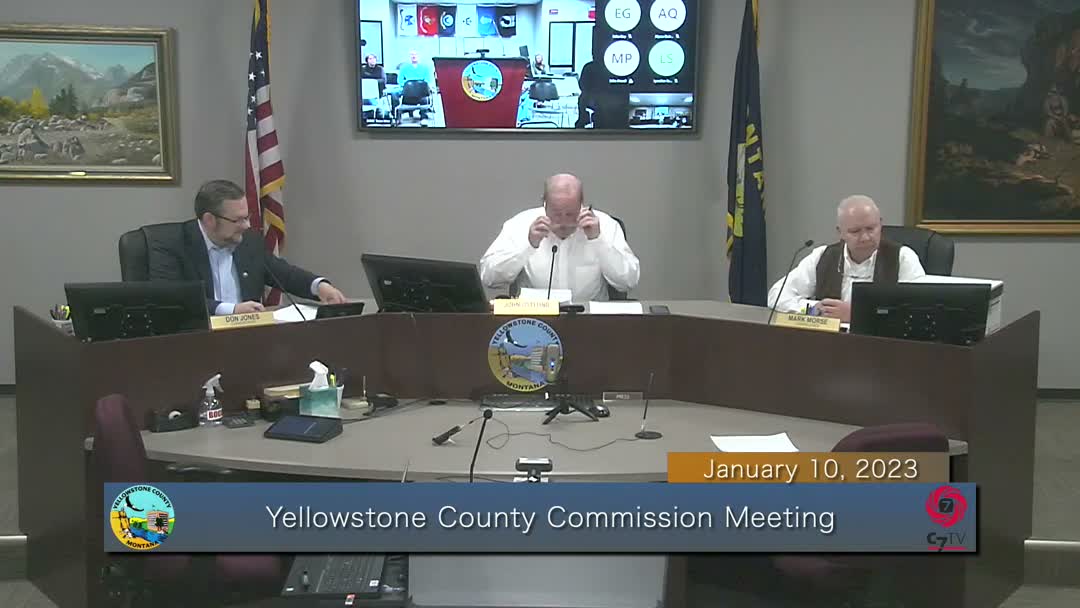
The Board of County Commissioners voted to approve the draft Billings Bypass Corridor study after a presentation by the consultant team and brief commissioner questions. The study, led by the metropolitan planning organization with participation from the city, Yellowstone County and the Montana Department of Transportation, is a planning guidance document rather than the construction contract for the roadway.
Lisa Olmstead, a consultant on the project, told commissioners the study focuses on the north section of the bypass in the Heights and is intended to knit together existing plans — growth policy, zoning, the fire master plan and water/wastewater master plans — to guide future decisions. The study includes renderings and recommendations to inform subsequent design and development discussions.
The draft lays out a new roadway name and basic controls: the roadway will be called Trailhead Road and the study records a posted speed of 45 miles per hour for both Trailhead Road and the adjacent county road segments. The presentation described signalized intersections at the new roadway’s crossings with Old Highway 312/Main Street and Bitterroot Drive, and stop control at Hawthorne Drive; the river crossing includes a 10-foot mixed-use path intended to connect to Dover Park trails.
Consultants said public engagement and stakeholder meetings informed five corridor development recommendations focused on respectful, quality-of-life-oriented growth: affordable and mixed-use housing, small-scale commercial services, green space and a possible town-center node. Renderings included illustrative commercial corners, a gas-station parcel already owned by Town Pump, and placeholder imagery for larger retail that some attendees mentioned for visualization only.
A member of the public attending online, Mike Powell, raised a concern that the Trailhead Road name had already been taken and asked staff to coordinate naming with emergency services and MDT; staff said they would follow up. Chair then called for a motion; the board approved the study by voice vote and will forward the document to the Policy Coordinating Committee (PCC) next week for further action.
The approval was a recommendation to PCC rather than a construction authorization; the Department of Transportation continues to lead the design-and-build phase of the bypass. The study document is intended to inform future design decisions and complementary projects such as transit stops, bicycle facilities and zoning considerations.
What happens next: The board forwarded the study to PCC for next-week consideration and consultants noted they would make a minor edit suggested by Commissioner Jones before final submission.
Lisa Olmstead, a consultant on the project, told commissioners the study focuses on the north section of the bypass in the Heights and is intended to knit together existing plans — growth policy, zoning, the fire master plan and water/wastewater master plans — to guide future decisions. The study includes renderings and recommendations to inform subsequent design and development discussions.
The draft lays out a new roadway name and basic controls: the roadway will be called Trailhead Road and the study records a posted speed of 45 miles per hour for both Trailhead Road and the adjacent county road segments. The presentation described signalized intersections at the new roadway’s crossings with Old Highway 312/Main Street and Bitterroot Drive, and stop control at Hawthorne Drive; the river crossing includes a 10-foot mixed-use path intended to connect to Dover Park trails.
Consultants said public engagement and stakeholder meetings informed five corridor development recommendations focused on respectful, quality-of-life-oriented growth: affordable and mixed-use housing, small-scale commercial services, green space and a possible town-center node. Renderings included illustrative commercial corners, a gas-station parcel already owned by Town Pump, and placeholder imagery for larger retail that some attendees mentioned for visualization only.
A member of the public attending online, Mike Powell, raised a concern that the Trailhead Road name had already been taken and asked staff to coordinate naming with emergency services and MDT; staff said they would follow up. Chair then called for a motion; the board approved the study by voice vote and will forward the document to the Policy Coordinating Committee (PCC) next week for further action.
The approval was a recommendation to PCC rather than a construction authorization; the Department of Transportation continues to lead the design-and-build phase of the bypass. The study document is intended to inform future design decisions and complementary projects such as transit stops, bicycle facilities and zoning considerations.
What happens next: The board forwarded the study to PCC for next-week consideration and consultants noted they would make a minor edit suggested by Commissioner Jones before final submission.
View the Full Meeting & All Its Details
This article offers just a summary. Unlock complete video, transcripts, and insights as a Founder Member.
✓
Watch full, unedited meeting videos
✓
Search every word spoken in unlimited transcripts
✓
AI summaries & real-time alerts (all government levels)
✓
Permanent access to expanding government content
30-day money-back guarantee
