Yellowstone County hears DOR briefing on 2022 property assessments, appeal steps and rebates
July 11, 2023 | Yellowstone, Montana
This article was created by AI summarizing key points discussed. AI makes mistakes, so for full details and context, please refer to the video of the full meeting. Please report any errors so we can fix them. Report an error »
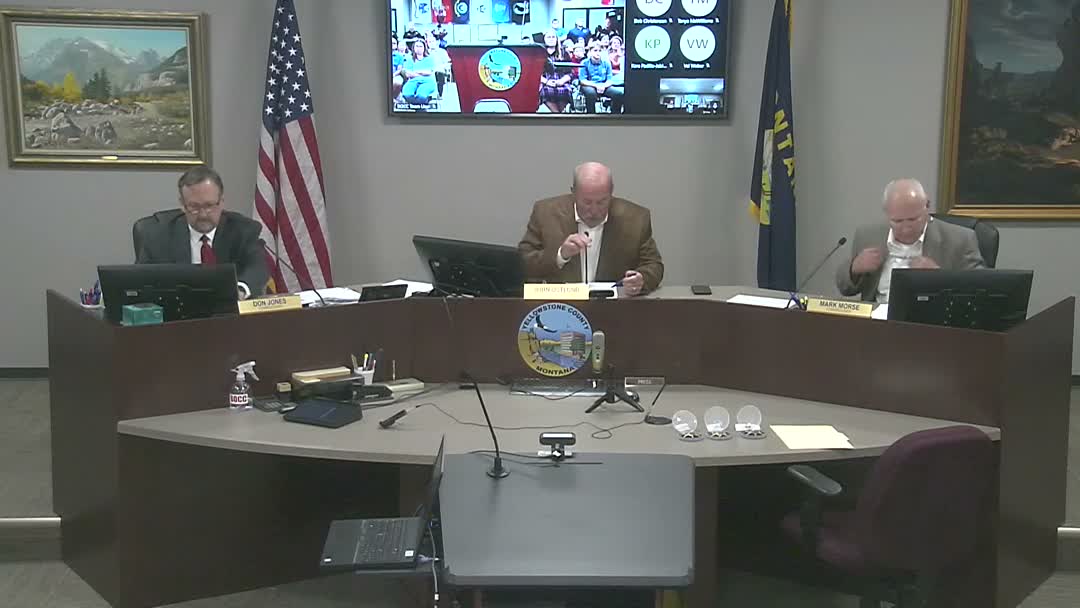
Billings — Department of Revenue appraisal staff told the Yellowstone County Board of County Commissioners on July 11 that the assessed values on this year’s appraisal and classification notices reflect market conditions as of Jan. 1, 2022, and that taxable bills will depend on those assessed values combined with locally set mill levies.
"We're here today to explain this process and answer any questions you might have," said Paula Gilbert, appraisal area manager for the Yellowstone County office of the Department of Revenue, who led the presentation. She told residents the department assesses property "at 100% of market value" as directed by statute and uses three valuation approaches — sales-comparison for most residences, income for commercial properties, and cost for unique or unfinished properties.
The presentation aimed to explain why mailed appraisal notices can look alarming while the tax amount may not rise in proportion. Regional manager Liz Franz described statutory limits local governments face on increasing budgets and mill levies and said jurisdictions are generally required to reduce mill levies when taxable values rise, which can offset some of the increase in assessed values.
Gilbert walked through how taxable value is calculated and the department's two-year tax cycle, noting that the values applied for 2023–24 were built from sales and data with a cutoff of Jan. 1, 2022. She said the department uses verified sales from July 1, 2021, through June 30, 2022, for sales-ratio studies and reported statewide sales-ratio results of about 97.42% for residential and 96.35% for commercial properties, which fall within the International Association of Assessing Officers' (IAAO) accepted range of 90%–110%.
Gilbert summarized the review and appeals process: taxpayers who disagree with an appraisal should first contact a local appraiser and may file an AB26 informal review form within 30 days of the assessment notice (most notices dated June 30 mean an AB26 must be postmarked, emailed or delivered by July 31). If the informal review does not resolve the issue, the next step is the County Tax Appeal Board (an informal, three-member local board that meets in this room), followed by the Montana Tax Appeal Board if needed.
Staff also outlined two state rebate programs: an automatic income tax rebate (up to $1,250 per individual, or $2,500 for joint filers) that requires no action by most taxpayers, and a property-tax rebate (up to $675) for which taxpayers must apply; the property-tax rebate application window opens Aug. 15.
In a public Q&A, residents pressed on several practical points: whether an owner can protest comparables used in a model (the department said owners can protest their own property's assessed value and can request to see comparables but cannot directly protest another owner’s assessment), how agricultural classifications apply to land under 20 acres, and whether solar panels are included in the mass-appraisal models. Gilbert said solar panels are not currently a modeled characteristic in Yellowstone County mass appraisal because variability and data limitations make it difficult to measure consistent value across tens of thousands of parcels, although statewide work is underway to study their effect.
The meeting also included routine county business and ceremonial items: the board approved minutes from June 27, 2023; approved listed claims; accepted a consent agenda; and set a public hearing for Resolution 23-81 (to modify subdivision regulations regarding family-member conveyance) for July 25 at 9:30 a.m. The sheriff’s office presented promotions to multiple deputies, including Laura Walker (promoted to corporal) and Robert Lester (promoted to captain), and highlighted a new assignment at the Yellowstone County Detention Facility.
The DOR team encouraged residents to review their property record on mtrevenue.gov and to contact local appraisers for a review before filing appeals. Gilbert concluded by reminding taxpayers that mills are not set until October and that taxable bills will reflect mill levies set later in the year.
The board recessed after the presentation; no final votes on assessment policy took place at the meeting.
"We're here today to explain this process and answer any questions you might have," said Paula Gilbert, appraisal area manager for the Yellowstone County office of the Department of Revenue, who led the presentation. She told residents the department assesses property "at 100% of market value" as directed by statute and uses three valuation approaches — sales-comparison for most residences, income for commercial properties, and cost for unique or unfinished properties.
The presentation aimed to explain why mailed appraisal notices can look alarming while the tax amount may not rise in proportion. Regional manager Liz Franz described statutory limits local governments face on increasing budgets and mill levies and said jurisdictions are generally required to reduce mill levies when taxable values rise, which can offset some of the increase in assessed values.
Gilbert walked through how taxable value is calculated and the department's two-year tax cycle, noting that the values applied for 2023–24 were built from sales and data with a cutoff of Jan. 1, 2022. She said the department uses verified sales from July 1, 2021, through June 30, 2022, for sales-ratio studies and reported statewide sales-ratio results of about 97.42% for residential and 96.35% for commercial properties, which fall within the International Association of Assessing Officers' (IAAO) accepted range of 90%–110%.
Gilbert summarized the review and appeals process: taxpayers who disagree with an appraisal should first contact a local appraiser and may file an AB26 informal review form within 30 days of the assessment notice (most notices dated June 30 mean an AB26 must be postmarked, emailed or delivered by July 31). If the informal review does not resolve the issue, the next step is the County Tax Appeal Board (an informal, three-member local board that meets in this room), followed by the Montana Tax Appeal Board if needed.
Staff also outlined two state rebate programs: an automatic income tax rebate (up to $1,250 per individual, or $2,500 for joint filers) that requires no action by most taxpayers, and a property-tax rebate (up to $675) for which taxpayers must apply; the property-tax rebate application window opens Aug. 15.
In a public Q&A, residents pressed on several practical points: whether an owner can protest comparables used in a model (the department said owners can protest their own property's assessed value and can request to see comparables but cannot directly protest another owner’s assessment), how agricultural classifications apply to land under 20 acres, and whether solar panels are included in the mass-appraisal models. Gilbert said solar panels are not currently a modeled characteristic in Yellowstone County mass appraisal because variability and data limitations make it difficult to measure consistent value across tens of thousands of parcels, although statewide work is underway to study their effect.
The meeting also included routine county business and ceremonial items: the board approved minutes from June 27, 2023; approved listed claims; accepted a consent agenda; and set a public hearing for Resolution 23-81 (to modify subdivision regulations regarding family-member conveyance) for July 25 at 9:30 a.m. The sheriff’s office presented promotions to multiple deputies, including Laura Walker (promoted to corporal) and Robert Lester (promoted to captain), and highlighted a new assignment at the Yellowstone County Detention Facility.
The DOR team encouraged residents to review their property record on mtrevenue.gov and to contact local appraisers for a review before filing appeals. Gilbert concluded by reminding taxpayers that mills are not set until October and that taxable bills will reflect mill levies set later in the year.
The board recessed after the presentation; no final votes on assessment policy took place at the meeting.
Don't Miss a Word: See the Full Meeting!
Go beyond summaries. Unlock every video, transcript, and key insight with a Founder Membership.
✓
Get instant access to full meeting videos
✓
Search and clip any phrase from complete transcripts
✓
Receive AI-powered summaries & custom alerts
✓
Enjoy lifetime, unrestricted access to government data
30-day money-back guarantee
