Bicycle and Pedestrian Advisory Committee highlights trails growth, seeks stronger ‘complete streets’ ties
February 07, 2023 | Yellowstone, Montana
This article was created by AI summarizing key points discussed. AI makes mistakes, so for full details and context, please refer to the video of the full meeting. Please report any errors so we can fix them. Report an error »
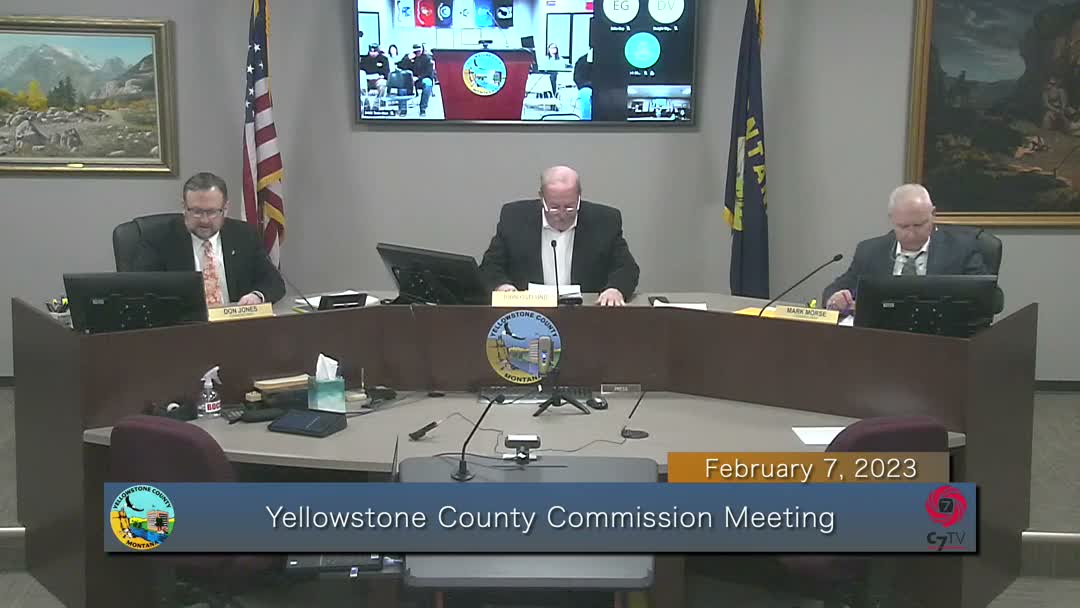
Joan Shea, the county-appointed member of the Bicycle and Pedestrian Advisory Committee, told the Yellowstone County Board of County Commissioners on Feb. 7 that non-motorized travel in Billings is rising and that the committee is focused on making streets and trails safer and more accessible. "Our focus is ensuring that the community's infrastructure enables people to walk, bike, and use wheelchairs safely," Shea said during the committee’s annual presentation.
Elise Monat, active transportation planner with the city–county planning office, introduced Shea and said the committee uses the Billings Area bikeway and trail master plan to guide recommendations. Shea highlighted completed connections and near-term projects, including the Skyline Trail along Highway 3, a proposed Stage Coach Trail, a marathon loop and a bike path on the Billings Bypass Bridge. "Key trail connections have been built," she said, and BPAC reported trail counts recently exceeding roughly 100 users per day — an estimate the committee said equates to some 35,000–40,000 trail uses annually.
Shea reviewed outreach and data collection methods — monthly public comment at BPAC meetings, online comment channels, and a three-month survey period to prioritize issues. She noted safety investments such as flashing beacons identified in the 2021 Safe Routes to School plan and urged increased driver enforcement and bicyclist education to reduce conflicts. "Driver education and law enforcement is a key to avoiding bike–pedestrian conflict," she said.
During a short question-and-answer exchange, a commissioner pointed out that the presentation’s complete-streets language incorrectly implied both Yellowstone County and the Montana Department of Transportation had adopted a complete-streets policy. Planning staff confirmed the county does not have a complete-streets policy and said they would correct the presentation materials. Shea asked whether a trail maintenance reserve fund could be incorporated into trail plans; staff replied the fund is reserved for county-owned trail repairs and should be reflected in trail planning and RSID (road special improvement district) arrangements when county segments require maintenance.
BPAC asked commissioners to support outreach campaigns, pursue recreational-trail and stewardship grants, and work with the city and state to strengthen complete-streets approaches as the master plan is updated. The committee framed the work as advancing public health and community connectivity and said it will continue compiling public input to prioritize projects.
Elise Monat, active transportation planner with the city–county planning office, introduced Shea and said the committee uses the Billings Area bikeway and trail master plan to guide recommendations. Shea highlighted completed connections and near-term projects, including the Skyline Trail along Highway 3, a proposed Stage Coach Trail, a marathon loop and a bike path on the Billings Bypass Bridge. "Key trail connections have been built," she said, and BPAC reported trail counts recently exceeding roughly 100 users per day — an estimate the committee said equates to some 35,000–40,000 trail uses annually.
Shea reviewed outreach and data collection methods — monthly public comment at BPAC meetings, online comment channels, and a three-month survey period to prioritize issues. She noted safety investments such as flashing beacons identified in the 2021 Safe Routes to School plan and urged increased driver enforcement and bicyclist education to reduce conflicts. "Driver education and law enforcement is a key to avoiding bike–pedestrian conflict," she said.
During a short question-and-answer exchange, a commissioner pointed out that the presentation’s complete-streets language incorrectly implied both Yellowstone County and the Montana Department of Transportation had adopted a complete-streets policy. Planning staff confirmed the county does not have a complete-streets policy and said they would correct the presentation materials. Shea asked whether a trail maintenance reserve fund could be incorporated into trail plans; staff replied the fund is reserved for county-owned trail repairs and should be reflected in trail planning and RSID (road special improvement district) arrangements when county segments require maintenance.
BPAC asked commissioners to support outreach campaigns, pursue recreational-trail and stewardship grants, and work with the city and state to strengthen complete-streets approaches as the master plan is updated. The committee framed the work as advancing public health and community connectivity and said it will continue compiling public input to prioritize projects.
Don't Miss a Word: See the Full Meeting!
Go beyond summaries. Unlock every video, transcript, and key insight with a Founder Membership.
✓
Get instant access to full meeting videos
✓
Search and clip any phrase from complete transcripts
✓
Receive AI-powered summaries & custom alerts
✓
Enjoy lifetime, unrestricted access to government data
30-day money-back guarantee
