County hears mid‑plan update on Safe Routes to School Phase 2
April 25, 2023 | Yellowstone, Montana
This article was created by AI summarizing key points discussed. AI makes mistakes, so for full details and context, please refer to the video of the full meeting. Please report any errors so we can fix them. Report an error »
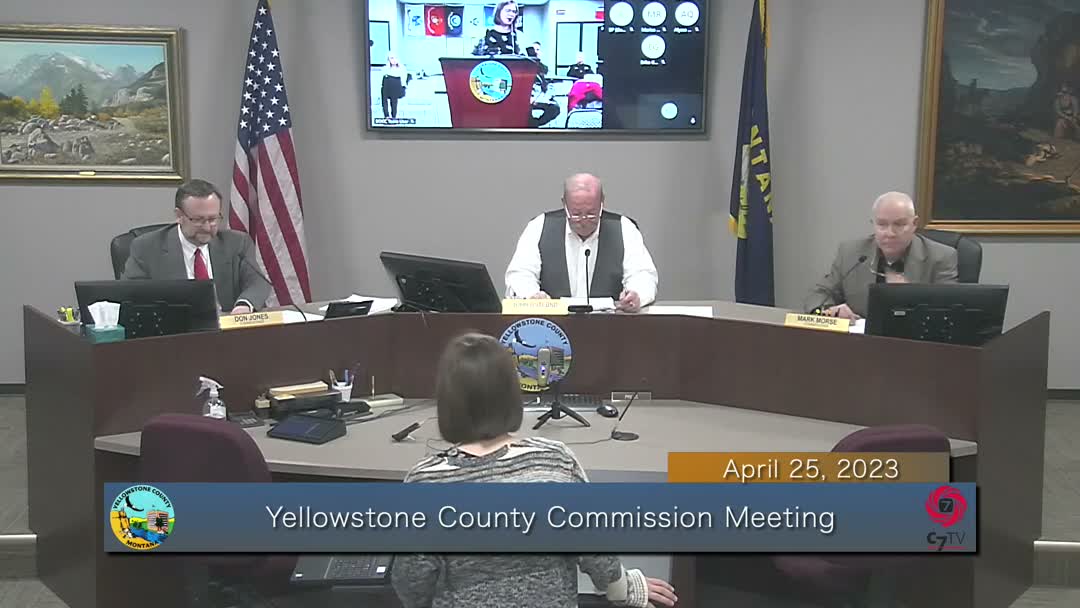
The Yellowstone County Board of County Commissioners received a mid‑plan report April 25 on Phase 2 of the county’s Safe Routes to School project, which extends analysis beyond elementary campuses to include middle schools, county and private schools.
Elise Monat, active transportation planner with the city‑county planning office, introduced the update and said staff will return later seeking a recommendation to forward the plan to the Policy Coordinating Committee.
Aaron Claunch, municipal group manager and project manager for Sanderson Stewart, told commissioners the Phase 2 scope deliberately widens previous work to include middle schools and non‑district schools such as Elysian, Lockwood and Pioneer, and a set of private campuses. He said the team has prepared preliminary base maps showing half‑mile and one‑mile walk radii, existing sidewalks and trails, and mapped historical bicycle and pedestrian crash points to identify missing links.
"We're about halfway through," Claunch said of the field work, referring to 8 of 17 schools where the team has completed walk audits. He described walk audits as "boots on the ground" inventories of traffic patterns, signage, crosswalk condition and pedestrian behavior to identify where infrastructure or programmatic fixes are needed.
The project team is also running public outreach, Claunch said, including in‑person engagement at school events and an online map and survey where residents can drop pins and leave comments about hazards such as speeding or poor crossings. Claunch demonstrated the map interface and explained how pins and comments are collected to inform future project lists.
Claunch said the next steps are to finish the remaining walk audits (the team expects the last audit around May 21), compile audit and survey data in June–August, draft recommendations and route the plan through the Technical Advisory Committee before returning to the board, city council and the Policy Coordinating Committee for final review in September–October.
On board questions about separated sidewalks and pedestrian counts, Claunch said separated sidewalks are the preferred outcome "ideally, yes," but that right‑of‑way constraints can limit options. He added the county and partners have trail counters and other tools they can use to monitor pedestrian activity, though school‑specific counts may vary.
Claunch flagged funding and coordination issues the board will need to resolve later: possible use of RSIDs and tying Safe Routes projects to larger capital improvements such as the Grand Avenue reconstruction so pedestrian improvements can be built alongside roadway projects.
The team will return in a few months with a draft document, Claunch said. "We'll be back in a few months when we've got a document for you," he told the board.
Elise Monat, active transportation planner with the city‑county planning office, introduced the update and said staff will return later seeking a recommendation to forward the plan to the Policy Coordinating Committee.
Aaron Claunch, municipal group manager and project manager for Sanderson Stewart, told commissioners the Phase 2 scope deliberately widens previous work to include middle schools and non‑district schools such as Elysian, Lockwood and Pioneer, and a set of private campuses. He said the team has prepared preliminary base maps showing half‑mile and one‑mile walk radii, existing sidewalks and trails, and mapped historical bicycle and pedestrian crash points to identify missing links.
"We're about halfway through," Claunch said of the field work, referring to 8 of 17 schools where the team has completed walk audits. He described walk audits as "boots on the ground" inventories of traffic patterns, signage, crosswalk condition and pedestrian behavior to identify where infrastructure or programmatic fixes are needed.
The project team is also running public outreach, Claunch said, including in‑person engagement at school events and an online map and survey where residents can drop pins and leave comments about hazards such as speeding or poor crossings. Claunch demonstrated the map interface and explained how pins and comments are collected to inform future project lists.
Claunch said the next steps are to finish the remaining walk audits (the team expects the last audit around May 21), compile audit and survey data in June–August, draft recommendations and route the plan through the Technical Advisory Committee before returning to the board, city council and the Policy Coordinating Committee for final review in September–October.
On board questions about separated sidewalks and pedestrian counts, Claunch said separated sidewalks are the preferred outcome "ideally, yes," but that right‑of‑way constraints can limit options. He added the county and partners have trail counters and other tools they can use to monitor pedestrian activity, though school‑specific counts may vary.
Claunch flagged funding and coordination issues the board will need to resolve later: possible use of RSIDs and tying Safe Routes projects to larger capital improvements such as the Grand Avenue reconstruction so pedestrian improvements can be built alongside roadway projects.
The team will return in a few months with a draft document, Claunch said. "We'll be back in a few months when we've got a document for you," he told the board.
Don't Miss a Word: See the Full Meeting!
Go beyond summaries. Unlock every video, transcript, and key insight with a Founder Membership.
✓
Get instant access to full meeting videos
✓
Search and clip any phrase from complete transcripts
✓
Receive AI-powered summaries & custom alerts
✓
Enjoy lifetime, unrestricted access to government data
30-day money-back guarantee
