Carmel board debates budget scenarios as trustees seek cuts, state aid and one‑time savings
April 16, 2024 | CARMEL CENTRAL SCHOOL DISTRICT, School Districts, New York
This article was created by AI summarizing key points discussed. AI makes mistakes, so for full details and context, please refer to the video of the full meeting. Please report any errors so we can fix them. Report an error »
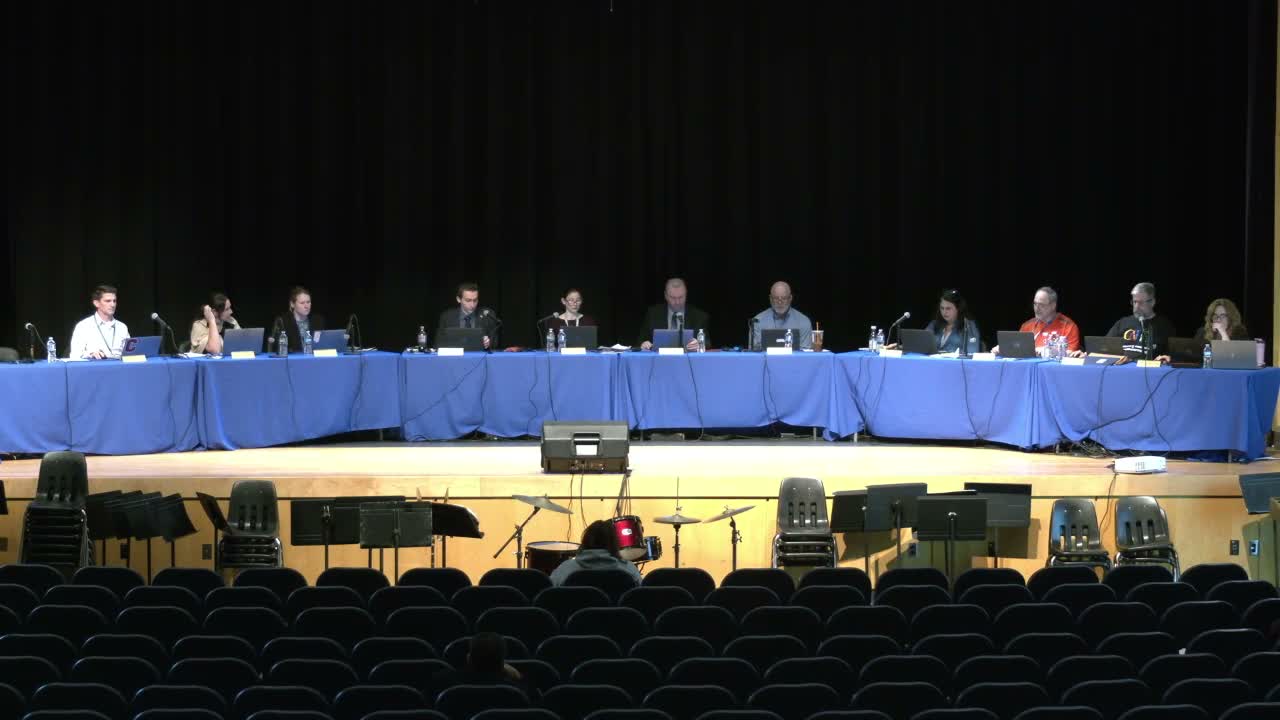
The Carmel Central School District Board of Education spent the bulk of its April 16 meeting focused on narrowing options to close a multi‑million‑dollar gap in the 2024–25 budget.
President Dahl said administrators identified a roughly $6 million shortfall and emphasized the need for long‑term reserve rebuilding while trustees and the public pressed for specific, verifiable savings. "We took from our rainy day funds even though it was sunny out," Dahl said in describing prior years' use of reserves.
Trustees reviewed several scenarios that would affect the tax levy and programs differently. Staff presented sample tax‑levy outcomes ranging from roughly 1.79% to 2.12% increases under different mixes of cuts and restored items. Under one commonly discussed configuration (scenario 9.3 plus trustee adjustments and a modest administrative reduction), administration calculated a projected levy near 1.79% before modeling additional one‑time savings. Directors said they would model variations if the state budget produced additional foundation aid.
A potential $700,000 increase in state foundation aid — still unresolved in Albany at the time of the meeting — drew repeated attention. Trustees discussed splitting any new aid between replenishing reserves and reducing the levy. Administration said it would produce models showing several alternatives (for example, moving $200,000 of hypothetical state aid to the levy and $500,000 to reserves) so the board can see tradeoffs.
Trustees also debated district‑level cost reductions: eliminating or trimming high‑cost line items such as administrative positions, custodial or grounds positions, freshman/modified sports, and a media‑specialist role. Board members repeatedly warned that cutting maintenance, grounds or custodial staff could increase contracted services and overtime costs, producing offsetting expenses.
Trustee Curzio pushed for more granular arithmetic. "Before we vote at a final budget on Wednesday, I would hate to see that tax‑levy number change because of rounding in these charts," he said, asking for an Excel spreadsheet with base numbers the board can edit live. Administration agreed to return with live, spreadsheeted models and to show the effect of each change in near real time.
Trustees also discussed two longer‑term measures to change underlying cost structures: a Princeton model for rebalancing elementary enrollments and the possibility of closing or consolidating buildings if future enrollment trends make it feasible. Administration described the Princeton option as promising but cautioned it required careful study of transportation, classroom configurations and retrofit costs; early staff estimates suggested two sections could be eliminated in targeted grades, with conservative savings put into models.
Public commenters repeatedly urged transparency and faulted the administration for line‑item irregularities. Residents flagged a pattern of line items that were underbudgeted year over year — notably in chaperone and overtime categories — and asked why the administration had not corrected repeated discrepancies earlier. Administration acknowledged past misallocations of payroll codes and said it was correcting them and reviewing major variance lines.
Board members set an aggressive schedule: the board will reconvene to refine the models with live spreadsheets and to vote in the next cycle, acknowledging the legal deadline to adopt a budget is tight. If the budget fails, trustees discussed the possibility of a contingent (0% levy) budget and the painful program changes that would follow.
Provenance: The board's budget discussion began in detail in the transcript at SEG 2966 and continued through extensive exchange ending around SEG 5636. The board requested updated spreadsheet models and additional scenario analysis to be provided before the next meeting.
President Dahl said administrators identified a roughly $6 million shortfall and emphasized the need for long‑term reserve rebuilding while trustees and the public pressed for specific, verifiable savings. "We took from our rainy day funds even though it was sunny out," Dahl said in describing prior years' use of reserves.
Trustees reviewed several scenarios that would affect the tax levy and programs differently. Staff presented sample tax‑levy outcomes ranging from roughly 1.79% to 2.12% increases under different mixes of cuts and restored items. Under one commonly discussed configuration (scenario 9.3 plus trustee adjustments and a modest administrative reduction), administration calculated a projected levy near 1.79% before modeling additional one‑time savings. Directors said they would model variations if the state budget produced additional foundation aid.
A potential $700,000 increase in state foundation aid — still unresolved in Albany at the time of the meeting — drew repeated attention. Trustees discussed splitting any new aid between replenishing reserves and reducing the levy. Administration said it would produce models showing several alternatives (for example, moving $200,000 of hypothetical state aid to the levy and $500,000 to reserves) so the board can see tradeoffs.
Trustees also debated district‑level cost reductions: eliminating or trimming high‑cost line items such as administrative positions, custodial or grounds positions, freshman/modified sports, and a media‑specialist role. Board members repeatedly warned that cutting maintenance, grounds or custodial staff could increase contracted services and overtime costs, producing offsetting expenses.
Trustee Curzio pushed for more granular arithmetic. "Before we vote at a final budget on Wednesday, I would hate to see that tax‑levy number change because of rounding in these charts," he said, asking for an Excel spreadsheet with base numbers the board can edit live. Administration agreed to return with live, spreadsheeted models and to show the effect of each change in near real time.
Trustees also discussed two longer‑term measures to change underlying cost structures: a Princeton model for rebalancing elementary enrollments and the possibility of closing or consolidating buildings if future enrollment trends make it feasible. Administration described the Princeton option as promising but cautioned it required careful study of transportation, classroom configurations and retrofit costs; early staff estimates suggested two sections could be eliminated in targeted grades, with conservative savings put into models.
Public commenters repeatedly urged transparency and faulted the administration for line‑item irregularities. Residents flagged a pattern of line items that were underbudgeted year over year — notably in chaperone and overtime categories — and asked why the administration had not corrected repeated discrepancies earlier. Administration acknowledged past misallocations of payroll codes and said it was correcting them and reviewing major variance lines.
Board members set an aggressive schedule: the board will reconvene to refine the models with live spreadsheets and to vote in the next cycle, acknowledging the legal deadline to adopt a budget is tight. If the budget fails, trustees discussed the possibility of a contingent (0% levy) budget and the painful program changes that would follow.
Provenance: The board's budget discussion began in detail in the transcript at SEG 2966 and continued through extensive exchange ending around SEG 5636. The board requested updated spreadsheet models and additional scenario analysis to be provided before the next meeting.
View the Full Meeting & All Its Details
This article offers just a summary. Unlock complete video, transcripts, and insights as a Founder Member.
✓
Watch full, unedited meeting videos
✓
Search every word spoken in unlimited transcripts
✓
AI summaries & real-time alerts (all government levels)
✓
Permanent access to expanding government content
30-day money-back guarantee
