Carmel schools present facilities budget, flag asbestos work and seek building aid transfer
January 23, 2024 | CARMEL CENTRAL SCHOOL DISTRICT, School Districts, New York
This article was created by AI summarizing key points discussed. AI makes mistakes, so for full details and context, please refer to the video of the full meeting. Please report any errors so we can fix them. Report an error »
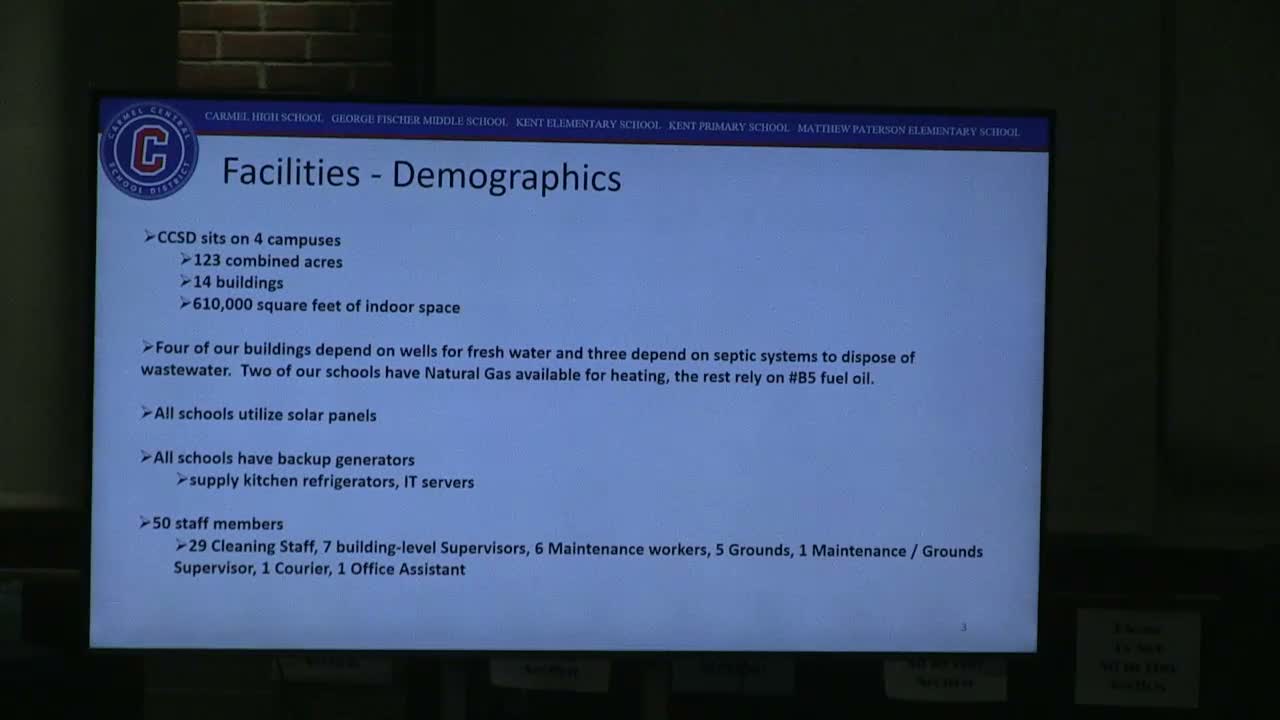
Alberto Venezia, the district facilities lead, told the Carmel Central School District board on Jan. 23 that the proposed 2024–25 facilities budget holds most accounts steady while asking for targeted equipment replacements and remediation work. He said the district operates four campuses across 14 buildings totaling about 610,000 square feet and highlighted recent and planned projects including asbestos abatement, a district‑run CAT‑6/VoIP wiring project, and equipment replacements.
Venezia said in‑house labor on the VoIP wiring has produced substantial savings compared with outside contractors. “If an outside vendor was hired to run the wiring, it would have cost the district $193,000. We did it in house for $67,000,” he said, citing a roughly $126,000 savings estimate. He recommended using some of those savings for unfunded equipment needs such as a Ventrac tractor, a Polaris sidewalk plow, and new floor cleaning machines.
Board members pressed on how flexible that saved money is and whether funds dedicated to the VoIP project can be reallocated. Venezia and business office staff said the work done in‑house did not tap the purchase authorization given for the VoIP contract and that moving funds into capital to secure building aid has procedural limits and timing tradeoffs. “If the timing works, we would receive about 60% building aid,” a district official said, noting the site must file with the State Education Department and that a transfer to capital could delay work until the next construction season.
Venezia also described proposed maintenance and in‑house upgrades: abatement and new flooring at Matthew Patterson Elementary, bathroom upgrades at George Fisher Middle School, new shades and lighting districtwide, and replacing aging maintenance vehicles on a three‑year replacement cadence. He estimated a proposed modest increase in the fuel line to $3.60 per gallon to reflect market volatility and flagged higher water and sewer charges from the Town of Carmel.
Why it matters: The board faces a calendar decision that will affect whether asbestos work is done before summer, which determines if the district can claim higher building aid this budget cycle. The choice weighs faster remediation against the potential for higher state reimbursement if the work is moved into capital and scheduled according to SED timelines.
What’s next: The facilities presentation fed into a broader capital discussion the board is advancing toward a likely May 2024 referendum. Administration said it will continue to refine the budget lines, confirm timing for capital transfers, and provide detail on equipment prioritization and any planned use of fund balances.
Venezia said in‑house labor on the VoIP wiring has produced substantial savings compared with outside contractors. “If an outside vendor was hired to run the wiring, it would have cost the district $193,000. We did it in house for $67,000,” he said, citing a roughly $126,000 savings estimate. He recommended using some of those savings for unfunded equipment needs such as a Ventrac tractor, a Polaris sidewalk plow, and new floor cleaning machines.
Board members pressed on how flexible that saved money is and whether funds dedicated to the VoIP project can be reallocated. Venezia and business office staff said the work done in‑house did not tap the purchase authorization given for the VoIP contract and that moving funds into capital to secure building aid has procedural limits and timing tradeoffs. “If the timing works, we would receive about 60% building aid,” a district official said, noting the site must file with the State Education Department and that a transfer to capital could delay work until the next construction season.
Venezia also described proposed maintenance and in‑house upgrades: abatement and new flooring at Matthew Patterson Elementary, bathroom upgrades at George Fisher Middle School, new shades and lighting districtwide, and replacing aging maintenance vehicles on a three‑year replacement cadence. He estimated a proposed modest increase in the fuel line to $3.60 per gallon to reflect market volatility and flagged higher water and sewer charges from the Town of Carmel.
Why it matters: The board faces a calendar decision that will affect whether asbestos work is done before summer, which determines if the district can claim higher building aid this budget cycle. The choice weighs faster remediation against the potential for higher state reimbursement if the work is moved into capital and scheduled according to SED timelines.
What’s next: The facilities presentation fed into a broader capital discussion the board is advancing toward a likely May 2024 referendum. Administration said it will continue to refine the budget lines, confirm timing for capital transfers, and provide detail on equipment prioritization and any planned use of fund balances.
Don't Miss a Word: See the Full Meeting!
Go beyond summaries. Unlock every video, transcript, and key insight with a Founder Membership.
✓
Get instant access to full meeting videos
✓
Search and clip any phrase from complete transcripts
✓
Receive AI-powered summaries & custom alerts
✓
Enjoy lifetime, unrestricted access to government data
30-day money-back guarantee
