Board pauses decision on Japantown Peace Plaza tree removals after tense hearing
January 17, 2024 | San Francisco City, San Francisco County, California
This article was created by AI summarizing key points discussed. AI makes mistakes, so for full details and context, please refer to the video of the full meeting. Please report any errors so we can fix them. Report an error »
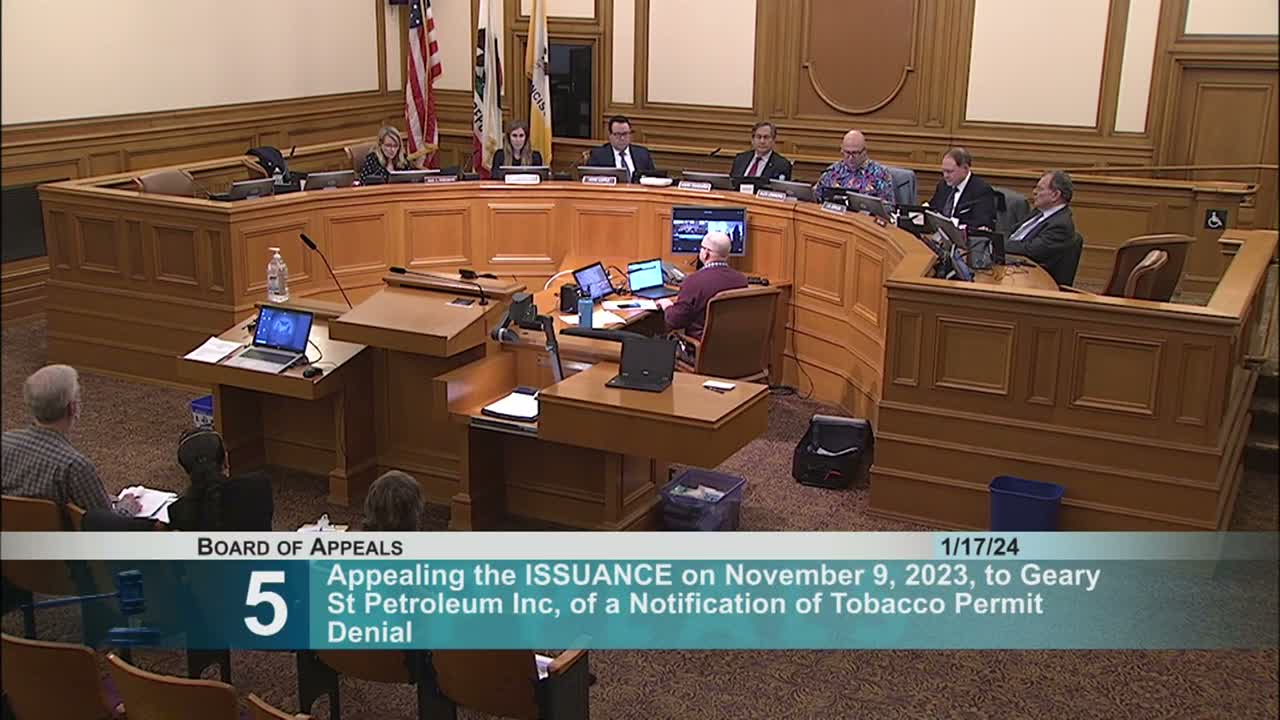
The San Francisco Board of Appeals on Jan. 17 continued a decision on a permit to remove two small trees at the Japantown Peace Plaza, directing Rec & Park, Public Works and the Bureau of Urban Forestry to negotiate a replacement plan and return to the board on March 13. The motion to continue carried 4-1.
The dispute centers on a curb-to-curb renovation at the plaza. Project staff say the trees were planted in constrained planters on top of substructure, that the species now conflict with visibility standards under the city’s Vision Zero program and that the small trees show poor long-term prospects at the site. Kevin Jensen, the city’s ADA and disability-access coordinator, told commissioners the trees “absolutely block those, pass pole mounted lights” and argued redundancy in signal placement is critical for safety when pedestrians and drivers make mistakes.
Appellant Mr Klipp (appearing as Joshua Clipp in filings) pushed back, saying Rec & Park’s presentation relied on misleading graphics and that the real safety problems are illegal parking and loading behavior at the crossing. “First, preserve these trees and address the real problem,” Klipp told the board. “If the trees cannot be preserved, move them rather than throw away 2 healthy trees.” He urged transplanting or fuller basal-area replacement consistent with the Climate Action Plan.
Chris Buck, Urban Forester at Public Works’ Bureau of Urban Forestry, said his agency had reviewed the site and that the case presented a public-safety concern. BUFF offered to verify trunk diameters, work with the appellant on a basal-area replacement calculation and identify nearby empty tree wells suitable for higher-value replacement plantings. Rec & Park’s project manager said the agency had briefed community advisory groups repeatedly and said the agency would be open to locating additional replacement trees, though she noted structural constraints under the plaza limit tree locations and sizes.
Public commenters and several commissioners pressed for clearer, site-specific evidence linking the trees to collisions or near-misses; BUFF and Public Works said Vision Zero is intentionally proactive and relies on design guidance beyond strictly recorded crash counts. Commissioners said the record submitted with the permit lacked some site-specific photos, crash metrics and a more robust replacement plan, and various members proposed remedying that deficit before a final vote.
Rather than rule for or against the removal at the hearing, the board amended a motion to continue the matter to allow the parties and community to reach a replacement plan consistent with feedback provided during the hearing. The board explicitly stated the continuance “does not assume the two trees will automatically be removed” and set March 13, 2024 as the continuation date for the item.
Next steps: Rec & Park, Public Works and BUFF were asked to return with a time‑bound, site‑specific replacement proposal (BUFF offered to verify trunk diameters and possible basal‑area equivalency) and evidence of community outreach. The board said if the parties cannot reach agreement the appeal can return for a final decision.
The dispute centers on a curb-to-curb renovation at the plaza. Project staff say the trees were planted in constrained planters on top of substructure, that the species now conflict with visibility standards under the city’s Vision Zero program and that the small trees show poor long-term prospects at the site. Kevin Jensen, the city’s ADA and disability-access coordinator, told commissioners the trees “absolutely block those, pass pole mounted lights” and argued redundancy in signal placement is critical for safety when pedestrians and drivers make mistakes.
Appellant Mr Klipp (appearing as Joshua Clipp in filings) pushed back, saying Rec & Park’s presentation relied on misleading graphics and that the real safety problems are illegal parking and loading behavior at the crossing. “First, preserve these trees and address the real problem,” Klipp told the board. “If the trees cannot be preserved, move them rather than throw away 2 healthy trees.” He urged transplanting or fuller basal-area replacement consistent with the Climate Action Plan.
Chris Buck, Urban Forester at Public Works’ Bureau of Urban Forestry, said his agency had reviewed the site and that the case presented a public-safety concern. BUFF offered to verify trunk diameters, work with the appellant on a basal-area replacement calculation and identify nearby empty tree wells suitable for higher-value replacement plantings. Rec & Park’s project manager said the agency had briefed community advisory groups repeatedly and said the agency would be open to locating additional replacement trees, though she noted structural constraints under the plaza limit tree locations and sizes.
Public commenters and several commissioners pressed for clearer, site-specific evidence linking the trees to collisions or near-misses; BUFF and Public Works said Vision Zero is intentionally proactive and relies on design guidance beyond strictly recorded crash counts. Commissioners said the record submitted with the permit lacked some site-specific photos, crash metrics and a more robust replacement plan, and various members proposed remedying that deficit before a final vote.
Rather than rule for or against the removal at the hearing, the board amended a motion to continue the matter to allow the parties and community to reach a replacement plan consistent with feedback provided during the hearing. The board explicitly stated the continuance “does not assume the two trees will automatically be removed” and set March 13, 2024 as the continuation date for the item.
Next steps: Rec & Park, Public Works and BUFF were asked to return with a time‑bound, site‑specific replacement proposal (BUFF offered to verify trunk diameters and possible basal‑area equivalency) and evidence of community outreach. The board said if the parties cannot reach agreement the appeal can return for a final decision.
View the Full Meeting & All Its Details
This article offers just a summary. Unlock complete video, transcripts, and insights as a Founder Member.
✓
Watch full, unedited meeting videos
✓
Search every word spoken in unlimited transcripts
✓
AI summaries & real-time alerts (all government levels)
✓
Permanent access to expanding government content
30-day money-back guarantee
