City staff report major spending and remaining balances on 2015, 2016 and 2019 affordable housing bonds
February 26, 2024 | San Francisco City, San Francisco County, California
This article was created by AI summarizing key points discussed. AI makes mistakes, so for full details and context, please refer to the video of the full meeting. Please report any errors so we can fix them. Report an error »
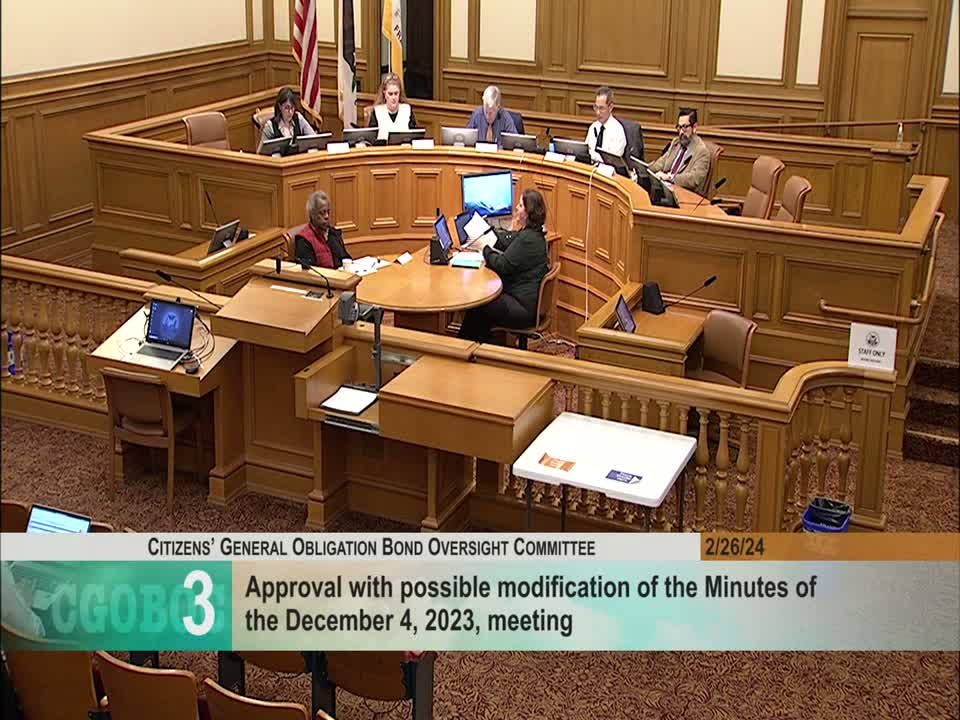
Andrew Grama, finance director at the Mayor's Office of Housing and Community Development, told the committee the city's affordable housing general obligation programs are largely being spent down and will remain a central funding source for preservation and new units.
"This was a $310,000,000 bond passed in November 2015. We have completed all 3 issuances and are more than 95% spent as of December 2023," Grama said during the presentation. He said the 2019 bond, passed in November 2019 for $600,000,000, has completed two issuances and is "more than 70% spent and encumbered" across those issuances, with a third issuance being planned and expected to be completed before the end of 2024.
Why it matters: the bonds subsidize multiple categories — low-income, middle-income, preservation, senior and educator housing — and leverage other funding to increase units more quickly than the city could by acting as a direct developer.
Key details from the presentation:
- 2015 GO bond: $310 million authorized; staff expect first and second issuances to be fully spent by mid-2024 and the third by the end of 2024; unit production projected to add more than 1,500 units across the bond (over 1,000 already completed).
- 2019 GO bond: $600 million authorized; low-income housing accounts for more than a third of the bond; low-income category was reported 84% issued with a full-spend projection into 2028; senior-housing and educator-housing categories are slated to comprise much of a planned third issuance.
- 2016 PASS (preservation and seismic safety): repurposed by voters in 2016 to provide acquisition and rehab loans, seismic retrofit, and preservation financing; loans carry long terms (Oliver said the office can offer "40 year loan terms") and include underwriting changes after COVID (debt-service ratio increased from 1.1 to 1.5 and vacancy assumptions were doubled to strengthen sponsor cash flow). Staff reported roughly $98,000,000 remains for preservation in a future series allocation.
Staff answered questions from commissioners about project scale and definitions: "a minimum would be 5 units on average. 5 to 25 is what we see in small sites. What we refer to as big sites would be anything over 25 units," a staff member said.
What remains: staff said certain lingering balances—retention and punch-list amounts and down-payment-assistance loans—will likely be reallocated or spent by the end of 2024. Grama also noted the 2024 ballot measure (Prop A) would add $300 million if approved.
Next steps: staff will continue planning the timing of the third 2019 issuance and report back as project spend-downs and interest-rate conditions firm up. Several commissioners signaled interest in more project-level address details for map items and additional follow-up on the PASS underwriting changes.
Provenance: topic introduced at committee presentation and concluded after Q&A (transcript evidence spans SEG 106–SEG 224 and SEG 262–SEG 367).
"This was a $310,000,000 bond passed in November 2015. We have completed all 3 issuances and are more than 95% spent as of December 2023," Grama said during the presentation. He said the 2019 bond, passed in November 2019 for $600,000,000, has completed two issuances and is "more than 70% spent and encumbered" across those issuances, with a third issuance being planned and expected to be completed before the end of 2024.
Why it matters: the bonds subsidize multiple categories — low-income, middle-income, preservation, senior and educator housing — and leverage other funding to increase units more quickly than the city could by acting as a direct developer.
Key details from the presentation:
- 2015 GO bond: $310 million authorized; staff expect first and second issuances to be fully spent by mid-2024 and the third by the end of 2024; unit production projected to add more than 1,500 units across the bond (over 1,000 already completed).
- 2019 GO bond: $600 million authorized; low-income housing accounts for more than a third of the bond; low-income category was reported 84% issued with a full-spend projection into 2028; senior-housing and educator-housing categories are slated to comprise much of a planned third issuance.
- 2016 PASS (preservation and seismic safety): repurposed by voters in 2016 to provide acquisition and rehab loans, seismic retrofit, and preservation financing; loans carry long terms (Oliver said the office can offer "40 year loan terms") and include underwriting changes after COVID (debt-service ratio increased from 1.1 to 1.5 and vacancy assumptions were doubled to strengthen sponsor cash flow). Staff reported roughly $98,000,000 remains for preservation in a future series allocation.
Staff answered questions from commissioners about project scale and definitions: "a minimum would be 5 units on average. 5 to 25 is what we see in small sites. What we refer to as big sites would be anything over 25 units," a staff member said.
What remains: staff said certain lingering balances—retention and punch-list amounts and down-payment-assistance loans—will likely be reallocated or spent by the end of 2024. Grama also noted the 2024 ballot measure (Prop A) would add $300 million if approved.
Next steps: staff will continue planning the timing of the third 2019 issuance and report back as project spend-downs and interest-rate conditions firm up. Several commissioners signaled interest in more project-level address details for map items and additional follow-up on the PASS underwriting changes.
Provenance: topic introduced at committee presentation and concluded after Q&A (transcript evidence spans SEG 106–SEG 224 and SEG 262–SEG 367).
View the Full Meeting & All Its Details
This article offers just a summary. Unlock complete video, transcripts, and insights as a Founder Member.
✓
Watch full, unedited meeting videos
✓
Search every word spoken in unlimited transcripts
✓
AI summaries & real-time alerts (all government levels)
✓
Permanent access to expanding government content
30-day money-back guarantee
