Fire chief outlines $511M budget, warns EMS workload and staffing limit flexibility
June 16, 2023 | San Francisco County, California
This article was created by AI summarizing key points discussed. AI makes mistakes, so for full details and context, please refer to the video of the full meeting. Please report any errors so we can fix them. Report an error »
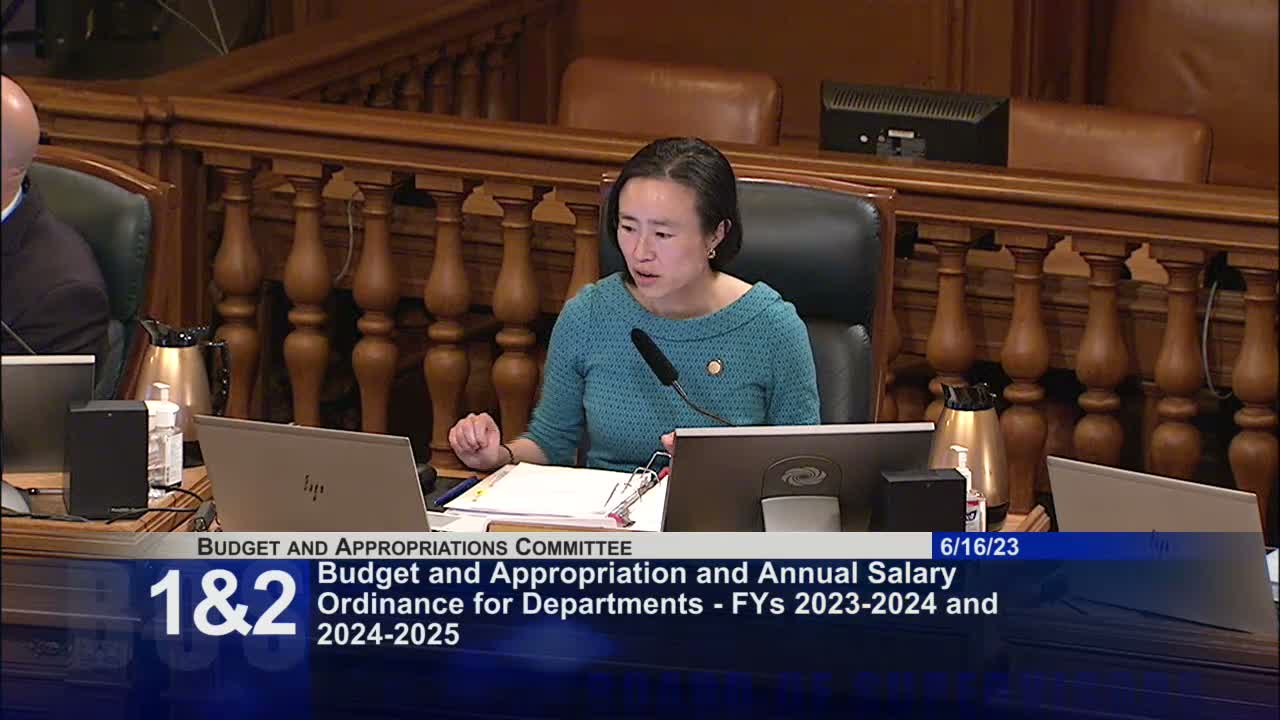
Fire Chief Janine Nicholson presented the San Francisco Fire Department’s proposed budget to the Board’s Budget and Appropriations Committee on June 16, saying the department will spend roughly $511 million–$527 million across the next two fiscal years and remains heavily dependent on General Fund support. She told supervisors that about 90% of the department’s budget is salary and benefits, and that the largest year‑over‑year increases reflect recent union (MOU) settlements rather than new program investments.
Nicholson said the department brought in about $33 million in EMS revenue this year, driven by higher call volumes and prior authorization of additional positions. She described a constrained budget profile for materials and supplies — the department ran short earlier in the fiscal year and was granted an additional $2.5 million to bring that line to roughly $7.1 million. Nicholson warned that, because personnel costs dominate the budget, there is “very limited flexibility” to reduce spending without affecting front‑line operations.
Supervisors asked specific questions about equipment and operational plans. Nicholson said engine purchases have climbed to roughly $900,000 apiece and ladder trucks exceed $2 million, and she urged the Board to consider long‑term replacement strategies. She also confirmed the department was training jet‑ski operations for District 10 and evaluating storage arrangements with a private developer but did not expect deployment this fiscal year.
Committee members pressed Nicholson on the fire department’s role in street crisis response. Supervisor Safaee and others asked whether Fire is absorbing costs after the Department of Public Health shifted behavioral health clinician funding; Finance and planning staff told the Committee that the 14 EMT positions the fire department proposes would cost a little under $2 million annually. Nicholson said the department has been covering some of that work with overtime and additional ambulance‑side staff trained in community paramedicine, and that street crisis teams are now making it to roughly 91% of dispatched calls but that call volumes remain well above pre‑pandemic levels.
Nicholson also described work to diversify the department and expand a local EMT pipeline; she said two firefighter academies per year remain a hiring strategy and that no new permanent positions were funded in the proposed budget. The presentation closed with Nicholson noting the twin pressures of rising equipment costs and a personnel‑heavy budget, and an acknowledgement that reductions will be limited and will likely impact non‑front‑line functions first.
The Committee left with follow‑up questions about long‑term equipment replacement planning and the precise dollar and service implications of absorbing century‑old street‑crisis functions currently funded elsewhere.
Nicholson said the department brought in about $33 million in EMS revenue this year, driven by higher call volumes and prior authorization of additional positions. She described a constrained budget profile for materials and supplies — the department ran short earlier in the fiscal year and was granted an additional $2.5 million to bring that line to roughly $7.1 million. Nicholson warned that, because personnel costs dominate the budget, there is “very limited flexibility” to reduce spending without affecting front‑line operations.
Supervisors asked specific questions about equipment and operational plans. Nicholson said engine purchases have climbed to roughly $900,000 apiece and ladder trucks exceed $2 million, and she urged the Board to consider long‑term replacement strategies. She also confirmed the department was training jet‑ski operations for District 10 and evaluating storage arrangements with a private developer but did not expect deployment this fiscal year.
Committee members pressed Nicholson on the fire department’s role in street crisis response. Supervisor Safaee and others asked whether Fire is absorbing costs after the Department of Public Health shifted behavioral health clinician funding; Finance and planning staff told the Committee that the 14 EMT positions the fire department proposes would cost a little under $2 million annually. Nicholson said the department has been covering some of that work with overtime and additional ambulance‑side staff trained in community paramedicine, and that street crisis teams are now making it to roughly 91% of dispatched calls but that call volumes remain well above pre‑pandemic levels.
Nicholson also described work to diversify the department and expand a local EMT pipeline; she said two firefighter academies per year remain a hiring strategy and that no new permanent positions were funded in the proposed budget. The presentation closed with Nicholson noting the twin pressures of rising equipment costs and a personnel‑heavy budget, and an acknowledgement that reductions will be limited and will likely impact non‑front‑line functions first.
The Committee left with follow‑up questions about long‑term equipment replacement planning and the precise dollar and service implications of absorbing century‑old street‑crisis functions currently funded elsewhere.
Don't Miss a Word: See the Full Meeting!
Go beyond summaries. Unlock every video, transcript, and key insight with a Founder Membership.
✓
Get instant access to full meeting videos
✓
Search and clip any phrase from complete transcripts
✓
Receive AI-powered summaries & custom alerts
✓
Enjoy lifetime, unrestricted access to government data
30-day money-back guarantee
