Supervisors press public-safety agencies on staffing as advocates warn cuts to social services
June 16, 2023 | San Francisco County, California
This article was created by AI summarizing key points discussed. AI makes mistakes, so for full details and context, please refer to the video of the full meeting. Please report any errors so we can fix them. Report an error »
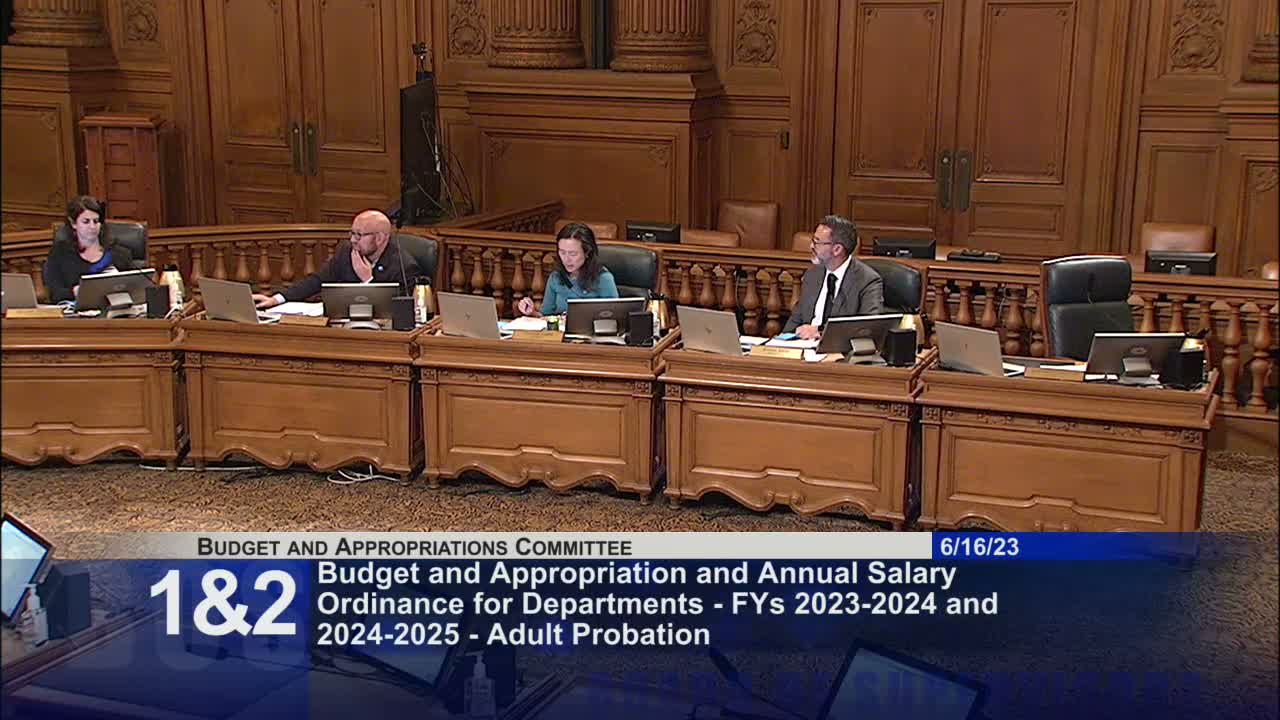
A wide-ranging set of presentations on June 16 put criminal justice funding and staffing at the center of the Budget & Appropriations Committee hearing. The day included separate budgets from the District Attorney, Public Defender, San Francisco Police Department, Sheriff’s Office, Adult Probation and Juvenile Probation — and a large public comment turnout pressing the Board to prioritize housing, food security and youth services over added policing.
District Attorney Brooke Jenkins described a proposed FY24 general‑fund budget of roughly $89.8 million and requested three new trial attorneys focused on narcotics prosecutions; she emphasized victim services and the rise in case filings and trial complexity. Public Defender Manoj Rahman described his office’s workload pressures (226 staff; 15 vacancies nearly filled), argued that discovery and modern evidence (phones, body cameras) have roughly doubled file complexity, and asked the Committee to recognize persistent under‑funding relative to prosecution. Rahman and staff highlighted grants (including a multi‑year Healing Justice grant) and community programs (Clean Slate, immigration defense) that supplement defense work.
Sheriff Paul Miyamoto and staff described a gap of roughly 150–185 deputies, the effect on jail staffing and a planned deployment of the Sheriff’s Emergency Services Unit (ESU) to the Tenderloin and South Market to address open‑air drug activity. The sheriff’s office said an internal appropriation of roughly $685,000 will help fund initial ESU activation through December; supervisors asked for detailed line‑item breakdowns and for assurances that jail operations and court security would not be undercut.
SFPD leadership acknowledged a multi‑year decline in deployable officers and outlined recruitment and retention steps — one‑day testing, lateral incentives, adjustments to academy throughput and new mandatory‑rotation overtime policies intended to distribute overtime more evenly. Chief and CFO staff described biweekly overtime reporting for command staff and asked for quarterly follow‑ups with the Committee.
Probation directors described shifting juvenile populations after the state closure of DJJ and the city’s new obligation to hold longer‑term secure youth treatment sentences; Juvenile Probation requested architectural work to plan a smaller, therapeutic facility on the current site. Adult Probation highlighted a $15M portfolio of community services and a planned case‑management IT upgrade.
The public comment period, which drew dozens of speakers in person and online, was dominated by calls to preserve or restore funding for childcare, food banks, tenant counseling, youth programs, and climate and library services. Many speakers urged the Board to reject proposed increases to police and DA budgets and to prioritize prevention and services instead.
Supervisors asked for follow‑up: line‑item breakdowns for police overtime and sheriff activation costs, quarterly recruitment and overtime monitoring reports from SFPD, a detailed list of DPA/DPA‑IG/Inspector General overlaps and resource needs, and the Healing Justice grant distribution and remaining balance. The Committee continued the main appropriation items to its June 21 meeting to allow follow‑up and additional detail to be submitted.
District Attorney Brooke Jenkins described a proposed FY24 general‑fund budget of roughly $89.8 million and requested three new trial attorneys focused on narcotics prosecutions; she emphasized victim services and the rise in case filings and trial complexity. Public Defender Manoj Rahman described his office’s workload pressures (226 staff; 15 vacancies nearly filled), argued that discovery and modern evidence (phones, body cameras) have roughly doubled file complexity, and asked the Committee to recognize persistent under‑funding relative to prosecution. Rahman and staff highlighted grants (including a multi‑year Healing Justice grant) and community programs (Clean Slate, immigration defense) that supplement defense work.
Sheriff Paul Miyamoto and staff described a gap of roughly 150–185 deputies, the effect on jail staffing and a planned deployment of the Sheriff’s Emergency Services Unit (ESU) to the Tenderloin and South Market to address open‑air drug activity. The sheriff’s office said an internal appropriation of roughly $685,000 will help fund initial ESU activation through December; supervisors asked for detailed line‑item breakdowns and for assurances that jail operations and court security would not be undercut.
SFPD leadership acknowledged a multi‑year decline in deployable officers and outlined recruitment and retention steps — one‑day testing, lateral incentives, adjustments to academy throughput and new mandatory‑rotation overtime policies intended to distribute overtime more evenly. Chief and CFO staff described biweekly overtime reporting for command staff and asked for quarterly follow‑ups with the Committee.
Probation directors described shifting juvenile populations after the state closure of DJJ and the city’s new obligation to hold longer‑term secure youth treatment sentences; Juvenile Probation requested architectural work to plan a smaller, therapeutic facility on the current site. Adult Probation highlighted a $15M portfolio of community services and a planned case‑management IT upgrade.
The public comment period, which drew dozens of speakers in person and online, was dominated by calls to preserve or restore funding for childcare, food banks, tenant counseling, youth programs, and climate and library services. Many speakers urged the Board to reject proposed increases to police and DA budgets and to prioritize prevention and services instead.
Supervisors asked for follow‑up: line‑item breakdowns for police overtime and sheriff activation costs, quarterly recruitment and overtime monitoring reports from SFPD, a detailed list of DPA/DPA‑IG/Inspector General overlaps and resource needs, and the Healing Justice grant distribution and remaining balance. The Committee continued the main appropriation items to its June 21 meeting to allow follow‑up and additional detail to be submitted.
View the Full Meeting & All Its Details
This article offers just a summary. Unlock complete video, transcripts, and insights as a Founder Member.
✓
Watch full, unedited meeting videos
✓
Search every word spoken in unlimited transcripts
✓
AI summaries & real-time alerts (all government levels)
✓
Permanent access to expanding government content
30-day money-back guarantee
