DPW outlines new snow priorities, thresholds and contractor protocols; council presses on verification and staffing
November 20, 2025 | Indianapolis City, Marion County, Indiana
This article was created by AI summarizing key points discussed. AI makes mistakes, so for full details and context, please refer to the video of the full meeting. Please report any errors so we can fix them. Report an error »
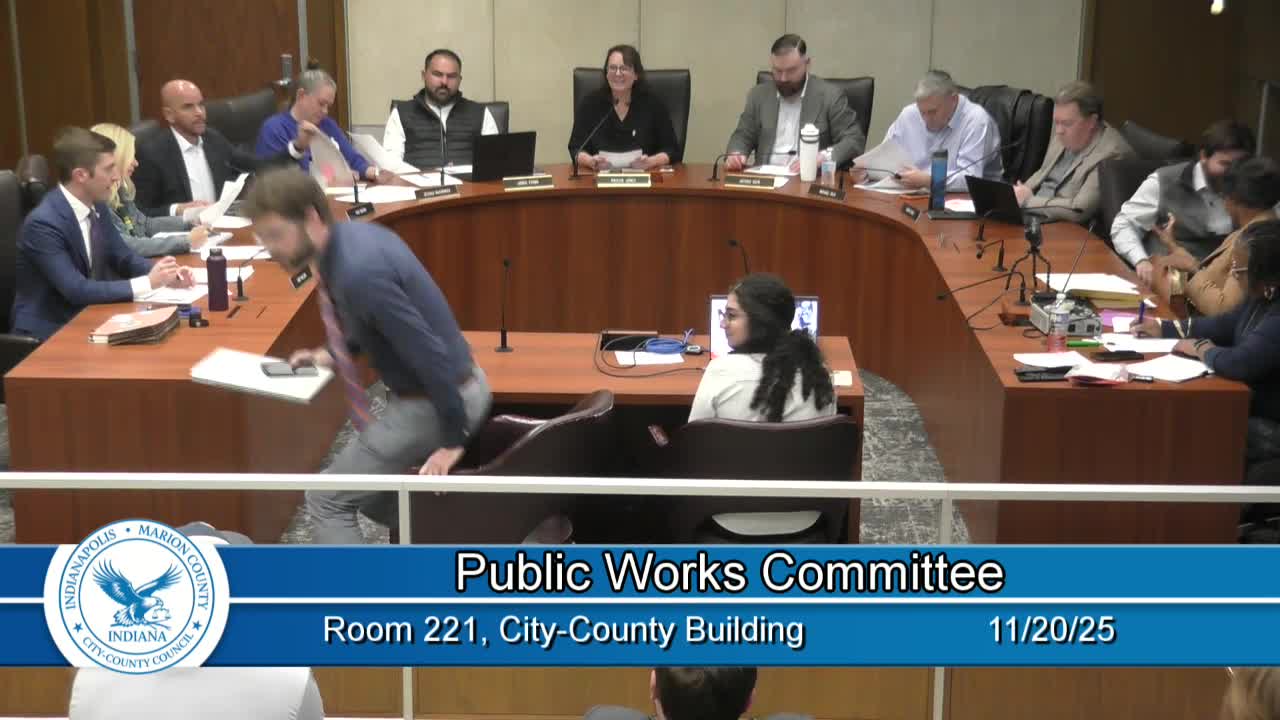
The Department of Public Works presented a comprehensive update to its snow response policy to the Public Works Committee on Nov. 20, explaining new priority networks, response thresholds, contractor deployment, staffing and technology plans.
Director Wilson said the Board of Public Works adopted the underlying policy earlier in the year and that the committee presentation clarifies how DPW will operationalize it. He outlined three priority networks: priority 1 thoroughfares (major arterials, hospital and fire-station routes), priority 2 connectors (key feeder streets near schools and public facilities) and priority 3 residential streets. The policy sets plowing triggers so that priority 2 streets are plowed at a 2‑inch accumulation and priority 3 streets at 4 inches; priority 1 streets are cleared at lower accumulations.
Wilson described contractor use for residential plowing, saying DPW has five contracted vendors and that calling contractors for an event would cost between $700,000 and $1.3 million per event with a $130,000 retainer shared across all contractors. He also explained that DPW expects cart transition activities and vendor invoice closeout work within the Solid Waste budget.
On staffing, Wilson acknowledged current limits. When asked whether 70 drivers is sufficient to cover about 8,400 lane miles the department maintains, Wilson said bluntly: “70 drivers is not enough. I would say we probably need 20 more drivers … And 20 more pieces of equipment.” That assessment prompted council members to signal support for pursuing additional resources.
DPW representatives also discussed technology upgrades. Deputy Director Daniel Stevenson said all DPW-owned snow fleet vehicles are outfitted with Samsara sensors to provide GPS tracking and telemetry (including whether plow blades are up or down and whether salt spreaders are active). He said DPW is seeking ways to incorporate contractor telemetry into the Snowforce viewer but that adding the required gateway devices to contractor vehicles is still under negotiation for this season.
On residential expectations, DPW said contractors will be directed to provide a single passable lane in residential areas (not curb-to-curb) and that sidewalks remain the responsibility of adjacent property owners. The department also said solid-waste collection may be suspended under collective-bargaining protections at extreme cold (examples cited in transcript), with alternate arrangements (e.g., additional crews picking up extra bags) and potential drop-off at the Southside landfill to be confirmed.
Councilors thanked staff and pledged fiscal follow-up. The committee closed with an adjournment.
Direct quotes and technical details were taken from the committee presentation and question-and-answer exchanges.
Director Wilson said the Board of Public Works adopted the underlying policy earlier in the year and that the committee presentation clarifies how DPW will operationalize it. He outlined three priority networks: priority 1 thoroughfares (major arterials, hospital and fire-station routes), priority 2 connectors (key feeder streets near schools and public facilities) and priority 3 residential streets. The policy sets plowing triggers so that priority 2 streets are plowed at a 2‑inch accumulation and priority 3 streets at 4 inches; priority 1 streets are cleared at lower accumulations.
Wilson described contractor use for residential plowing, saying DPW has five contracted vendors and that calling contractors for an event would cost between $700,000 and $1.3 million per event with a $130,000 retainer shared across all contractors. He also explained that DPW expects cart transition activities and vendor invoice closeout work within the Solid Waste budget.
On staffing, Wilson acknowledged current limits. When asked whether 70 drivers is sufficient to cover about 8,400 lane miles the department maintains, Wilson said bluntly: “70 drivers is not enough. I would say we probably need 20 more drivers … And 20 more pieces of equipment.” That assessment prompted council members to signal support for pursuing additional resources.
DPW representatives also discussed technology upgrades. Deputy Director Daniel Stevenson said all DPW-owned snow fleet vehicles are outfitted with Samsara sensors to provide GPS tracking and telemetry (including whether plow blades are up or down and whether salt spreaders are active). He said DPW is seeking ways to incorporate contractor telemetry into the Snowforce viewer but that adding the required gateway devices to contractor vehicles is still under negotiation for this season.
On residential expectations, DPW said contractors will be directed to provide a single passable lane in residential areas (not curb-to-curb) and that sidewalks remain the responsibility of adjacent property owners. The department also said solid-waste collection may be suspended under collective-bargaining protections at extreme cold (examples cited in transcript), with alternate arrangements (e.g., additional crews picking up extra bags) and potential drop-off at the Southside landfill to be confirmed.
Councilors thanked staff and pledged fiscal follow-up. The committee closed with an adjournment.
Direct quotes and technical details were taken from the committee presentation and question-and-answer exchanges.
View the Full Meeting & All Its Details
This article offers just a summary. Unlock complete video, transcripts, and insights as a Founder Member.
✓
Watch full, unedited meeting videos
✓
Search every word spoken in unlimited transcripts
✓
AI summaries & real-time alerts (all government levels)
✓
Permanent access to expanding government content
30-day money-back guarantee
