Policy & Services committee endorses auditor’s review of building permit and inspection fees
November 20, 2025 | Palo Alto, Santa Clara County, California
This article was created by AI summarizing key points discussed. AI makes mistakes, so for full details and context, please refer to the video of the full meeting. Please report any errors so we can fix them. Report an error »
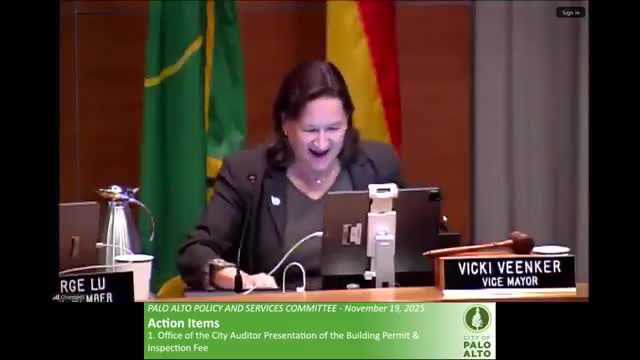
The Palo Alto Policy & Services Committee voted unanimously Nov. 19 to accept a city auditor report that found most major building permit and inspection fees were assessed correctly but that some smaller fees were inconsistently applied.
The audit, presented by City Auditor Kate Murdock, examined a sample of 60 building projects. Murdock said auditors found two projects missing building permit fees and that 15 of 60 projects (25 percent) lacked a record retention fee; at the FY24 rate of $7.88 per plan sheet, the uncollected record-retention total in the sample was $184.41. Auditors also sampled reinspection cases and identified six missing reinspection fees across 30 permits, estimating the sample shortfall between roughly $500 and $1,000.
Murdock said auditors identified configuration and process weaknesses in the city’s land‑use system (referred to in the presentation as Acela/Exela), including a lack of definitive labeling to classify reinspections and a complex fee schedule that relies on staff judgment. She told the committee that demolition permits were sometimes charged an improper SB1474 surcharge: “In 5 of the 12 sample demolition permits we reviewed, the SB1474 surcharge was incorrectly assessed,” adding that overcharges ranged from $1 to $41 per project.
Why it matters: even small, unauthorized fees can carry financial, legal and reputational risk, the auditor said, and undercollection can obscure budget projections. Council members repeatedly pressed staff on the aggregate revenue impact; auditors said the reinspection area showed the most potential uncollected revenue but that a definitive citywide figure required further analysis.
Staff response and next steps
Planning and Development Services staff acknowledged the findings and described corrective actions. Senior operations manager Sarah McCray said staff are retroactively reviewing records and refunding customers who were overcharged, and that management will work with project coordinators to document standard procedures and improve onboarding and training. McCray said the city is pursuing an RFP to replace the current land‑use permitting system and will explore low‑cost system configuration changes and front‑end fee calculators to reduce staff burden and increase transparency.
Council Member Liu pressed auditors and staff on how the team established the "ground truth" for which fees apply. Murdock described interviews and real‑time observations of project coordinators, while staff explained that for many new‑construction permits valuation‑based calculations are deterministic, though nonconstruction and stand‑alone permits often require professional judgment.
Vote and disposition
Council Member Stone moved — and Chair Venker seconded — that the committee accept the audit and refer it to the full City Council for approval. The roll call vote was Stone — yes; Liu — yes; Chair Venker — yes. The motion carried unanimously.
What to watch for: staff committed to follow up with a more detailed estimate of uncollected reinspection fees, to document corrective refunds, to propose system configuration changes where feasible, and to draft updated training/onboarding materials; the audit will be forwarded to the City Council for formal consideration.
The audit, presented by City Auditor Kate Murdock, examined a sample of 60 building projects. Murdock said auditors found two projects missing building permit fees and that 15 of 60 projects (25 percent) lacked a record retention fee; at the FY24 rate of $7.88 per plan sheet, the uncollected record-retention total in the sample was $184.41. Auditors also sampled reinspection cases and identified six missing reinspection fees across 30 permits, estimating the sample shortfall between roughly $500 and $1,000.
Murdock said auditors identified configuration and process weaknesses in the city’s land‑use system (referred to in the presentation as Acela/Exela), including a lack of definitive labeling to classify reinspections and a complex fee schedule that relies on staff judgment. She told the committee that demolition permits were sometimes charged an improper SB1474 surcharge: “In 5 of the 12 sample demolition permits we reviewed, the SB1474 surcharge was incorrectly assessed,” adding that overcharges ranged from $1 to $41 per project.
Why it matters: even small, unauthorized fees can carry financial, legal and reputational risk, the auditor said, and undercollection can obscure budget projections. Council members repeatedly pressed staff on the aggregate revenue impact; auditors said the reinspection area showed the most potential uncollected revenue but that a definitive citywide figure required further analysis.
Staff response and next steps
Planning and Development Services staff acknowledged the findings and described corrective actions. Senior operations manager Sarah McCray said staff are retroactively reviewing records and refunding customers who were overcharged, and that management will work with project coordinators to document standard procedures and improve onboarding and training. McCray said the city is pursuing an RFP to replace the current land‑use permitting system and will explore low‑cost system configuration changes and front‑end fee calculators to reduce staff burden and increase transparency.
Council Member Liu pressed auditors and staff on how the team established the "ground truth" for which fees apply. Murdock described interviews and real‑time observations of project coordinators, while staff explained that for many new‑construction permits valuation‑based calculations are deterministic, though nonconstruction and stand‑alone permits often require professional judgment.
Vote and disposition
Council Member Stone moved — and Chair Venker seconded — that the committee accept the audit and refer it to the full City Council for approval. The roll call vote was Stone — yes; Liu — yes; Chair Venker — yes. The motion carried unanimously.
What to watch for: staff committed to follow up with a more detailed estimate of uncollected reinspection fees, to document corrective refunds, to propose system configuration changes where feasible, and to draft updated training/onboarding materials; the audit will be forwarded to the City Council for formal consideration.
View the Full Meeting & All Its Details
This article offers just a summary. Unlock complete video, transcripts, and insights as a Founder Member.
✓
Watch full, unedited meeting videos
✓
Search every word spoken in unlimited transcripts
✓
AI summaries & real-time alerts (all government levels)
✓
Permanent access to expanding government content
30-day money-back guarantee
