City of Flagstaff staff lay out financial outlook, reserves and budget schedule
November 20, 2025 | Flagstaff City, Coconino County, Arizona
This article was created by AI summarizing key points discussed. AI makes mistakes, so for full details and context, please refer to the video of the full meeting. Please report any errors so we can fix them. Report an error »
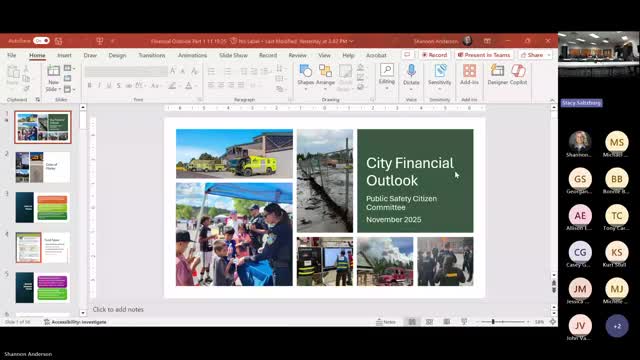
Rick, the city’s management service director and city treasurer, presented a citywide financial outlook to the Public Safety System Committee, describing the structure of more than 50 funds, the city’s reserve policies and the timeline for the annual budget process. He said the presentation was intended to give committee members a foundation for upcoming discussions of the general fund and public‑safety funding.
Rick said the city treats funds as earmarked "color of money" and that many revenue streams are legally restricted to specific purposes — special revenue funds for grants and programs, enterprise funds for business‑type activities such as water and airport operations, capital project funds for bond‑funded projects, and debt service funds for repayment. He said the city’s 1% base sales tax supplies roughly $30,000,000 annually to the general fund and that other restricted taxes such as the bed, board and beverage (BBB) tax provide additional finance for tourism, arts and beautification projects. "We operate over 50 funds in our city," Rick said, noting statutory and voter restrictions limit cross‑fund transfers.
The presentation summarized several fiscal policies the city uses to preserve fiscal health. Rick said the city targets a 20% minimum general‑fund balance (in line with Government Finance Officers Association guidance), maintains a 10% target for most special revenue and enterprise funds (water policy at 25% by city policy), and builds five‑ and ten‑year structural plans that incorporate recessionary scenarios. He described a recession plan adopted in early 2020 that defines staged management actions based on revenue declines (alert, moderate and major stages) so staff can act quickly if revenues fall.
On process, Rick described the budget schedule: a council retreat in December to set goals, further retreats in February and April to refine priorities, budget team review through March, tentative and final budget hearings and a July 1 implementation date. He said the city manager’s recommended budget is presented to council after the budget team completes internal reviews.
Committee members asked for follow‑up information. One member requested a historical breakdown of primary property tax revenues since 2020 and asked staff to quantify the fiscal impact of reduced building permits; Rick agreed to bring that data in a later session. Rick said staff will return with comparative data on local tax rates and the expiration schedules for voter‑approved taxes.
The committee adjourned after confirming a follow‑up Financial Outlook Part 2 presentation at the next scheduled meeting (discussed as December 3 during the session).
Rick said the city treats funds as earmarked "color of money" and that many revenue streams are legally restricted to specific purposes — special revenue funds for grants and programs, enterprise funds for business‑type activities such as water and airport operations, capital project funds for bond‑funded projects, and debt service funds for repayment. He said the city’s 1% base sales tax supplies roughly $30,000,000 annually to the general fund and that other restricted taxes such as the bed, board and beverage (BBB) tax provide additional finance for tourism, arts and beautification projects. "We operate over 50 funds in our city," Rick said, noting statutory and voter restrictions limit cross‑fund transfers.
The presentation summarized several fiscal policies the city uses to preserve fiscal health. Rick said the city targets a 20% minimum general‑fund balance (in line with Government Finance Officers Association guidance), maintains a 10% target for most special revenue and enterprise funds (water policy at 25% by city policy), and builds five‑ and ten‑year structural plans that incorporate recessionary scenarios. He described a recession plan adopted in early 2020 that defines staged management actions based on revenue declines (alert, moderate and major stages) so staff can act quickly if revenues fall.
On process, Rick described the budget schedule: a council retreat in December to set goals, further retreats in February and April to refine priorities, budget team review through March, tentative and final budget hearings and a July 1 implementation date. He said the city manager’s recommended budget is presented to council after the budget team completes internal reviews.
Committee members asked for follow‑up information. One member requested a historical breakdown of primary property tax revenues since 2020 and asked staff to quantify the fiscal impact of reduced building permits; Rick agreed to bring that data in a later session. Rick said staff will return with comparative data on local tax rates and the expiration schedules for voter‑approved taxes.
The committee adjourned after confirming a follow‑up Financial Outlook Part 2 presentation at the next scheduled meeting (discussed as December 3 during the session).
View the Full Meeting & All Its Details
This article offers just a summary. Unlock complete video, transcripts, and insights as a Founder Member.
✓
Watch full, unedited meeting videos
✓
Search every word spoken in unlimited transcripts
✓
AI summaries & real-time alerts (all government levels)
✓
Permanent access to expanding government content
30-day money-back guarantee
